 Area: Achill
Started: June 1951
Finished: February 1953
Poles used: 1425
Line used (km): 115
Premises connected: 767
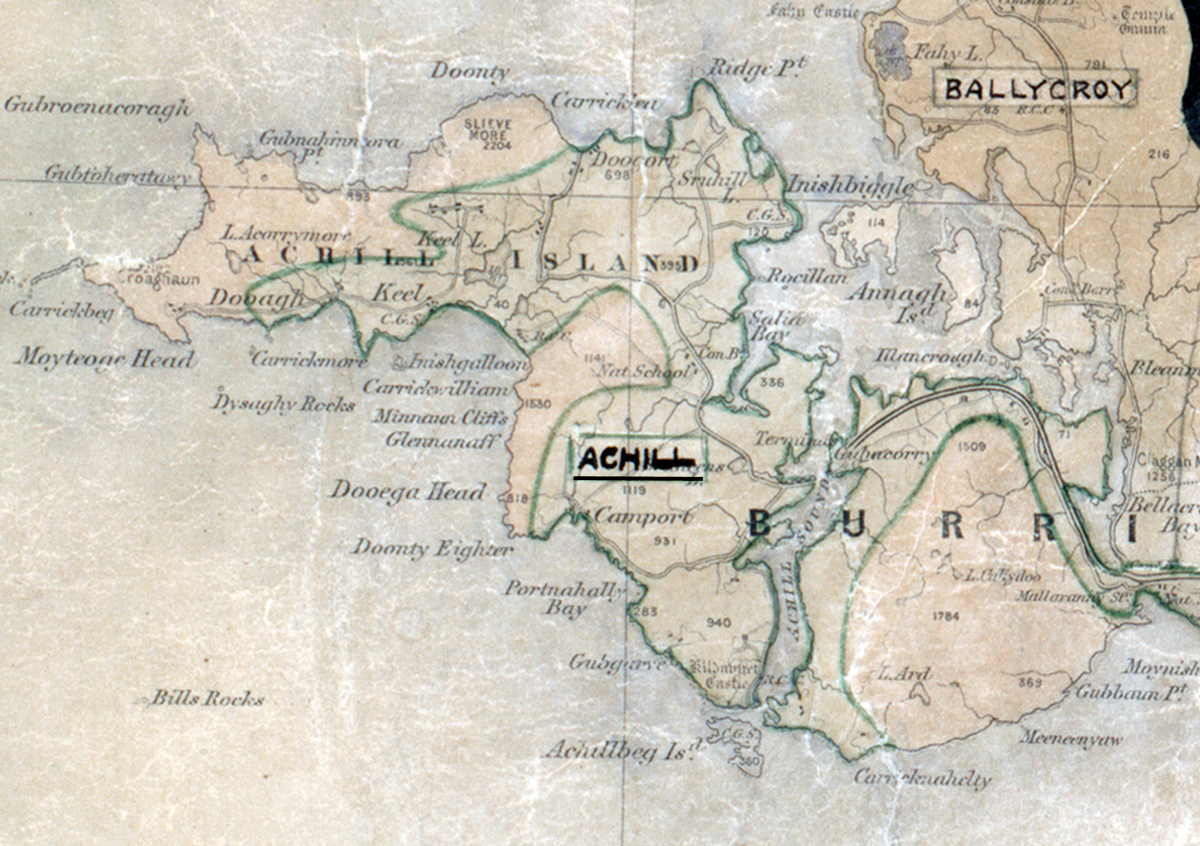
The figures above were sourced from our REO News magazine, to learn more about what these figures mean, visit our interactive map. The map above shows the area boundary and is from a digitised version of the original map used during the scheme.
The REO News from April 1953 featured a report on Achill.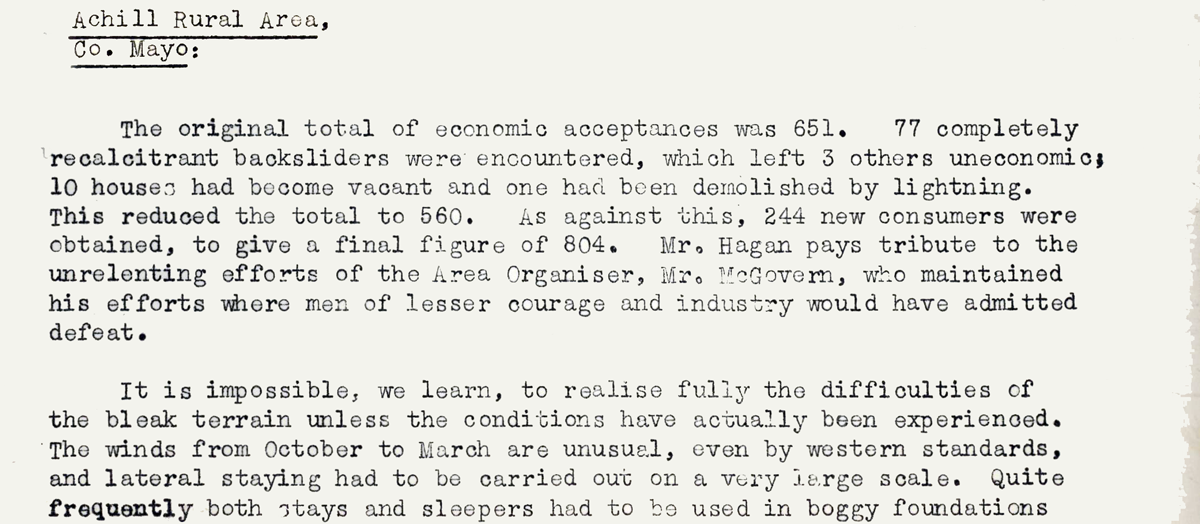
 This digital scan from the REO News displays the following text:
“Achill Rural Area, Co. Mayo: The original total of economic acceptances was 651. 77 completely recalcitrant backsliders were encountered, which left 3 others uneconomic; 10 houses had become vacant and one had been demolished by lightning. This reduced the total to 560. As against this, 244 new consumers were obtained, to give a final figure of 804. Mr. Hagan pays tribute to the unrelenting efforts of the Area Organiser, Mr. McGovern, who maintained his efforts where men of lesser courage and industry would have admitted defeat.
It is impossible, we learn, to realise fully the difficulties of the bleak terrain unless the conditions have actually been experienced. The winds from October to March are unusual, even by western standards, and lateral staying had to be carried out on a very large scale. Quite frequently both stays and sleepers had to be used in boggy foundations.”
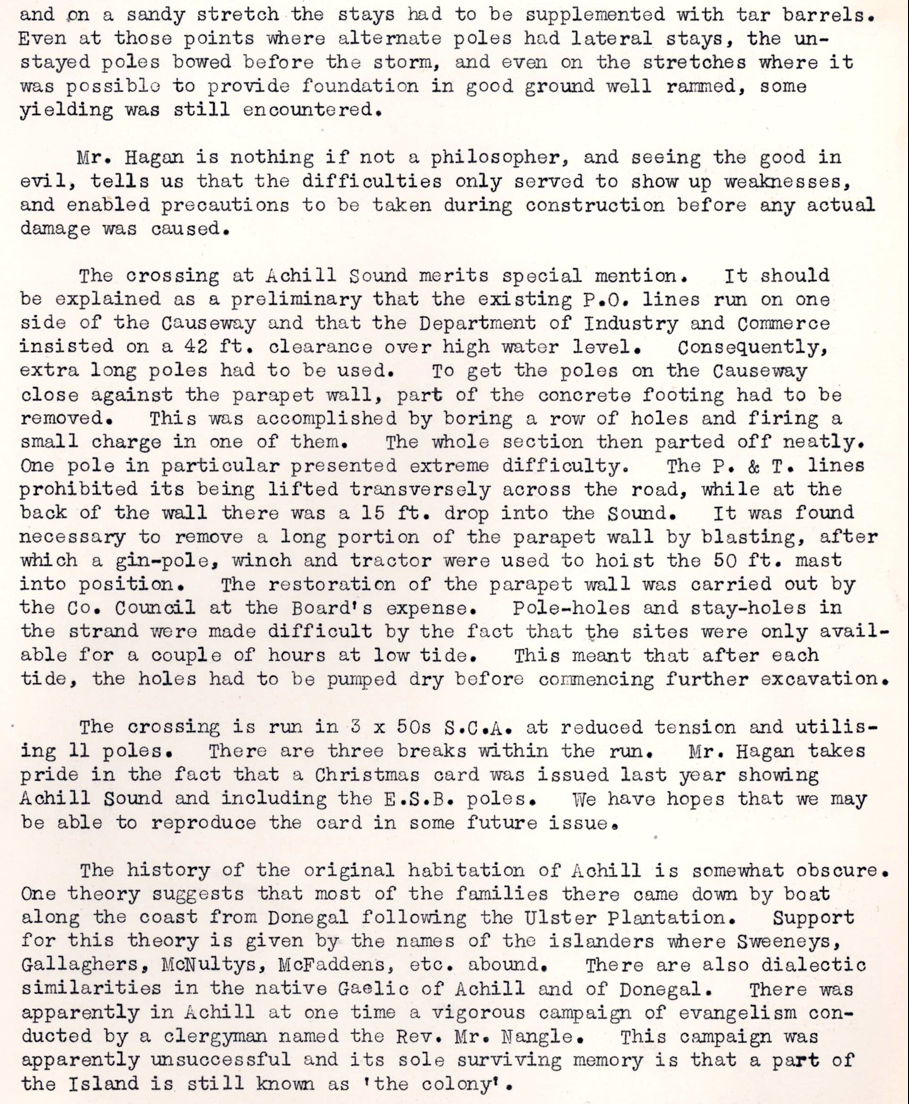
“: …and on a sandy stretch the stays had to be supplemented with tar barrels. Even at those points where alternate poles had lateral stays, the unstayed poles bowed before the storm, and even on the stretches where it was possible to provide foundation in good ground well rammed, some yielding was still encountered.
Mr. Hagan is nothing if not a philosopher, and seeing the good in evil, tells us that the difficulties only served to show up weaknesses, and enabled precautions to be taken during construction before any actual damage was caused.
The crossing at Achill Sound merits special mention. It should be explained as a preliminary that the existing P.O. lines run on one side of the Causeway and that the Department of Industry and Commerce insisted on a 42 ft. clearance over high water level. Consequently, extra long poles had to be used. To get the poles on the Causeway close against the parapet wall, part of the concrete footing had to be removed. This was accomplished by boring a row of holes and firing a small charge in one of them. The whole section then parted off neatly. One local journalist presented an extra difficulty. The P. & T. lines prohibited his being lifted transversely across the road, while at the back of the wall there was 15 ft. drop into the Sound. It was found necessary to remove a portion of the parapet wall by shifting, after it had been drilled, the concrete yard‑wall on to the 50 ft. main position. The restoration of the parapet‑wall was carried out by the Co. Council at the Board’s expense. Pole‑holes and stay‑holes in the strand were made difficult by the fact that they were only available for a couple of hours at low tide. This meant that after each tide, the holes had to be pumped dry before commencing further excavation.
The crossing is run in 3 x 50s S.C. & A. at reduced tension and utilising P.O. line and strand fittings wherever possible. Mr. Hagan takes pride in the fact that a Christmas card was issued last year showing Achill Sound including the E.S.B. poles. We have hopes that he may be able to reproduce the card in some future issue.
The history of the original habitation of Achill is somewhat obscure. One theory suggests that most of the families there came down by boat over the Sound from Donegal following the Ulster Plantation. Support for this theory is given by the names of the islanders where Sweeneys, Gallaghers, McLoughlins, McGees, etc., predominate. There is also a similarity in the native Gaelic of Achill and of Donegal. There were apparently in Achill at one time vigorous campaigns of evangelism on the island by Jesuits, and this is borne out by the present fairly general understanding that the sole surviving memory is that part of Island is still known as ‘the colony’.
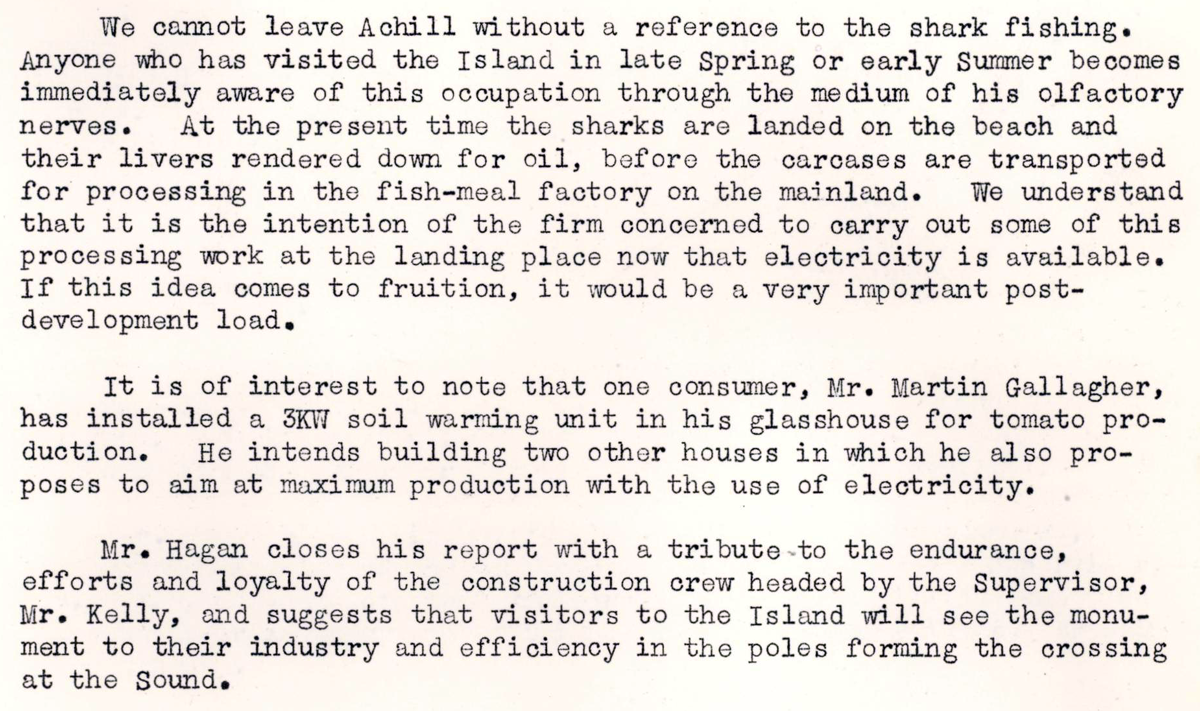
“We cannot leave Achill without a reference to the shark fishing. Anyone who has visited the Island in late Spring or early Summer becomes immediately aware of this occupation through the medium of his olfactory nerves. At the present time the sharks are landed on the beach and their livers rendered down for oil, before the carcasses are transported for processing in the fish‑meal factory on the mainland. We understand that it is the intention of the firm concerned to carry out some of this processing work at the landing place now that electricity is available. If this idea comes to fruition, it would be a very important post‑development load.
It is of interest to note that one consumer, Mr. Martin Gallagher, has installed a 3 kW soil warming unit in his glasshouse for tomato production. He intends building two other houses in which he also proposes to aim at maximum production with the use of electricity.
Mr. Hagan closes his report with a tribute to the endurance, efforts and loyalty of the construction crew headed by the Supervisor, Mr. Kelly, and suggests that visitors to the Island will see the monument to their industry and efficiency in the poles forming the crossing at the Sound.”