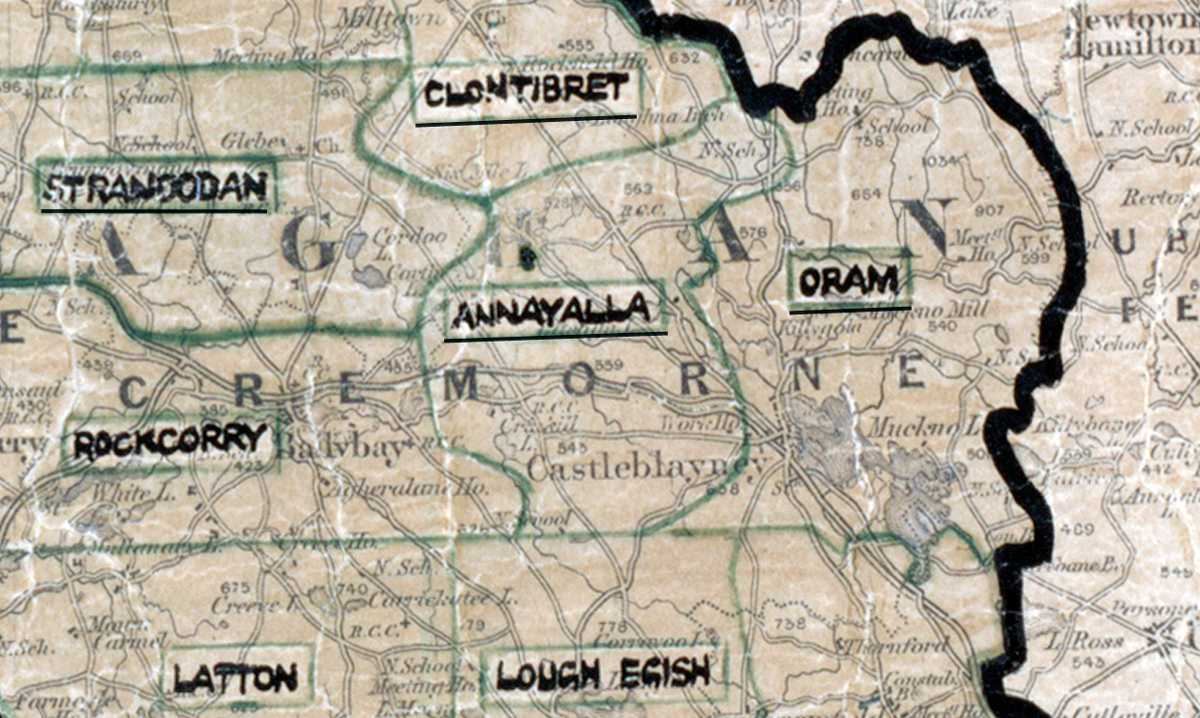
 Area: Annayalla
Started: August 1952
Finished: September 1953
Poles used: 1204
Line used (km): 105
Premises connected: 337
The figures above were sourced from our REO News magazine, to learn more about what these figures mean, visit our interactive map. The map above shows the area boundary and is from a digitised version of the original map used during the scheme.
Annayalla was very dependent on the flax industry according to The REO News from November 1953.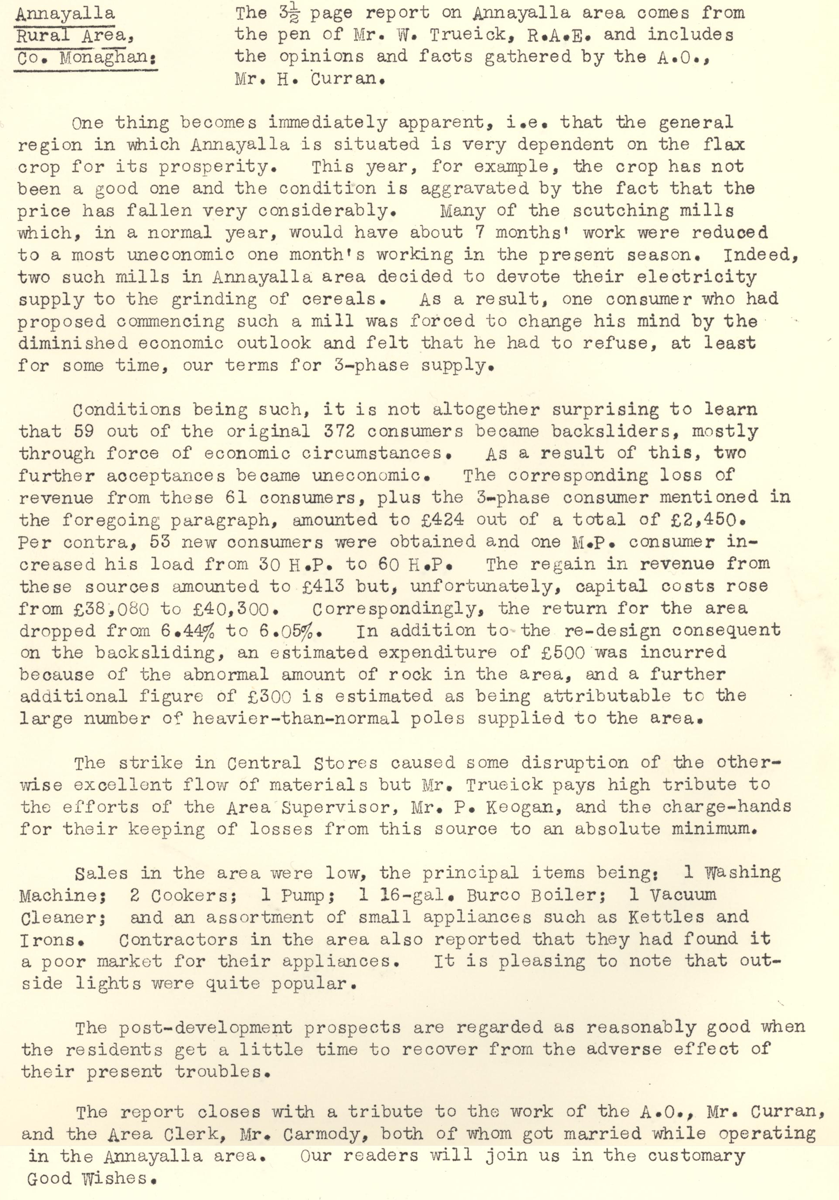 This digital scan from the REO News displays the following text:
“Annayalla Rural Area, Co. Monaghan: The 3½ page report on Annayalla area comes from the pen of Mr. W. Trueick, R.A.E. and includes the opinions and facts gathered by the A.O., Mr. H. Curran.
One thing becomes immediately apparent, i.e. that the general region in which Annayalla is situated is very dependent on the flax crop for its prosperity. This year, for example, the crop has not been a good one and the condition is aggravated by the fact that the price has fallen very considerably. Many of the scutching mills which, in a normal year, would have about 7 months’ work were reduced to a most uneconomic one month’s working in the present season. Indeed, two such mills in Annayalla area decided to devote their electricity supply to the grinding of cereals. As a result, one consumer who had number of scutching motors found that with this change he must be diminished economic outlook and felt that he had to refuse, at least for some time, our terms for 3‑phase supply.
Conditions being such, it is not altogether surprising to learn that 59 out of the original 372 consumers became backsliders, mostly through force of economic circumstances. As a result of this, two further acceptances became uneconomic. The corresponding loss of revenue from these 61 consumers, plus the 3‑phase consumers mentioned in the foregoing paragraph, amounted to £424 out of a total of £2,450. Of course, 151 new consumers were obtained and the net gain revenue from the 90 new consumers was £413 but, unfortunately, capital cost rose from £38,800 to £40,300. Correspondingly, the return for the area dropped from 6.44% to 6.05%. In addition to the re‑design consequent on backsliding, an estimated expenditure of £500 was incurred because of the abnormal amount of rock in the area, and a further additional figure of £300 is estimated as being attributable to the dampness of the shales encountered in many parts of the area.
The strike in Central Stores caused some disruption of the otherwise excellent flow of materials but Mr. Trueick pays high tribute to the work of the Area Supervisor, Mr. P. Keogan, and the charge‑hands for their keeping of losses from this source to an absolute minimum.
Sales in the area were low, the principal items being: 1 Washing Machine; 2 Cookers; 1 Pump; 1 16‑gal. Burco Boiler; 1 Vacuum Cleaner; and numerous small items such as Kettles and Irons. Contractors found, in the main, that they had to adopt a poor market for their appliances. It is pleasing to note that outside lights were quite popular.
The post‑development prospects are regarded as reasonably good when the residents get a little time to recover from the adverse effect of their present troubles.
The report closes with a tribute to the work of the A.O., Mr. Curran, and the Area Clerk, Mr. Carmody, both of whom married while operating in the Annayalla area. Our readers will join us in the customary Good Wishes.”