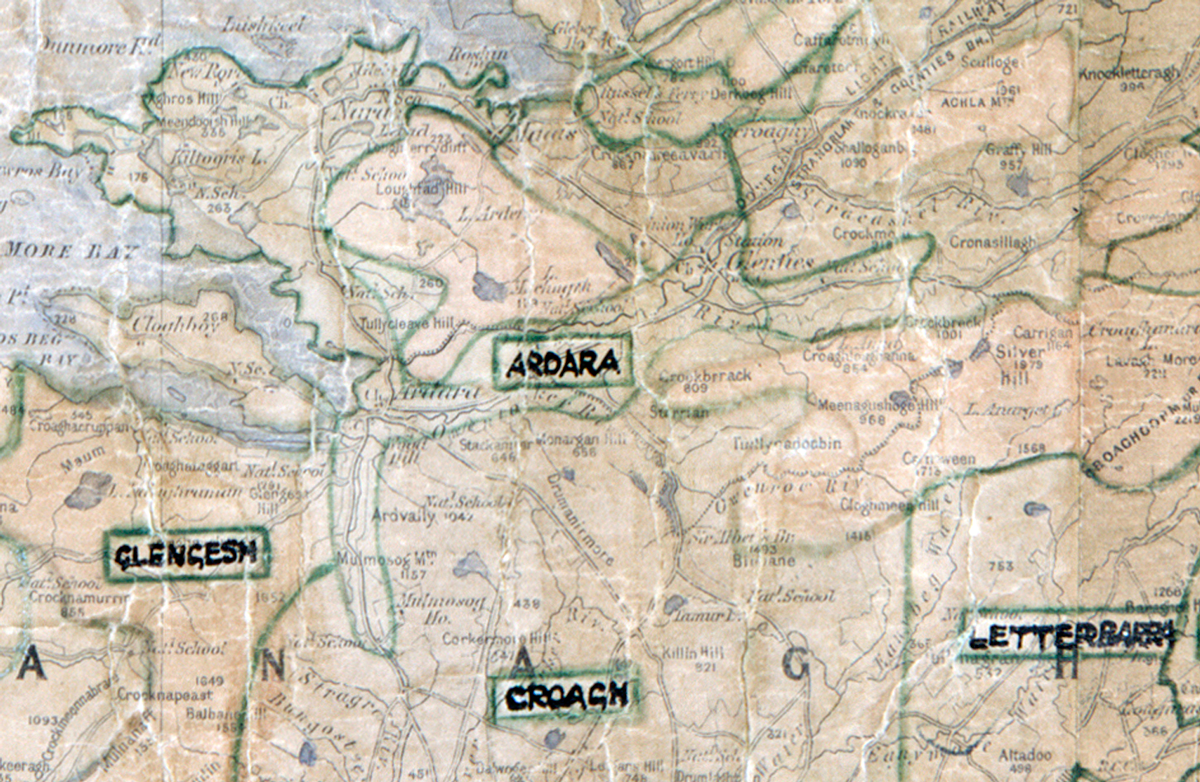
 Area: Ardara
Started: June 1951
Finished: April 1953
Poles used: 1451
Line used (km): 112
Premises connected: 562
The figures above were sourced from our REO News magazine, to learn more about what these figures mean, visit our Interactive map page. The map above shows the area boundary and is from a digitised version of the original map used during the scheme.
Rock and wet bog caused problems in Ardara according to a report in The REO News from June 1953.
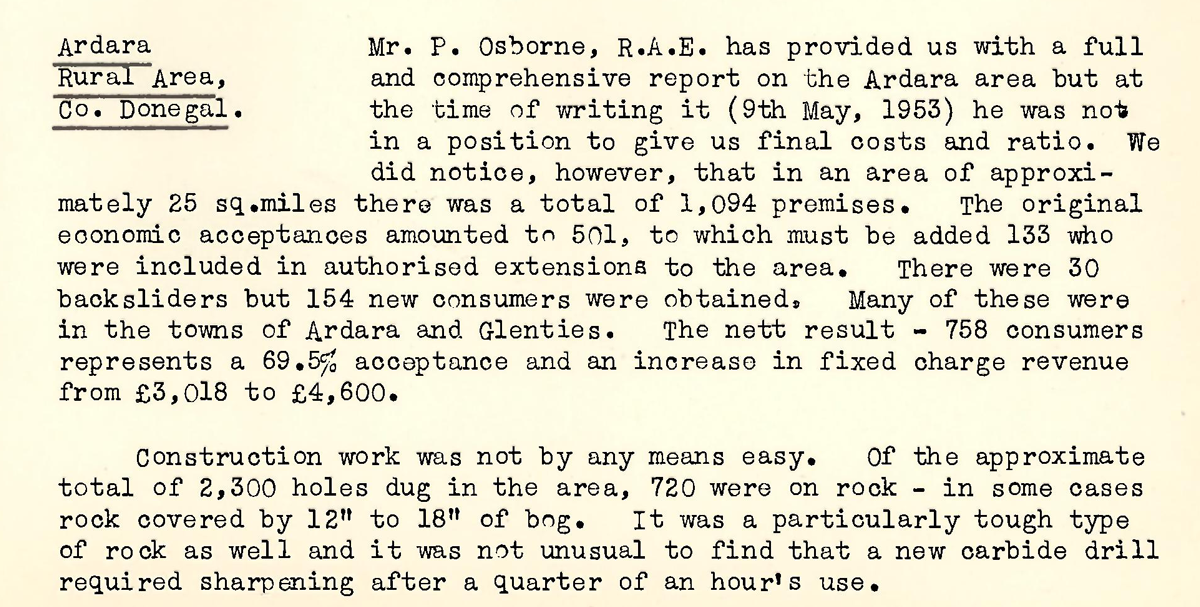
This digital scan from the REO News displays the following text:
"Ardara Rural Area, Co. Donegal: Mr. P. Osborne, R.A.E. has provided us with a full and comprehensive report on the Ardara area but at the time of writing it (9th May, 1953) he was not in a position to give us final costs and ratio. We did notice, however, that in an area of approximately 25 sq. miles there was a total of 1,094 premises. The original economic acceptances amounted to 501, to which must be added 133 who were included in authorised extensions to the area. There were 30 backsliders but 154 new consumers were obtained. Many of these were in the towns of Ardara and Glenties. The nett result – 758 consumers represents a 69.5% acceptance and an increase in fixed charge revenue from £3,018 to £4,600.
Construction work was not by any means easy. Of the approximate total of 2,300 holes dug in the area, 720 were on rock – in some cases rock covered by 12" to 18" of bog. It was a particularly tough type of rock as well and it was not unusual to find that a new carbide drill required sharpening after a quarter of an hour’s use."
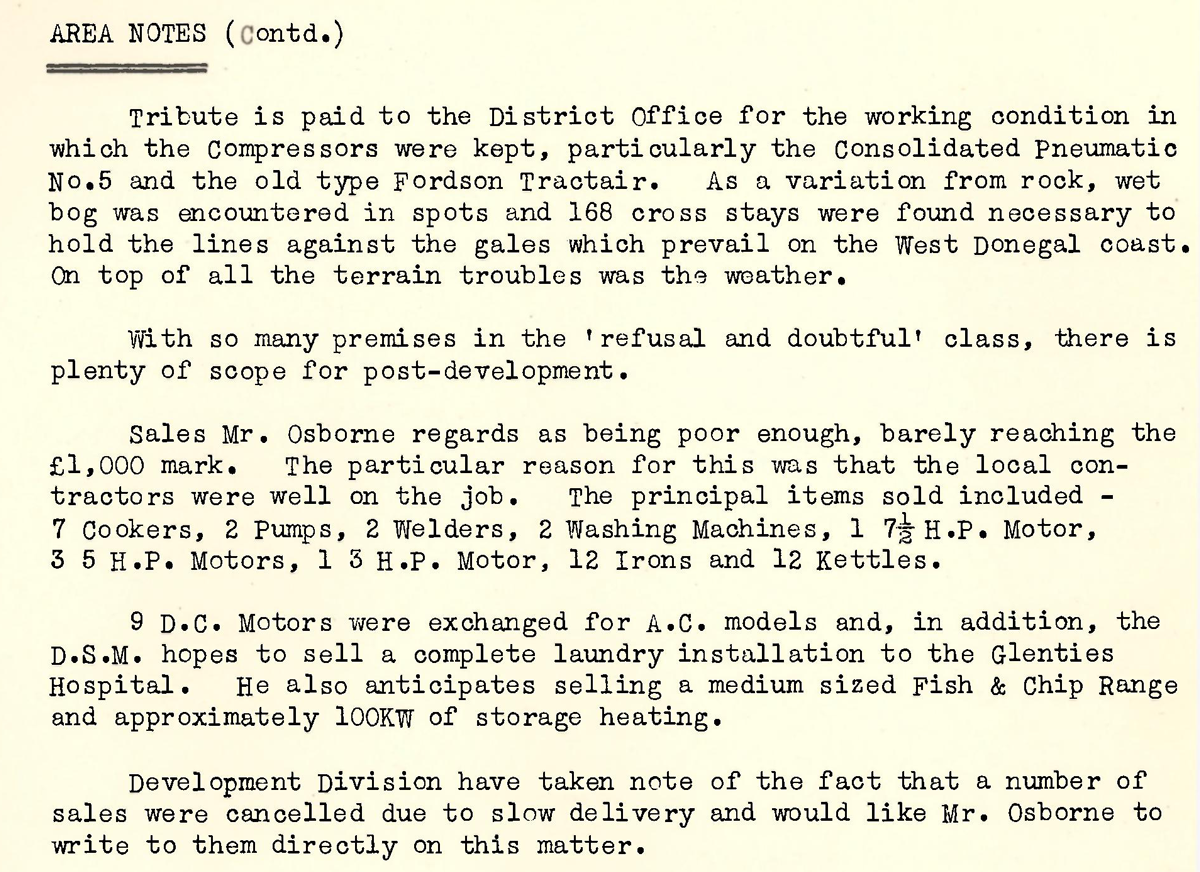
This digital scan from the REO News displays the following text:
"AREA NOTES (contd.)
Tribute is paid to the District Office for the working condition in which the Compressors were kept, particularly the Consolidated Pneumatic No. 5 and the old type Fordson Tractair. As a variation from rock, wet bog was encountered in spots and 168 cross stays were found necessary to hold the lines against the gales which prevail on the West Donegal coast. On top of all the terrain troubles was the weather.
With so many premises in the ‘refusal and doubtful’ class, there is plenty of scope for post-development.
Sales Mr. Osborne regards as being poor enough, barely reaching the £1,000 mark. The particular reason for this was that the local contractors were well on the job. The principal items sold included – 7 Cookers, 2 Pumps, 2 Welders, 2 Washing Machines, 1 7½ H.P. Motor, 3 5 H.P. Motors, 1 3 H.P. Motor, 12 Irons and 12 Kettles.
9 D.C. Motors were exchanged for A.C. models and, in addition, the D.S.M. hopes to sell a complete laundry installation to the Glenties Hospital. He also anticipates selling a medium sized Fish & Chip Range and approximately 100KW of storage heating.
Development Division have taken note of the fact that a number of sales were cancelled due to slow delivery and would like Mr. Osborne to write to them directly on this matter."