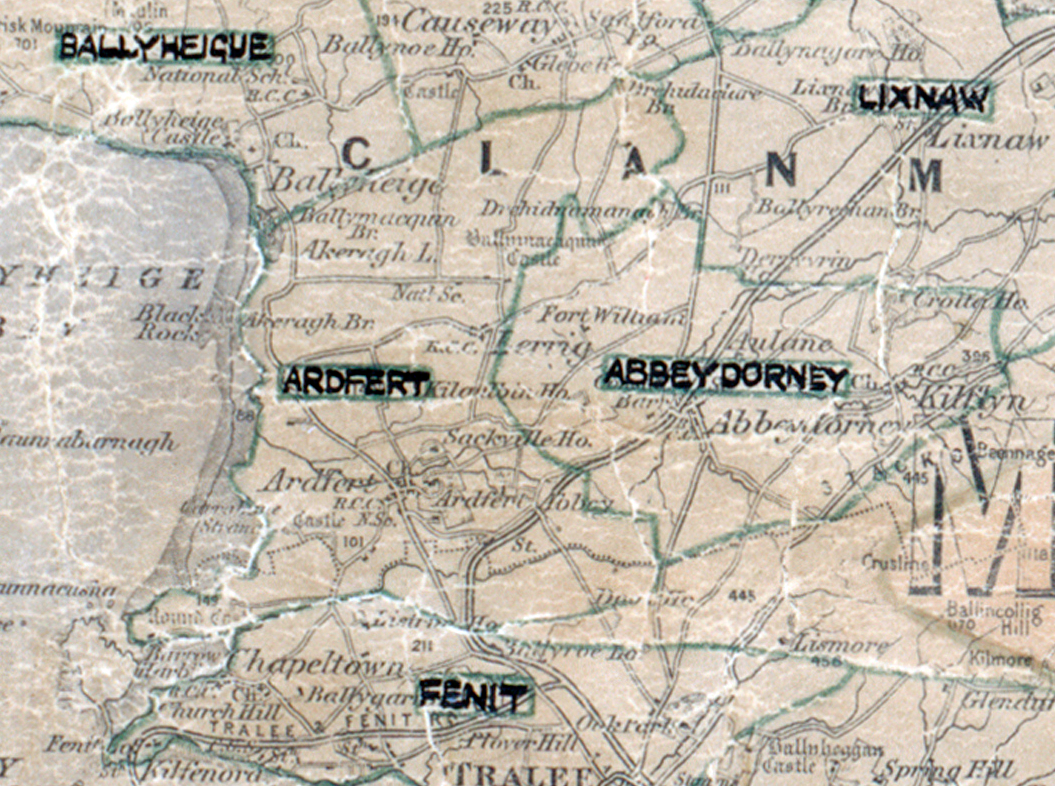
 Area: Ardfert
Started: August 1948
Finished: April 1949
Poles used: 1078
Line used (km): 82
Premises connected: 207
The figures above were sourced from our REO News magazine, to learn more about what these figures mean, visit our interactive map. The map above shows the area boundary and is from a digitised version of the original map used during the scheme.
According to The REO News from December 1948 appliance sales were booming in The Kingdom. This digital scan from the REO News displays the following text:
"NEWS ITEMS
Sales in some rural areas continue to boom. Last month we congratulated an A.O. for sales at Muinebeag Demonstration. Now we are glad to congratulate A.O. John Conroy who has sales amounting to £500 in the same area. Congratulations A.Os and congratulations Muinebeag. News from Ardfert Area, Co. Kerry is news. At the Demonstration sales amounted to £700 and they are still selling. Our congratulations to the Kingdom. Other areas please note."
Ballyrobert farm Ardfert was featured in The REO News from April 1953. This digital scan from the REO News displays the following text:
"FEATURE FARM
No. 7 — TRALEE DISTRICT
Ballyrobert Farm, Ardfert, Co. Kerry: There is nothing extraordinary about our Feature Farm this month. It has no hundreds of broad fertile acres, no grand stud, no herd of 80 or 100 cows and no milking parlours. It is just an ordinary farm of less than 100 statute acres, all good arable land, at Ballyrobert, Ardfert, Co. Kerry.
But, when the activities of the owner of this farm and of his wife are outlined, it will be apparent that these two people are something out of the ordinary and that their farming activities are well worth writing about in “R.E.O. News”.
The owner of the farm is Mr. John Kearney and he and Mrs. Kearney are proud of the fact that they have always moved with the times and that they use their heads as well as their hands. “We had anticipated that the coming of Rural Electrification would bring many advantages but they state they did not fully realise what a difference electricity would make.” They are, however, quite candid as to the more interesting points about which something will be said later on.
First, a brief outline of the nature of the general farming carried on at Ballyrobert Farm. There are twenty-four milking cows, the milk of which is sold in Ardfert Creamery. The bulk of the cows are due to calve in March and these earlier calves are retained until the yearling stage. But the cows continue in milk to Christmas. For the Red Polled strain the average yield is 600 gallons, allowing for the feed for strain and the maintenance of the cows. Mr. Kearney finds that the shorter gestation period of the strain gives a very good return. As regards the bulls the breed is purely optional but, for example, Herefords are the best sellers at the present time.
One sow is kept and, as occasion arises, other litters of bonhams are purchased; but at present pigs are always being fattened at this time. Mrs. Kearney is also interested in poultry and a number of turkeys is regularly reared for the Christmas market.
For approximately five acres of wheat, six acres of oats and about eight acres of barley are regularly sown, six or seven acres of the barley being malted. The combined crops provide feed for the cows. The rest of the farm produce is sold.
The land produces arable. That is the system at present, but Mr. Kearney intends to change from arable to mixed farming. On the farm are grown the following crops; wheat, oats, barley, potatoes, mangolds and turnips.
When we turn to the applications of electricity, the list almost reads like an appliance course. In the out offices you will find the 1 H.P. Grain Grinder, a 3-Unit Milking Machine, a 15 Gal. Water Boiler,"