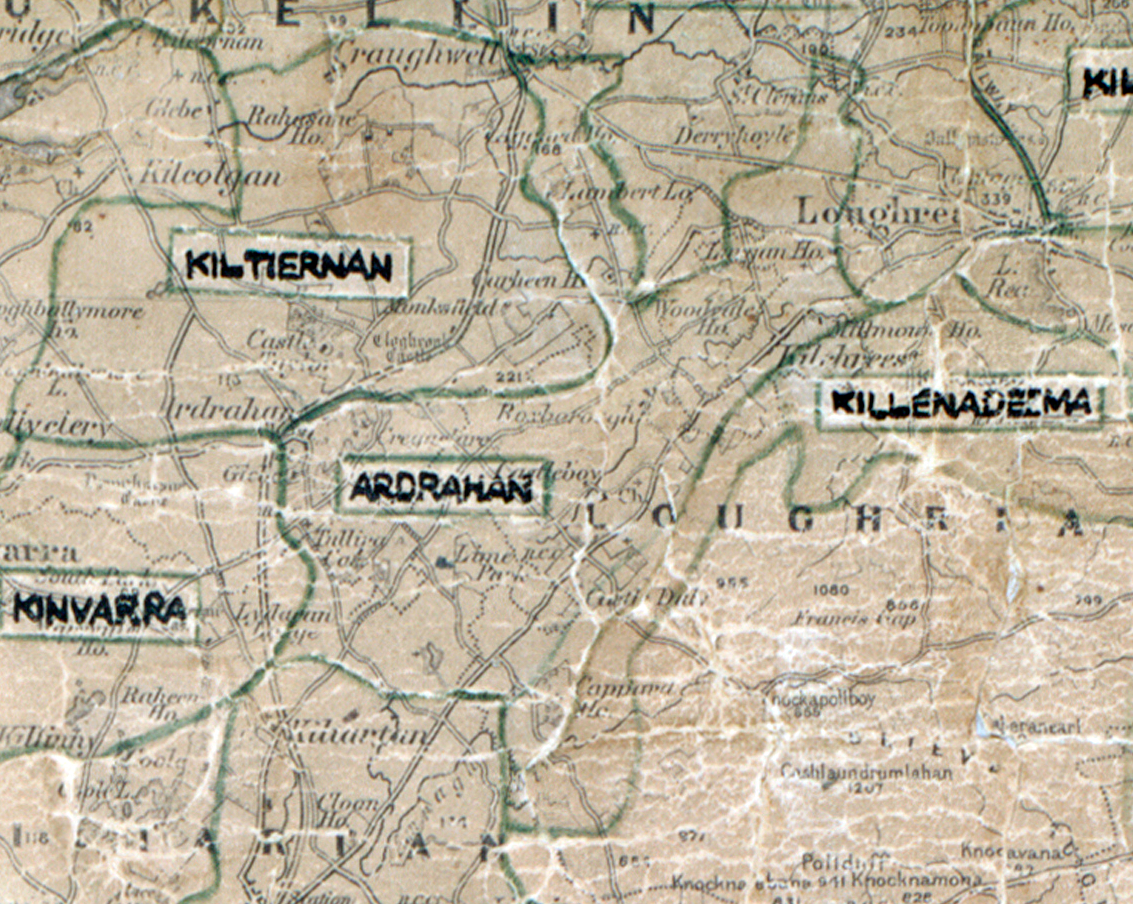
 Area: Ardrahan
Started: December 1947
Finished: July 1948
Poles used: 958
Line used (km): 66
Premises connected: 208
The figures above were sourced from our REO News magazine, to learn more about what these figures mean, visit our Interactive map page. The map above shows the area boundary and is from a digitised version of the original map used during the scheme.
The farming community enjoyed the benefits of scheme as reported in The REO News from November 1952.
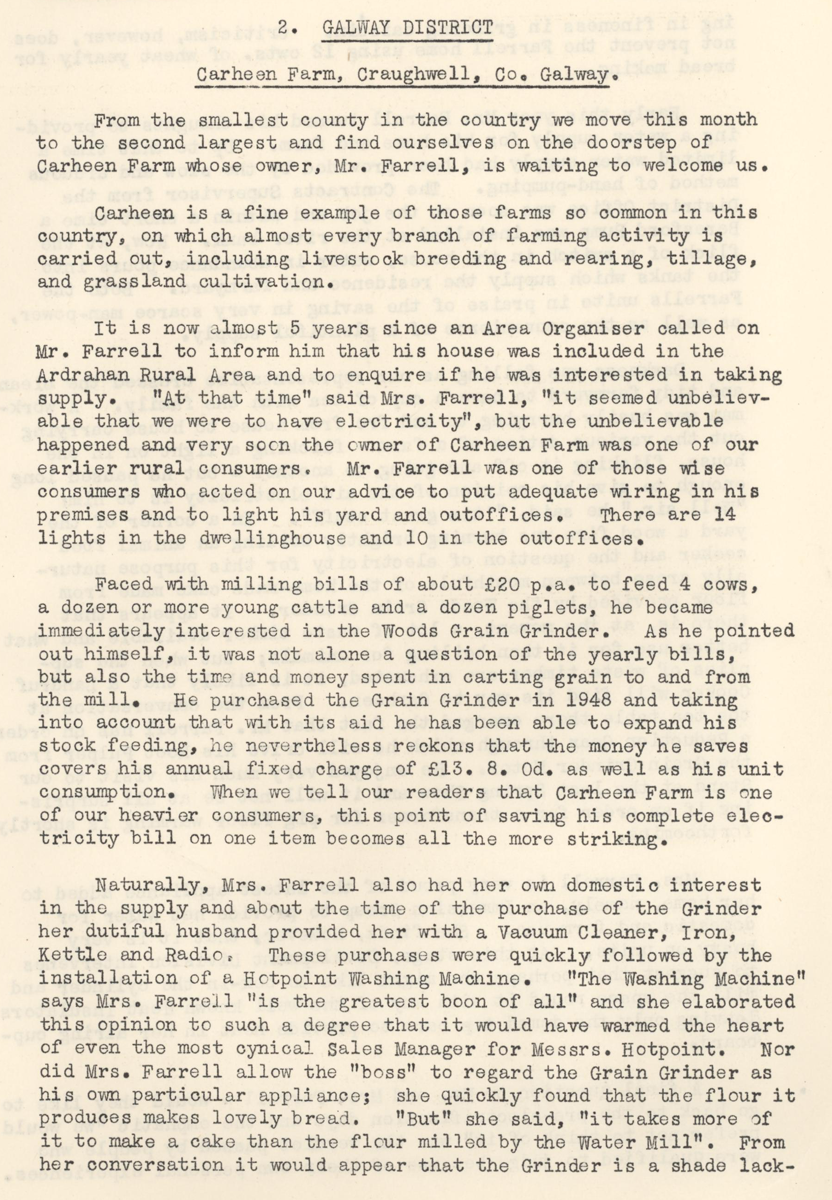
This digital scan from the REO News displays the following text:
"Carheen Farm, Craughwell, Co. Galway: From the smallest county in the country we move this month to the second largest and find ourselves on the doorstep of Carheen Farm whose owner, Mr. Farrell, is waiting to welcome us.
Carheen is a fine example of those farms so common in this country, on which almost every branch of farming activity is carried out, including livestock breeding and rearing, tillage, and grassland cultivation.
It is now almost 5 years since an Area Organiser called on Mr. Farrell to inform him that his house was included in the Ardrahan Rural Area and to enquire if he was interested in taking supply. "At that time" said Mrs. Farrell, "it seemed unbelievable that we were to have electricity", but the unbelievable happened and very soon the owner of Carheen Farm was one of our earlier rural consumers. Mr. Farrell was one of those wise consumers who acted on our advice to put adequate wiring in his premises and to light his yard and outoffices. There are 14 lights in the dwellinghouse and 10 in the outoffices.
Faced with milling bills of about £20 p.a. to feed 4 cows, a dozen or more young stock and a dozen piglets, he became immediately interested in the Woods Grain Grinder. As he pointed out himself, it was not alone a question of the yearly bills, but also the time and money spent in carting grain to and from the mill. He purchased the Grain Grinder in 1949 and talking to him a short time ago it was obvious he is well satisfied with his purchase. He remarked, "in the first place the saving in time and the fact that I can now grind at any hour I require is a big convenience." He uses a bag and a half daily and says the Grinder will grind as much meal per hour as his unit consumption. When we call to the house at Carheen Farm is at one of her lower consumer, this operation of having a complete electricity bill on one’s hands is made more striking.
Naturally, Mrs. Farrell also had her own domestic interest in the supply and about the time of the purchase of the Grinder her dutiful husband provided a Cooker, Refrigerator, Iron, Kettle and Radio. These purchases were quickly followed by the welcome arrival of the “Eclipse” Washing Machine. “The Washing Machine,” Mrs. Farrell “is the greatest boon of all” and the elaborate battery of switch sockets and other installations “has made the heart of every one of my women friends who has seen it drop.” Nor has Mr.
Farrell himself escaped the wonders of the Grid Grinder as it produces marvellous results. “But” she said, “it takes more of the meal very soon.” The “Flour Mill” was then “Flour Mill.” From her conversation it would appear that the Grinder is a shade lack"
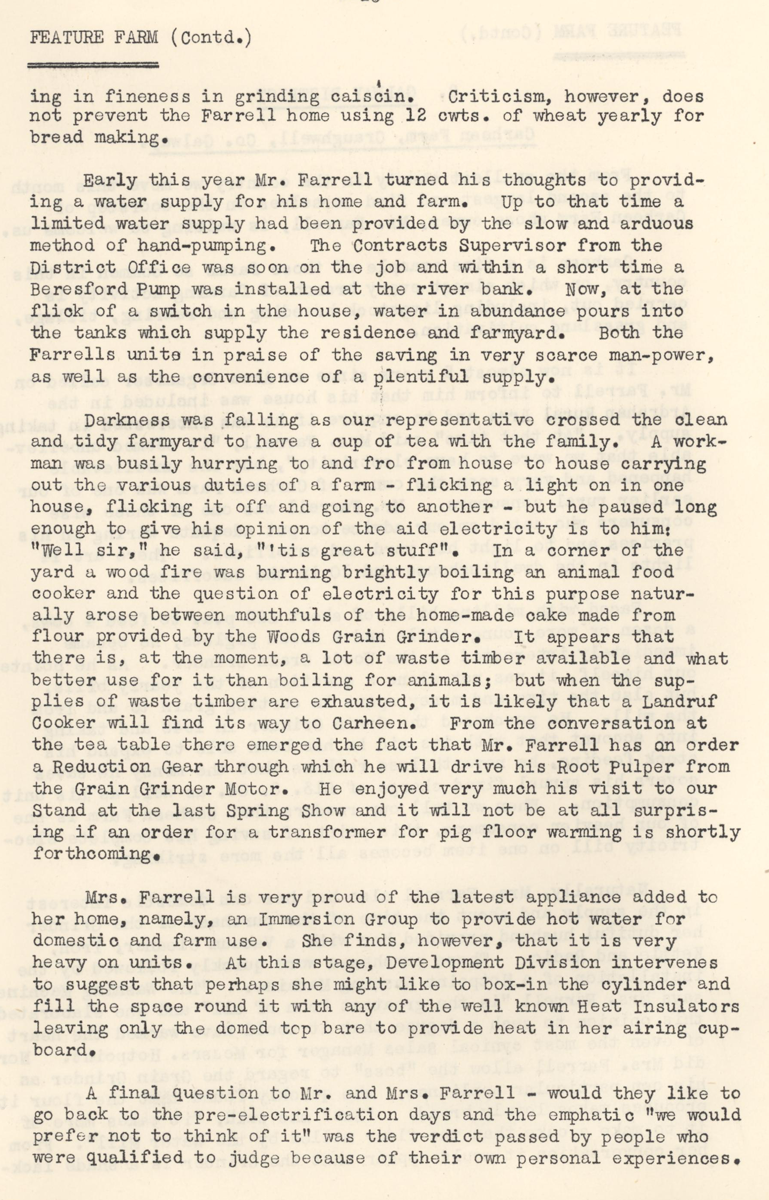
This digital scan from the REO News displays the following text:
"Feature Farm (Contd.)
ing in fineness in grinding oatsin. Criticism, however, does not prevent the Farrell home using 12 cwts. of wheat yearly for bread making.
Early this year Mr. Farrell turned his thoughts to providing a water supply for his home and farm. Up to that time a limited water supply had been provided by the slow and arduous method of hand-pumping. The Contracts Supervisor from the District Office was soon on the job and within a short time a Dresserd Pump was installed at the river bank. A light tap fills a cistern in the house, water in abundance pours into the tanks which supply the residence and farmyard. Both the Farrells will welcome the saving of labour on the farm, as well as the convenience of a plentiful supply.
Darkness was falling as our representative crossed the clean and tidy farmyard to have a cup of tea with the family. A workman was busily hurrying to and fro from house to house carrying out the various duties of a farm — flicking a light on in one house, flicking it off on going to another; but he paused long enough to give his opinion of the “Grid–electricity” to him. “Well sir,” he said, “this is great stuff”. In a corner of the yard a cooker stood, burning brightly boiling the mid–day meal for the house and the question of turf for this purpose naturally arose between Mr. Farrell and himself. As he explained, there is, at the moment, a lot of waste timber available and what better use could waste timber be put to. But when the supplies of waste timber are exhausted, it is likely that a Landruif boiler will find its way to Carheen Farm. In the conversation which ensued Mr. Farrell was very proud of the part he is to play in the forthcoming Home Management Week. He has placed an order with a local agricultural merchant for the “Double Root Pulper from Stand.” It was this machine which was demonstrated by Mr. J. Grindor at the last Spring Show and it will not be surprising if at our next visit we observe it warming up shortly in use.
Mrs. Farrell is very proud of the latest appliance added to her home, namely, an Immersion Group to provide hot water for domestic units. At this stage, Development Division intervenes and leaves a card with the attractive little box–in the cylinder and fill the space around it say to the well known Heat Insulators leaving the house modern heater to provide heat in the mornings upon rising.
A final question to Mr. and Mrs. Farrell – would they like to go back to the pre–electrification days and the reply was “We would not” and their family endorse the words of the great many people who were qualified to judge because of their own personal experiences."
Demonstrations were popular in Ardrahan as mentioned in The REO News from April 1957.

This digital scan from the REO News displays the following text:
"We are pleased to note that, although the demonstrations were not very well patronised by the residents of the new area, there was a notable attendance of well established consumers from the Ardrahan area nearby which was the first rural area developed in Galway District."