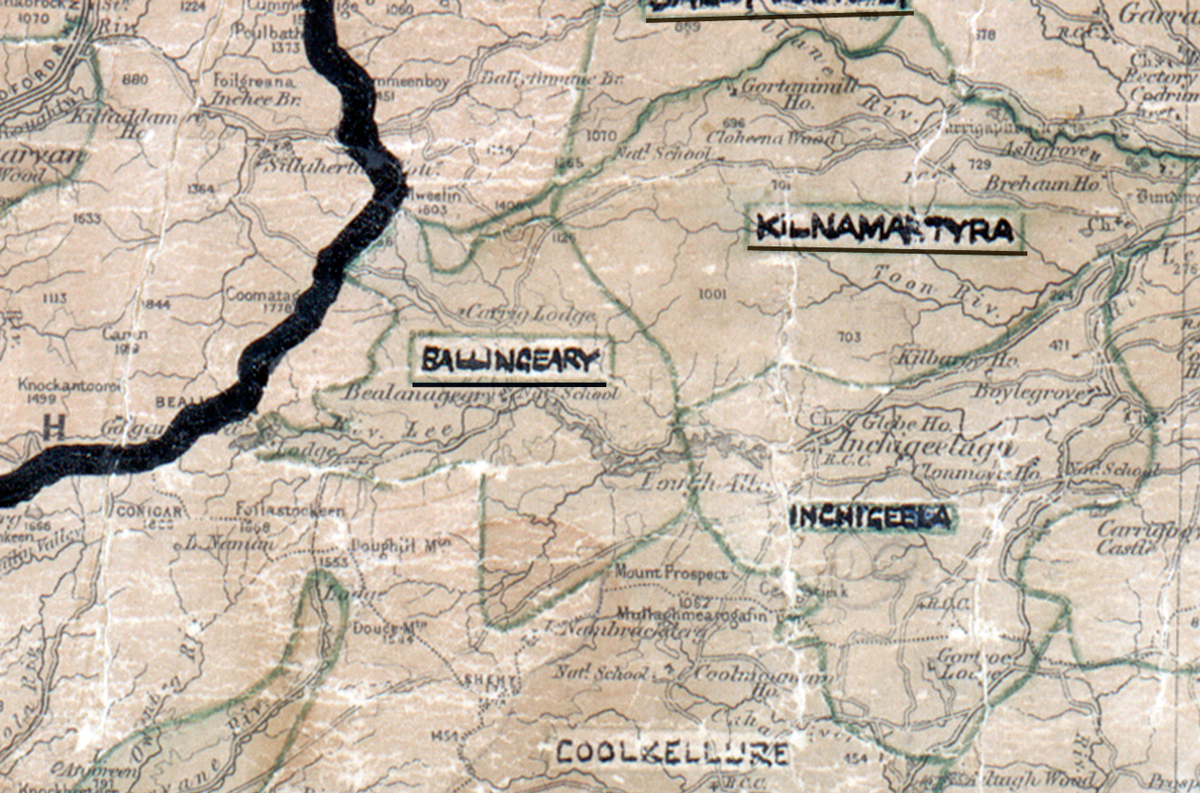
 Area: Ballingeary
Started: April 1955
Finished: April 1956
Poles used: 656
Line used (km): 49
Premises connected: 134
The figures above were sourced from our REO News magazine, to learn more about what these figures mean, visit our interactive map. The map above shows the area boundary and is from a digitised version of the original map used during the scheme.
The REO News from August 1955 tells us that the switch on ceremony in Ballingeary was an all Irish event.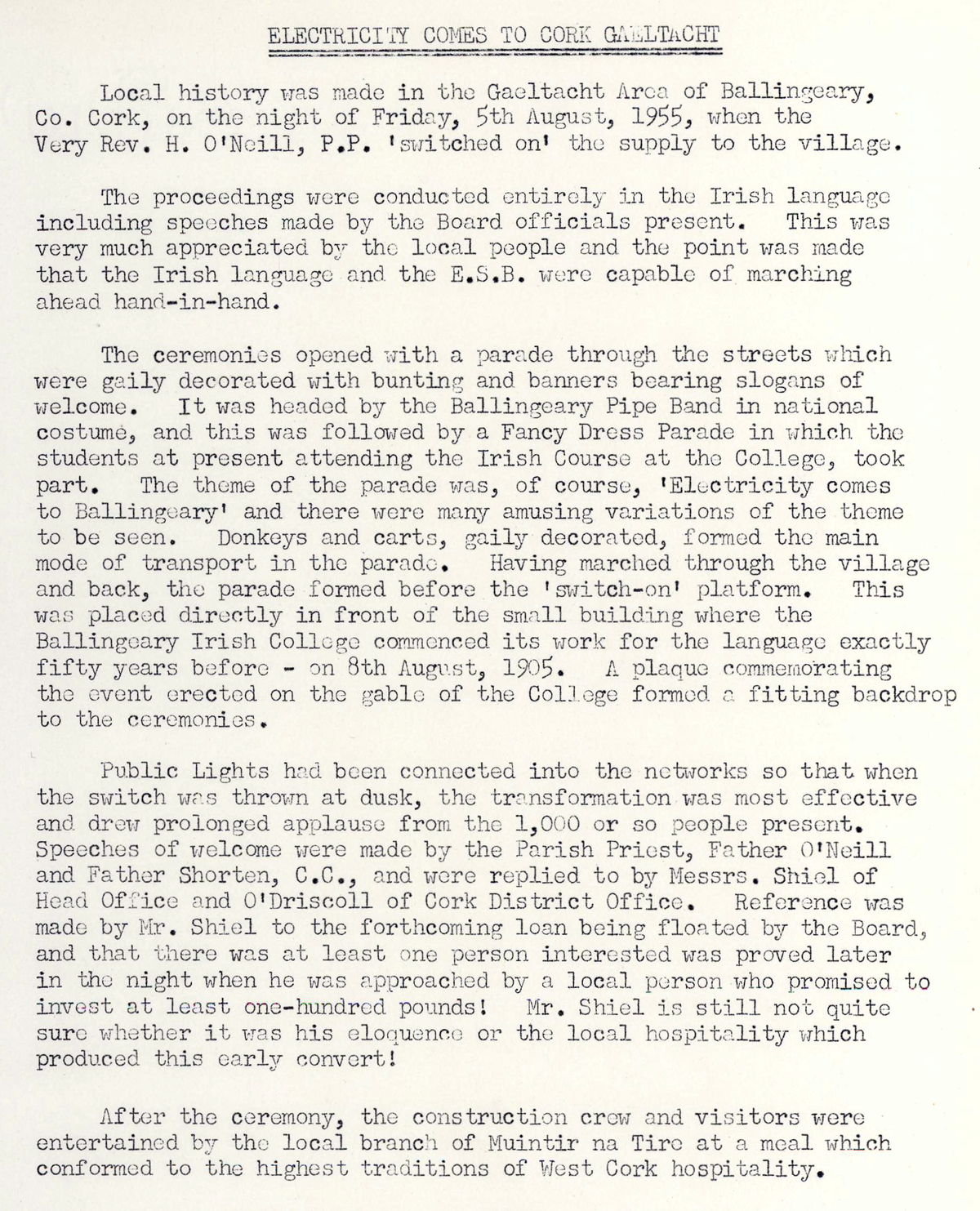 This digital scan from the REO News displays the following text:
"ELECTRICITY COMES TO CORK GAEILTACHT
Local history was made in the Gaeltacht Area of Ballingeary, Co. Cork, on the night of Friday, 5th August, 1955, when the Very Rev. H. O’Neill, P.P., switched on the supply to the village.
The proceedings were conducted entirely in the Irish language including speeches made by the Board officials present. This was very much appreciated by the local people and the point was made that the Irish language and the E.S.B. were capable of marching ahead hand-in-hand.
The ceremonies opened with a parade through the streets which were gaily decorated with bunting and banners bearing slogans of welcome. It was headed by the Ballingeary Pipe Band in national costume, and this was followed by a Fancy Dress Parade in which the students at present attending the Irish Course at the College, took part. The theme of the parade was, of course, ‘Electricity comes to Ballingeary’ and there were many amusing variations of the theme to be seen. Donkeys and carts, gaily decorated, formed the main mode of transport in the parade. Having paraded through the village and back, the parade formed before the ‘switch-on’ platform. This was placed directly in front of the small building where the Ballingeary Irish College commenced its work for the language exactly fifty years ago — on 8th August, 1905. A plaque commemorating the event erected on the gable of the College formed a fitting backdrop to the ceremonies.
Public Lights had been connected into the networks so that when the switch was thrown at dusk, the transformation was most effective and resulted in ample applause from the 1,000 or so people present. Speeches were made by the Very Rev. Father Priest, Father O’Neill and Father Shorten, C.C., and were replied to by Messrs. Shiel of Sales and Mr. O’Driscoll of Cork District Office. Reference was made to the cost of the forthcoming benefits to be felt in the area, and in this connection it was learnt that the person interested was prepared to invest at least one-hundred pounds! Mr. Shiel is still not quite sure whether the quality of the speaker or the local hospitality which produced this early convert!
After the ceremony, the construction crew and visitors were entertained by the local branch of Muintir na Tíre at a meal which conformed to the highest traditions of West Cork hospitality."
Ballingeary has had it’s fair share of famous sons according to The REO News from July 1956.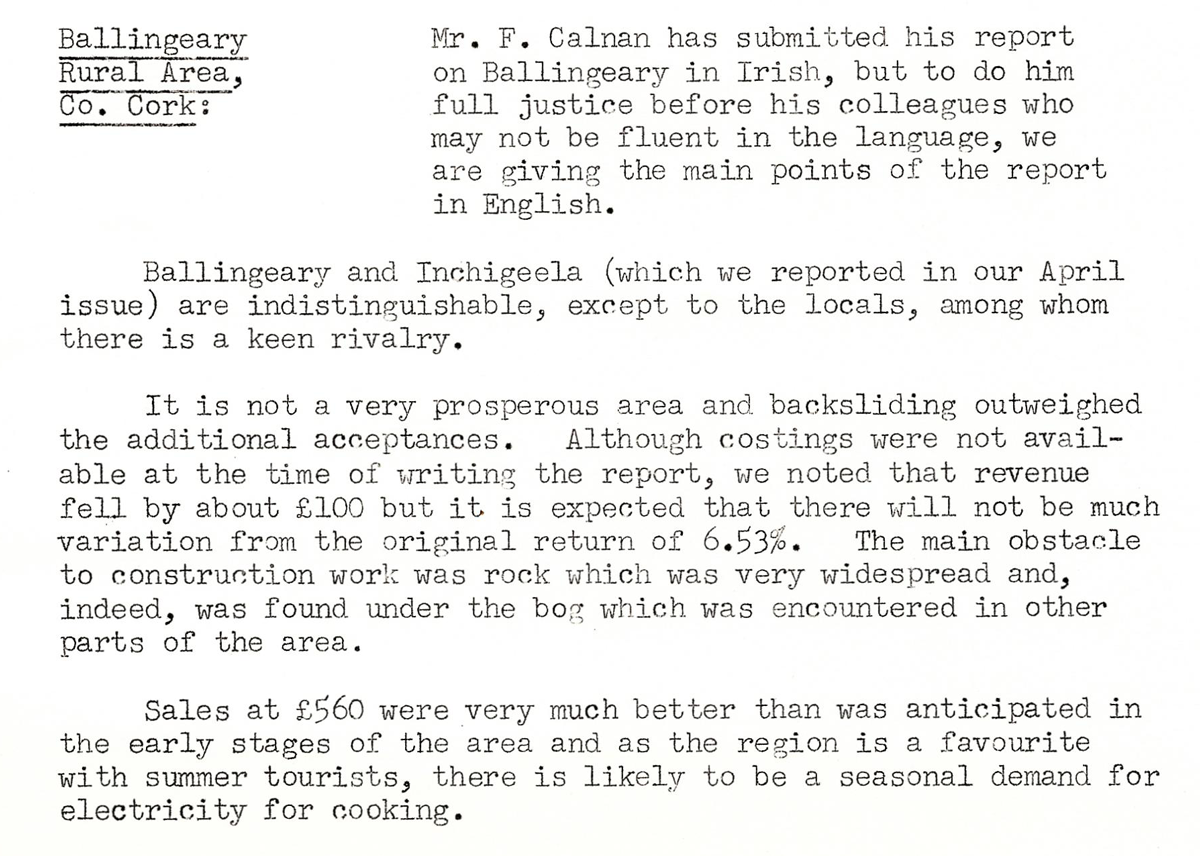 This digital scan from the REO News displays the following text:
"Ballingeary Rural Area, Co. Cork: Mr. F. Calnan has submitted his report on Ballingeary in Irish, but to do him full justice before his colleagues who may not be fluent in the language, we are giving the main points of the report in English.
Ballingeary and Inchigeela (which we reported in our April issue) are indistinguishable, except to the locals, among whom there is a keen rivalry
It is not a very prosperous area and backsliding outweighed the additional acceptances. Although costings were not available at the time of writing the report, we noted that revenue fell by about £100 but it is expected that there will not be much variation from the original return of 6.53%. The main obstacle to construction work was rock which was very widespread and, indeed, was found under the bog which was encountered in other parts of the area.
Sales at £560 were very much better than was anticipated in the early stages of the area and as the region is a favourite with summer tourists, there is likely to be a seasonal demand for electricity for cooking."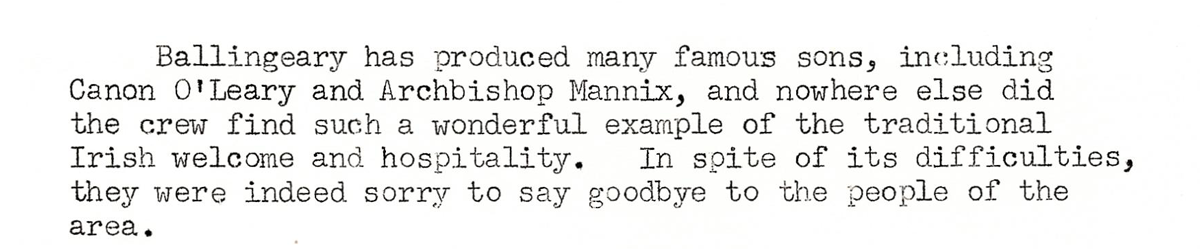 This digital scan from the REO News displays the following text:
"Ballingeary has produced many famous sons, including Canon O’Leary and Archbishop Mannix, and nowhere else did the crew find such a wonderful example of the traditional Irish welcome and hospitality. In spite of its difficulties, they were indeed sorry to say goodbye to the people of the area."