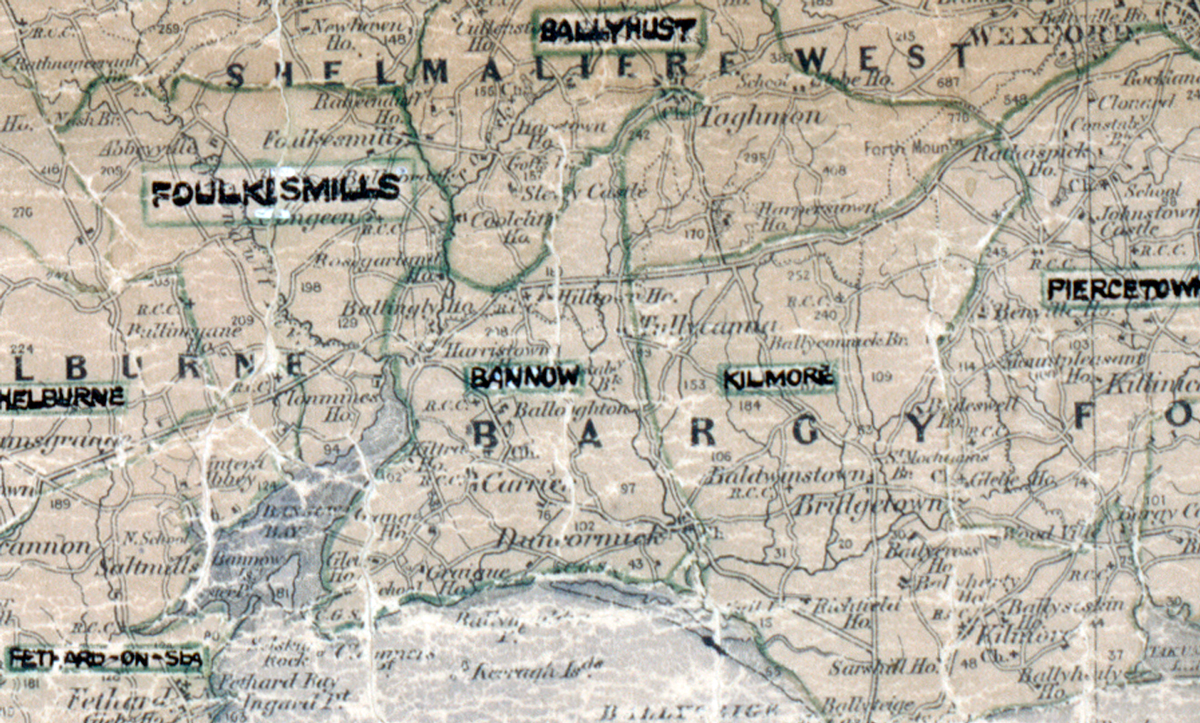
 Area: Bannow
Started: December 1949
Finished: October 1950
Poles used: 904
Line used (km): 77
Premises connected: 25
The figures above were sourced from our REO News magazine, to learn more about what these figures mean, visit our interactive map. The map above shows the area boundary and is from a digitised version of the original map used during the scheme.
The REO News from January 1951 reports on the need for a large amount of gelignite in Bannow.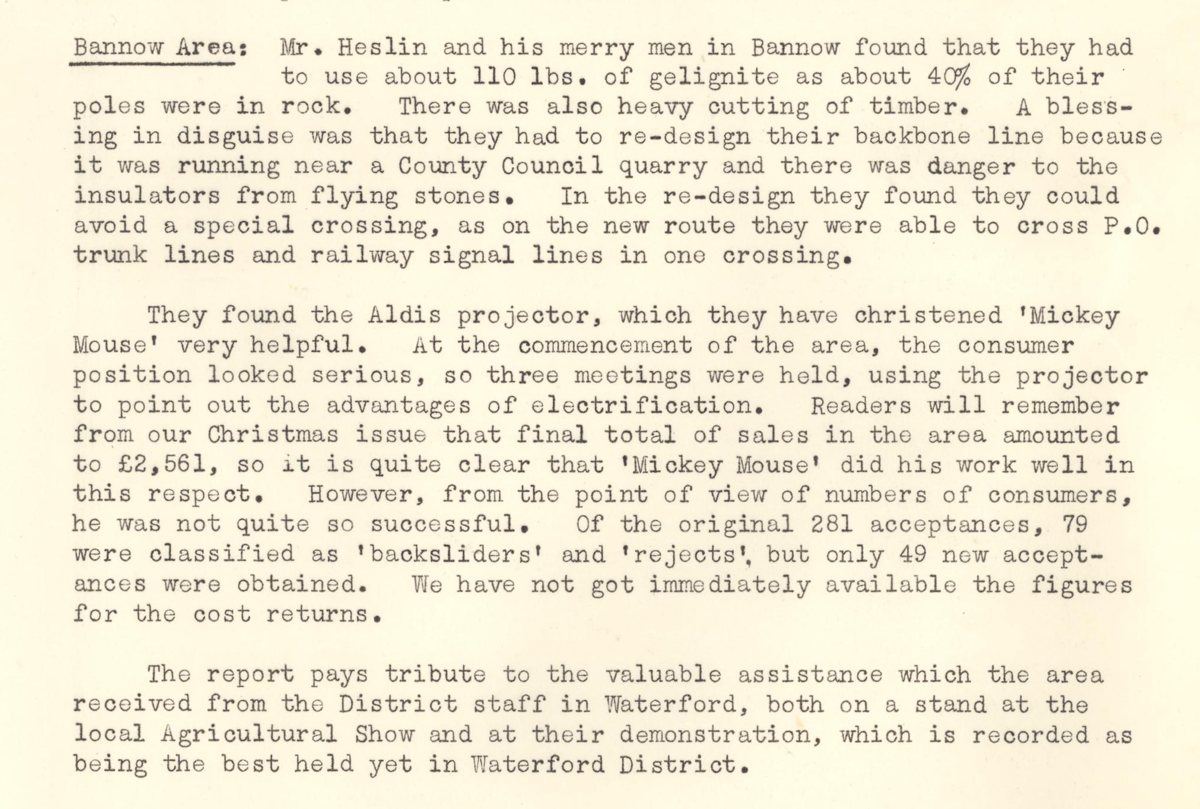 This digital scan from the REO News displays the following text:
“Bannow Area: Mr. Heslin and his merry men in Bannow found that they had to use about 110 lbs. of gelignite as about 40% of their poles were in rock. There was also heavy cutting of timber. A blessing in disguise was that they had to re‑design their backbone line because it was running near a County Council quarry and there was danger to the insulators from flying stones. In the re‑design they found they could avoid a special crossing, as on the new route they were able to cross P.O. trunk lines and railway signal lines in one crossing.
They found the Aldis projector, which they have christened ‘Mickey Mouse’, very helpful. At the commencement of the area, the consumer position looked serious, so three meetings were held, using the projector to point out the advantages of electrification. Readers will remember from our Christmas issue that final total of sales in the area amounted to £2,561, so it is quite clear that ‘Mickey Mouse’ did his work well in this respect. However, from the point of view of numbers of consumers, he was not quite so successful. Of the original 291 acceptances, 79 were classified as ‘backsliders’ and ‘rejects’, but only 49 new acceptances were obtained. We have not got immediately available the figures for the cost returns.
The report pays tribute to the valuable assistance which the area received from the District staff in Waterford, both on a stand at the local Agricultural Show and at their demonstration, which is recorded as being the best held yet in Waterford District.”
Ballygow Farm, Bannow was featured in The REO News from February 1954.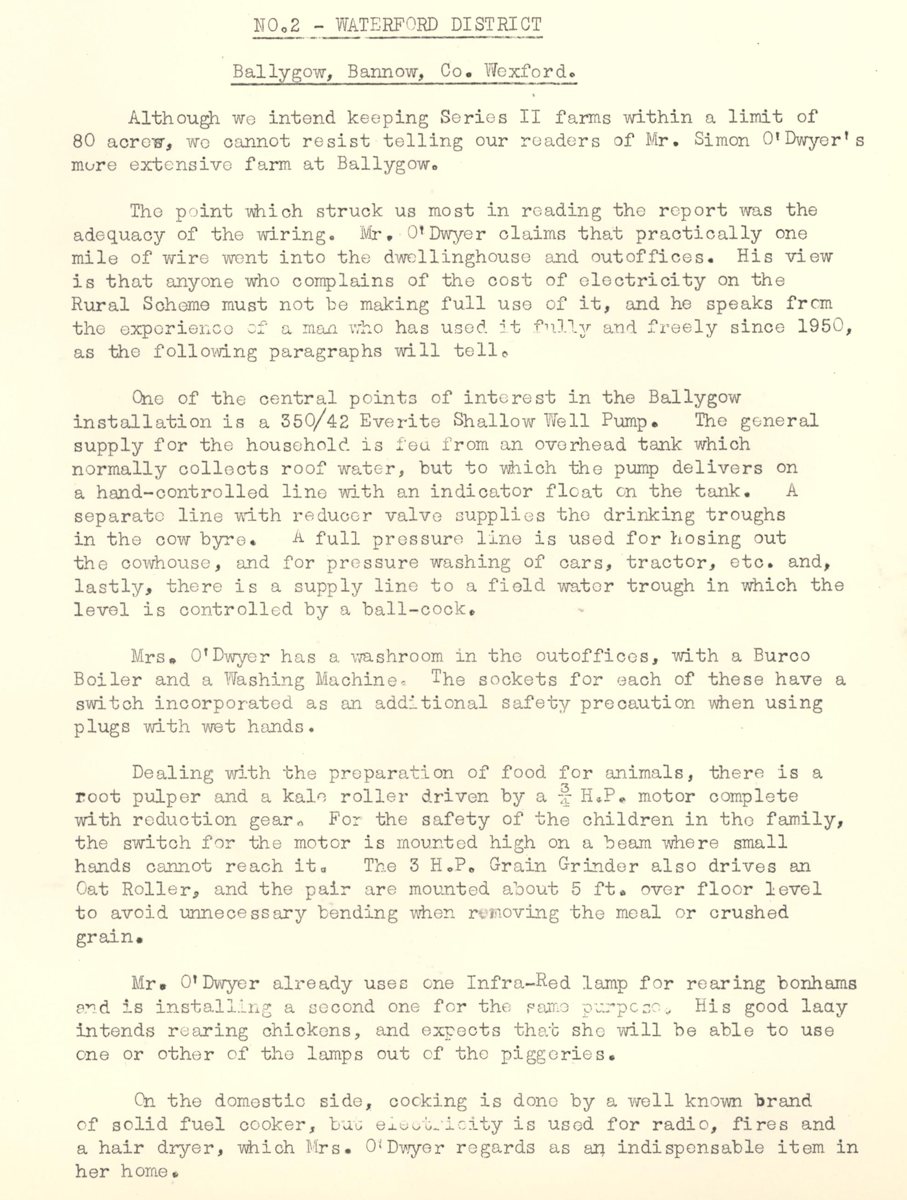 This digital scan from the REO News displays the following text:
“Ballygow, Bannow, Co. Wexford: Although we intend keeping Series II farms within a limit of 80 acres, we cannot resist telling our readers of Mr. Simon O’Dwyer’s more extensive farm at Ballygow.
The point which struck us most in reading the report was the adequacy of the wiring. Mr. O’Dwyer claims that practically one mile of wire went into the dwellinghouse and outoffices. His view is that anyone who complains of the cost of electricity on the Rural Scheme must not be making full use of it, and he speaks from the experience of a man who has used it fully and freely since 1950, as the following paragraph will tell.
One of the central points of interest in the Ballygow installation is a 350/42 Everite Shallow Well Pump. The general supply for the household is fed from an overhead tank which normally collects roof water, but to which the pump delivers on a hand‑controlled line with an indicator float on the tank. A separate line with a reducer valve supplies the drinking troughs in the cow byre. A full pressure line is used for hosing out the cowhouse, and for pressure washing of cars, tractors, etc., and, lastly, there is a line running to a field water trough in which the level is controlled by a ball‑cock.
Mrs. O’Dwyer has a washroom in the outoffices, with a Burco Boiler and a Washing Machine. The sockets for each of these have a switch incorporated as an additional safety precaution when using plugs with wet hands.
Dealing with the preparation of food for animals, there is a root pulper and a kale masher driven by a 3 H.P. motor and a hairslicer by another ½ H.P. motor. For the school children in the family, a ‘hot press’ was installed to warm the clothes. There are two small electric cookers at Ballygow, one by a well‑known brand ‘the Hot Roller’, on which are mounted the switchers over floor level to avoid unnecessary wear and tear, providing 5 ± over floor level and thus unobtrusive.
Mrs. O’Dwyer already uses one Infra‑Red lamp for rearing bonhams and is installing a second one for the same purpose. His good lady says that by switching the plugs on and off, he will be able to use one or other of the lamps out at the piggery.
In the domestic side, cooking is done by a well‑known brand solid fuel cooker, but electricity is used for radio, fires and a hair dryer, which Mrs. O’Dwyer regards as an indispensable item in her home.”