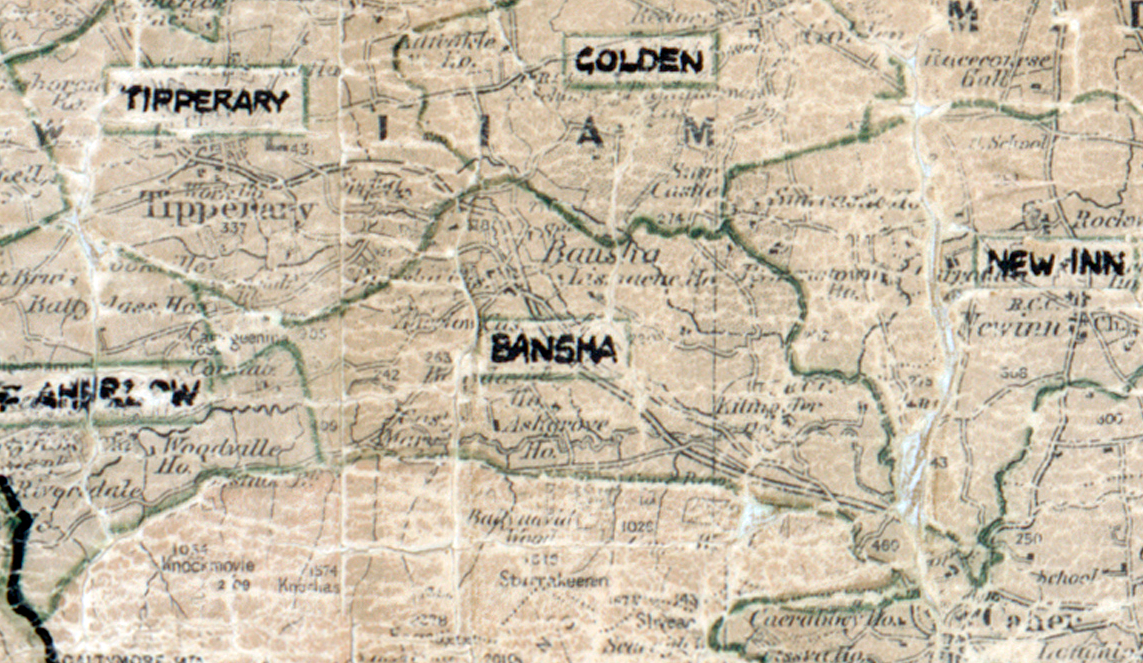
 Area: Bansha
Started: December 1947
Finished: November 1948
Poles used: 1613
Line used (km): 121
Premises connected: 423
The figures above were sourced from our REO News magazine. Click interactive map to find out more on what the figures mean. The map above shows the area boundary and is from a digitised version of the original map used during the scheme.
Survey and switch on
An initial survey was conducted in the Bansha rural area in Co Tipperary circa July 1947, which covered 36.8 sq miles. The estimated cost of implementing the scheme was recorded as £28,281.30. From a total of 518 houses, there were: 452 acceptances of the scheme; 36 refusals; 4 ‘doubtfuls’; and 26 recorded as vacant.
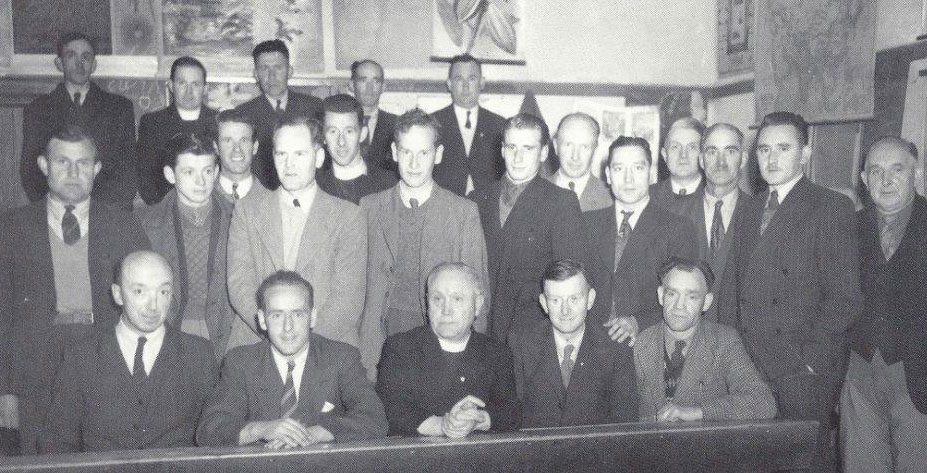 Bansha Rural Committee, 1948. Back row (L-R): [unknown]; Fr Walsh; Willie Matt Grogan; Charlie O’Neill; and Dan O’Connell. Second row from back (L-R): John Butler; Fr English; [unknown]; Tom Brosnan; and Ned Haney. Second row from front (L-R): Paddy Gallagher; Alfred Kissane; Dr Jim Russell; [unknown]; [unknown]; [unknown]; [unknown]; and [unknown]. Front row (L-R): [unknown]; [unknown]; Canon Hayes; [unknown]; and [unknown].
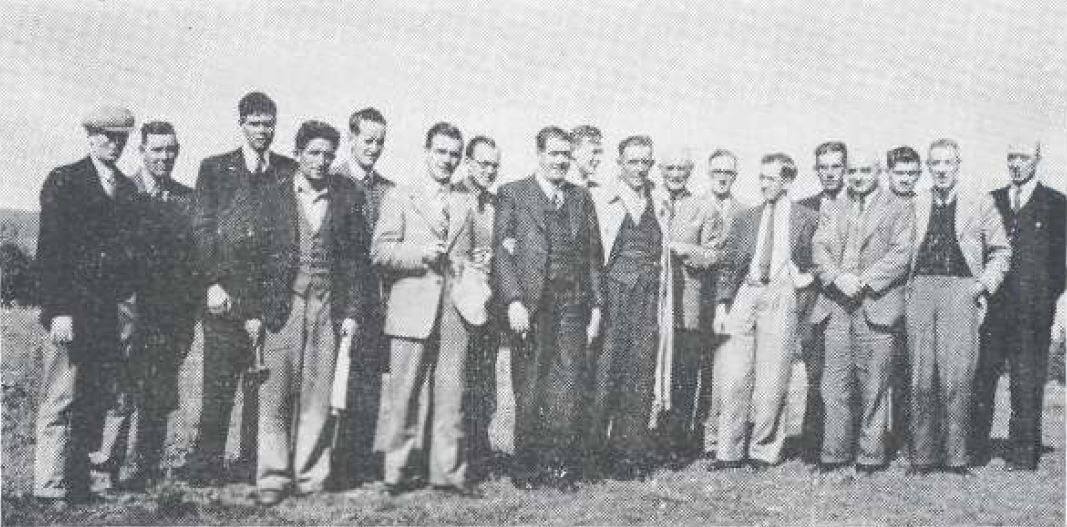 Bansha rural employees, 1948 (L-R): T Drennan; J Nolan; C Clune; M Whyte; J Dillon; T Costello, C O’Reilly; J Bergin; R Dowd; P Grace; J King (Alcan); B Lanigan; S Nolan; [unknown]; J Kelly; S Gibson; J Ware; and PG Collier.
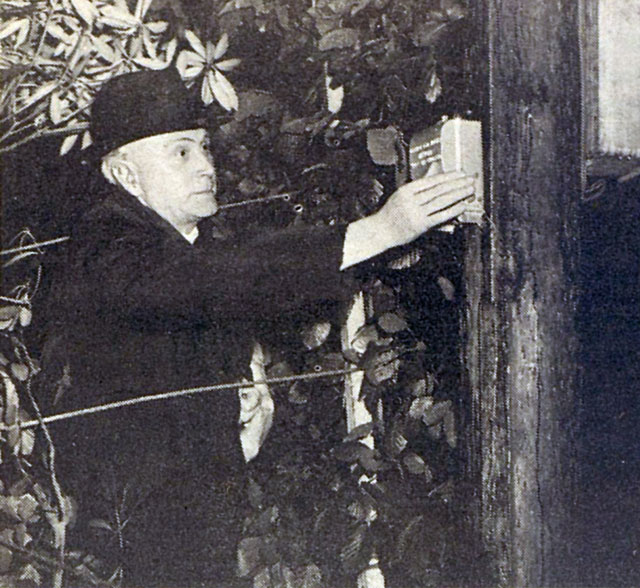 Switch on by Parish Priest Very Rev Cannon JM Hayes at Bansha, 24 May 1948
The official switch on ceremony was held in Bansha on 24 May 1948, as described in The REO News from June 1948:
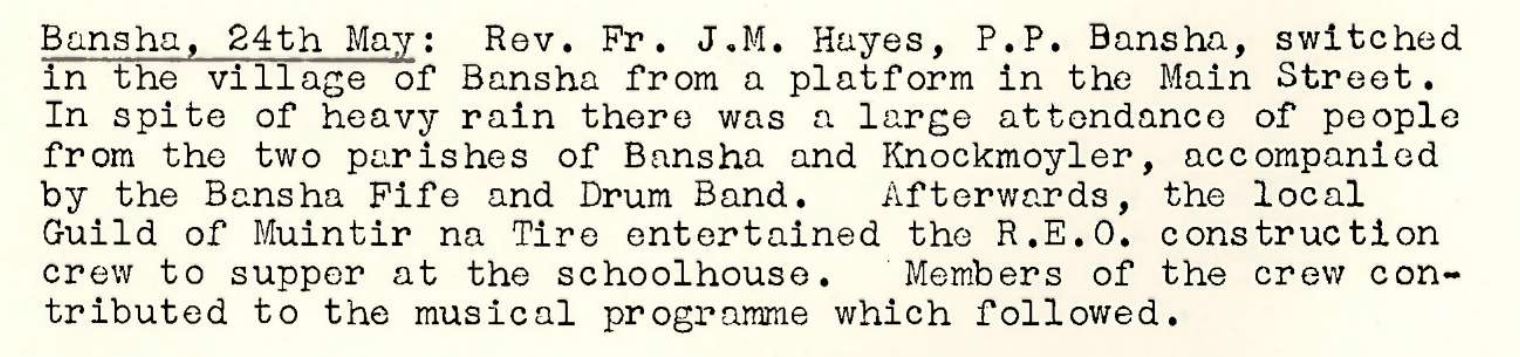
This digital scan from the REO News displays the following text:
"Bansha, 24th May: Rev. Fr. J.M. Hayes, P.P. Bansha, switched in the village of Bansha from a platform in the Main Street. In spite of heavy rain there was a large attendance of people from the two parishes of Bansha and Knockmoyler, accompanied by the Bansha Fife and Drum Band. Afterwards, the local Guild of Muintir na Tire entertained the R.E.O. construction crew to supper at the schoolhouse. Members of the crew contributed to the musical programme which followed."
During the switch on ceremony, Cannon Hayes, Founder Member of Muintir na Tíre remarked:
"No material interest can do as much to uplift the rural people and give them a status in accordance with the important position they hold in the nation. Rural people who supply the fundamental necessities for the whole nation should at least have an equal right to the amenities of the nation. It is more than an amenity, it is a revolution which will sweep away the inferiority complexes."
Benefits
The immediate impact of electricity was apparent, drastically improving domestic, commercial and industrial life in the area. One industry in particular flourished as a direct result of the rural electrification scheme, namely a new local jam factory:
REO News, November 1948
This digital scan from the REO News displays the following text:
""Last February, there was an old mill on the main Limerick-Waterford road, where it winds through Bansha. The walls were tumbling down. It was another of those many wrecked buildings which blot our countryside. 'What was the best use to which that building could be put?' asked the Parish Council. The ideal answer was found. A native of Bansha, Mr. Holloway, was in the jam business in Dublin. With his advice, Bansha would have the technical help.
All the fruit grown by the farmers of the parish would have a guaranteed outlet in the factory and they would be encouraged to grow more and better.
But they needed money to buy equipment, to repair the old mill and to go into production. The parishioners were asked to subscribe pound shares to a limited company, formed to manage the project. Poor people pooled shillings and half-crowns between friends to buy a share. Soon the capital was subscribed. Equipment shortages caused Mr. Holloway to tour Ireland and Britain to find the parts to construct the machinery.
There was no electricity in Bansha and no factory could run without it. The Parish Council got the necessary support from the people for the installation of rural electrification under the E.S.B. Scheme. This was to be the first factory in Ireland, established through rural electrification.
In March, they started work on the building and the E.S.B. started work on the lines. In June, where there had once been a derelict building and grass breaking through the cracked floors, in a village where the youth grew up merely to go away, a siren sounded, the boilers were stirred and fired, the fruit was pulped and boiled; the jams and jellies, custard powders and other products began to appear expertly jarred and packed, in their home-produced boxes, and the shops in Bansha displayed the manufactured products of their own village.
This afternoon, when Mr. Morrissey cut the tape in front of the gate of this prosperous-looking factory, thick smoke billowed up into the air from a chimney that had been cold for years; girls in white overalls stood around; some of them had returned from abroad to work at home; and, while listening and watching, were the people of Bansha of every class, who had more than a local pride in the new factory, THEY OWN IT."
(P.P. O'Reilly broadcasting from Radio Eireann, 3/11/48)"
Find audio recording of the switch on ceremony including Cannon Hayes’ speech on RTÉ Archives
RTÉ Archives | Collections | The Electrification Of Bansha : Switch On (rte.ie)