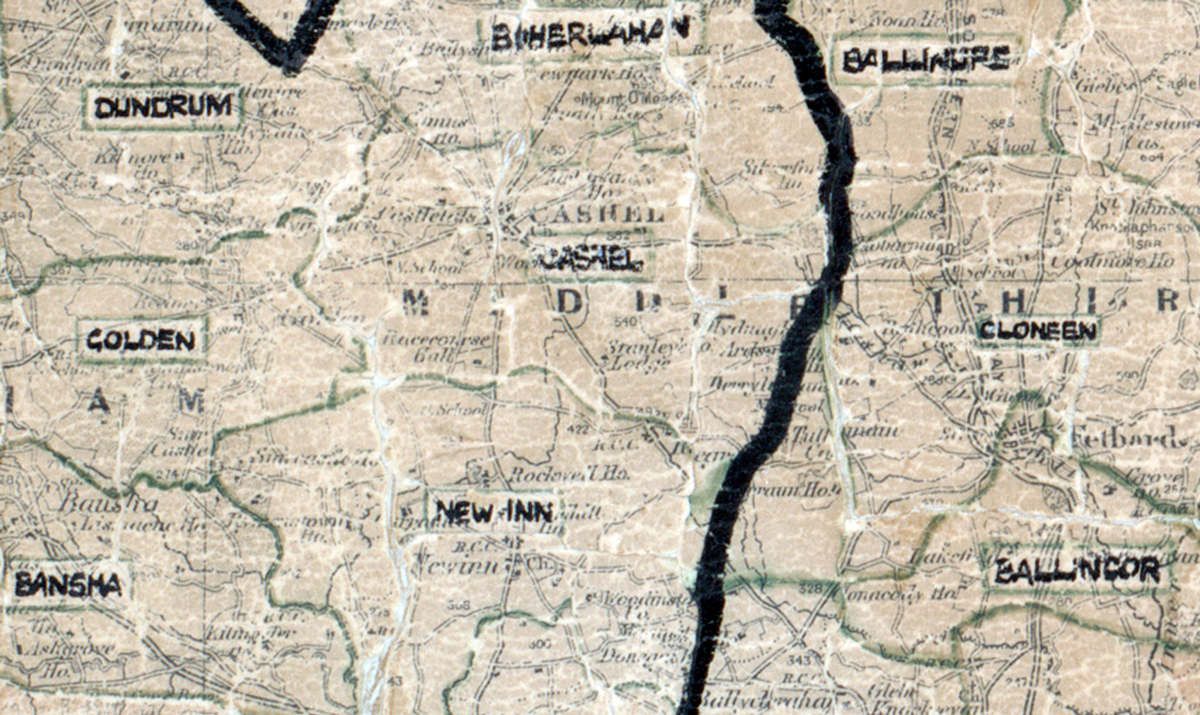
 Area: Cashel
Started: April 1957
Finished: November 1957
Poles used: 1202
Line used (km): 102
Premises connected: 175
The figures above were sourced from our REO News magazine. Click interactive map to find out more on what the figures mean. The map above shows the area boundary and is from a digitised version of the original map used during the scheme.
The REO News from October 1958 included a clipping from The Munster Tribune regarding Cashel:
This digital scan from the REO News displays the following text:
"From the Munster Tribune Mr. Cronin, Limerick District, has forwarded this cutting:
"For many years six farmers at Cashel were drawing water from a well, the same as their grandfathers before them. Now all this is changed.
They put their heads and their purses together and decided to get a modern water supply system installed. Though they all live in farms widely separated they are now getting a piped supply from the same crystal clear well, thanks to the Rural Electrification Scheme which has already been a great boon to farmers all over the country.
They are the first farmers in the Cashel area to avail of this type of scheme but now that it is a success many more farmers still depending on outmoded methods of water supply are expected to have the system installed.
Cost of the pipeline to the six farmers was about £110 each. They did a lot of the work themselves, like digging the trenches for the pipeline. This cut down expenses.
Said farmer Paddy Morrissey: "It is one of the best projects any farmer could put money into. We even have hot water in our farmhouses now."
"Man who introduced the scheme for the E.S.B. was organiser Gerry White who has now left Cashel, but there to give any information about it are Dan McCarthy and Denis Ryan."
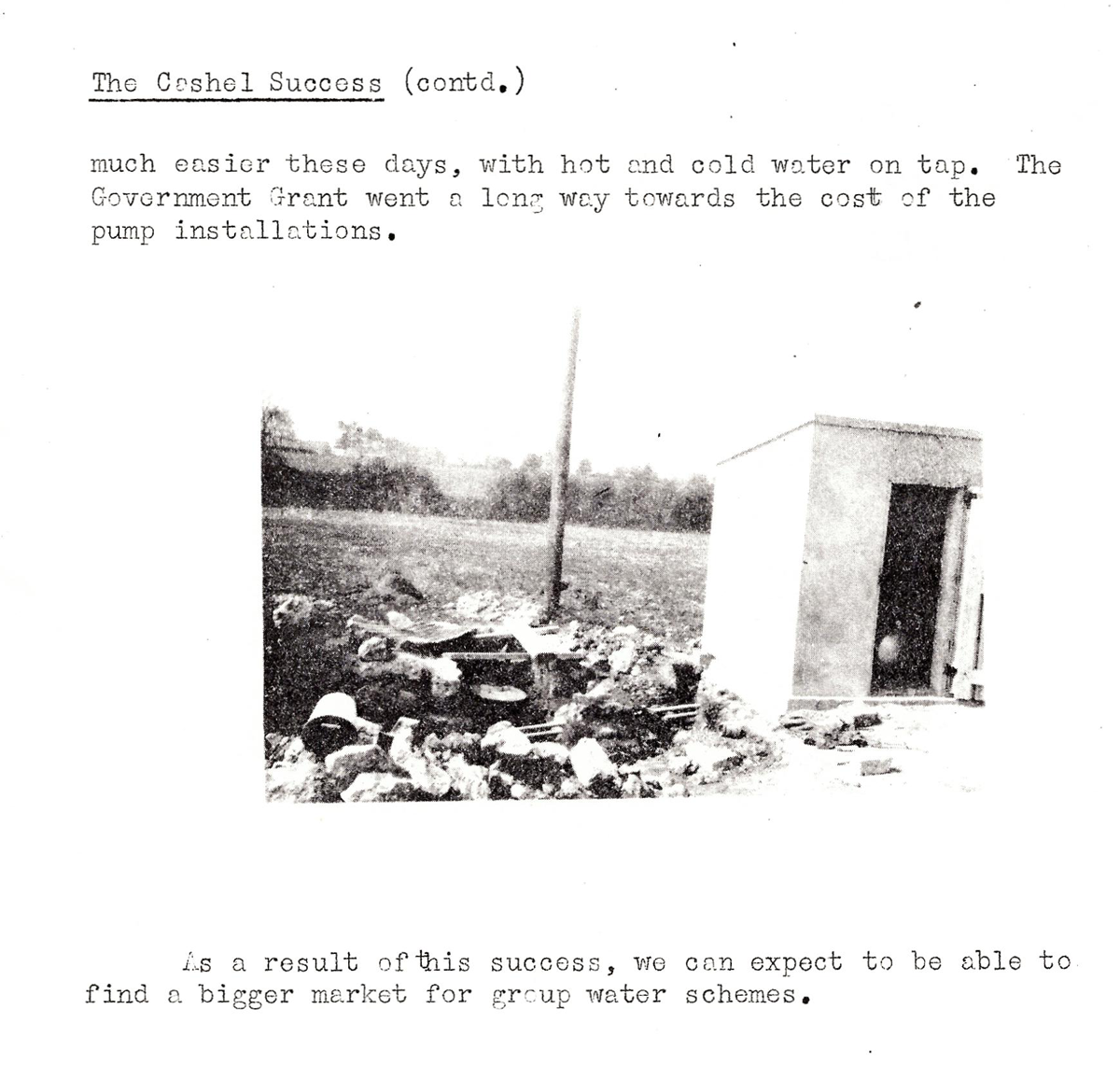
A well deserved pat on the back is due to the staff in Limerick District and the Pump Advisory Service, who carried out the installation of this pumping system, including 6,000 yards of piping. Our photo shows the pumphouse, and the beginning of the piping, and the map on the facing page shows the layout of the piping.
Two standard shallow-well pumps are installed, which can work together or, in the event of a breakdown, independently. All six consumers have also bought water-heaters, and find that life is...
Contd.
The Cashel Success (contd.)
Much easier these days, with hot and cold water on tap. The Government Grant went a long way towards the cost of the pump installations.
As a result of this success, we can expect to be able to find a bigger market for group water schemes."
The REO News from August 1961 tells us of a man with initiative in Cashel:
This digital scan from the REO News displays the following text:
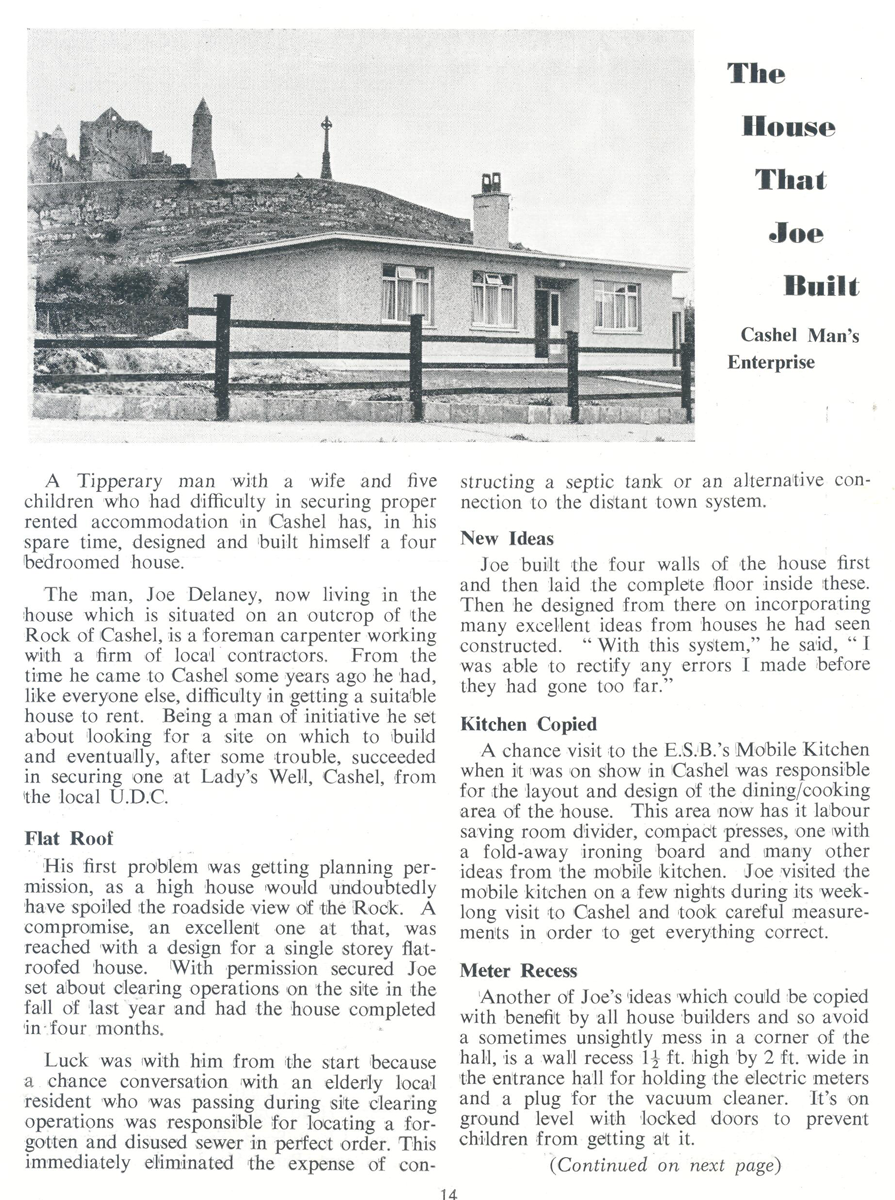
"The House That Joe Built: Cashel Man's Enterprise
A Tipperary man with a wife and five children who had difficulty in securing proper rented accommodation in Cashel has, in his spare time, designed and built himself a four-bedroomed house.
The man, Joe Delaney, now living in the house which is situated on an outcrop of the Rock of Cashel, is a foreman carpenter working with a firm of local contractors. From the time he came to Cashel some years ago he had, like everyone else, difficulty in getting a suitable house to rent. Being a man of initiative he set about looking for a site on which to build and eventually, after some trouble, succeeded in securing one at Lady's Well, Cashel, from the local U.D.C.
Flat Roof
His first problem was getting planning permission, as a high house would undoubtedly have spoiled the roadside view of the Rock. A compromise, an excellent one at that, was reached with a design for a single-storey flat-roofed house. With permission secured Joe set about clearing operations on the site in the fall of last year and had the house completed in four months.
Luck was with him from the start because a chance conversation with an elderly local resident who was passing during site clearing operations was responsible for locating a forgotten and disused sewer in perfect order. This immediately eliminated the expense of constructing a septic tank or an alternative connection to the distant town system.
New Ideas
Joe built the four walls of the house first and then laid the complete floor inside these. Then he designed from there on incorporating many excellent ideas from houses he had seen constructed. "With this system," he said, "I was able to rectify any errors I made before they had gone too far."
Kitchen Copied
A chance visit to the E.S.B.'s Mobile Kitchen when it was on show in Cashel was responsible for the layout and design of the dining/cooking area of the house. This area now has its labour-saving room divider, compact presses, one with a fold-away ironing board and many other ideas from the mobile kitchen. Joe visited the mobile kitchen on a few nights during its week-long visit to Cashel and took careful measurements in order to get everything correct.
Meter Recess
Another of Joe's ideas which could be copied with benefit by all house builders and so avoid a sometimes unsightly mess in a corner of the hall, is a wall recess 1½ ft. high by 2 ft. wide in the entrance hall for holding the electric meters and a plug for the vacuum cleaner. It's on ground level with locked doors to prevent children from getting at it.
(Continued on next page)
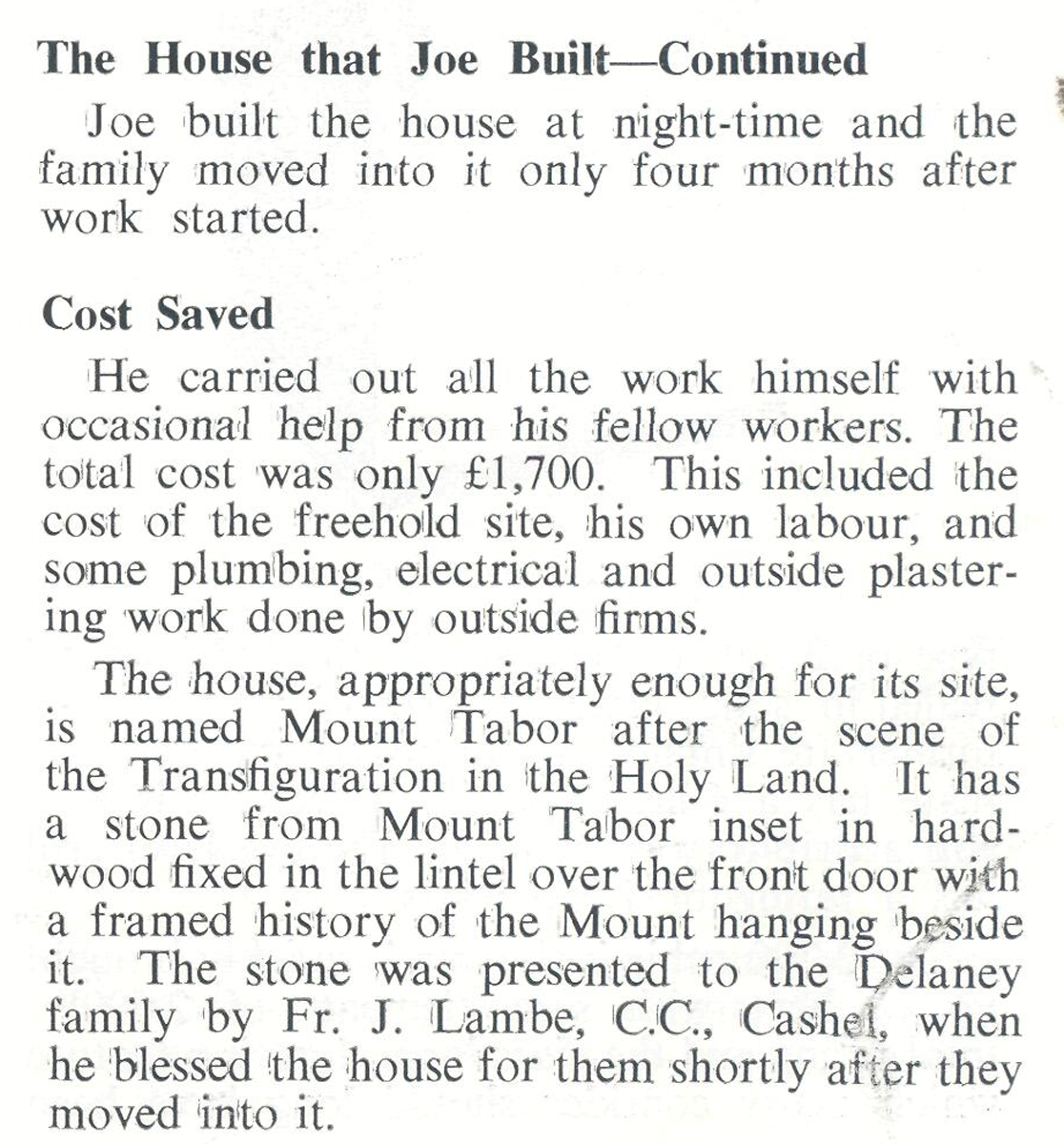
The House that Joe Built - Continued
Joe built the house at night-time and the family moved into it only four months after work started.
Cost Saved
He carried out all the work himself with occasional help from his fellow workers. The total cost was only £1,700. This included the cost of the freehold site, his own labour, and some plumbing, electrical and outside plastering work done by outside firms.
The house, appropriately enough for its site, is named Mount Tabor after the scene of the Transfiguration in the Holy Land. It has a stone from Mount Tabor inset in hardwood fixed in the lintel over the front door, with a framed history of the Mount hanging beside it. The stone was presented to the Delaney family by Fr. J. Lambe, C.C., Cashel, when he blessed the house for them shortly after they moved into it."