 Area: Castlegregory
Started: February 1952
Finished: July 1952
Poles used: 933
Line used (km): 75
Premises connected: 253
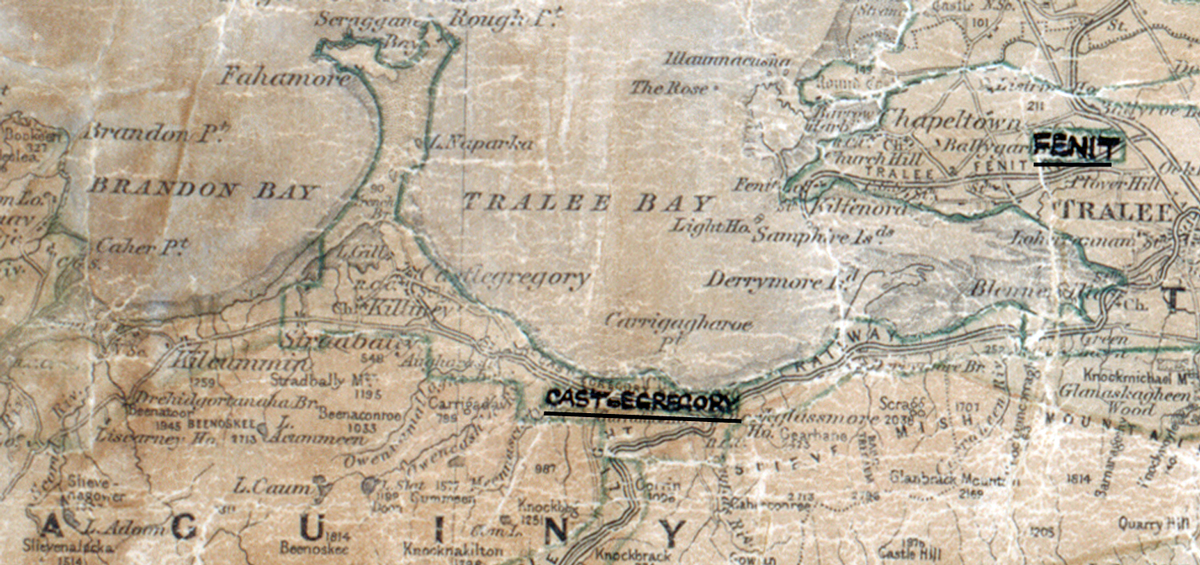
The figures above were sourced from our REO News magazine, to learn more about what these figures mean, visit our interactive map. The map above shows the area boundary and is from a digitised version of the original map used during the scheme.
Castlegregory was a sizeable pig and poultry centre according to The REO News from August 1952. This digital scan from the REO News displays the following text:
"Castlegregory Rural Area: The Castlegregory area was an extremely awkward shape, being 22 miles long by about a mile wide. Indeed, at one stage, the R.A.E., Mr. S.W. Gibson, considered the advisability of providing two Area Offices, but as the bulk of the consumers were at the western end of the area, he compromised by selecting a position about 2 miles to the east of the main village of Castlegregory itself. One of the results was that mileage was much higher than either Mr. Gibson or anyone else could wish.
The first few miles of the area from the town of Tralee to Camp are not in the Castlegregory Parish and do not come under the auspices of any local committee who might exert some pressure on the many backsliders that were experienced in this section. An appeal was made to the local clergy, but though they exhorted their people to accept supply, they themselves became backsliders. Apart from this, the position was not too bad. As against a total of 46 backsliders, 42 additional houses were obtained. This resulted in a decrease in revenue of approximately £52, as against which the decrease in capital was £892 and it is anticipated that the final return will drop to 7.7%.
As might be expected with a long narrow area of this nature, the bulk of the non‑acceptances can be reached by a service only and it is expected that a number of them will apply for service in the autumn of the year. In addition, 12 of the backsliders refused supply because they were building new houses on, or near, the existing buildings and will, therefore, be picked up relatively easily.
Appliances sold in the area by the E.S.B. included 3 – Cookers, 3 – Washing Machines, 1 – Refrigerator, 1 – Welder, 1 – Shallow Well Pump; 1 – 3 H.P. Motor; 1 – 1 H.P. Motor. In addition, 6 appliances are outstanding for cookers and Mr. Lane, A.O., anticipates that the return from future sales will, in general, be high due to the lack of local fuel. Contractors sold 16 – Cookers, 1 – Washing Machine, 2 – Ice Cream Refrigerators, 1 – 3 H.P. Motor, 6 – Kettles and 10 – Irons." This digital scan from the REO News displays the following text:
"Castlegregory itself is a sizeable pig and poultry centre and there may be a demand for the larger sized feed boilers. The area as a whole is the main onion growing centre in the country and the County Committee of Agriculture, as well as the local factors, are anxious to install an onion drying plant, somewhat similar to the grain drying plants which we are endeavouring to popularise in other parts of the country. A difficulty about the onion drying is that we have no data on which to work, nor is there any detailed data readily available either in England or in America. However, we in Head Office are making arrangements to install an experimental plant this autumn and hope to be in a position to expand this activity in the coming years.
Due to the shortage of conductor, it became necessary to design the L.T. exceedingly accurately with a high proportion of 16 sq. mm. S.c.A. On the only long spur in the area, there was considerable difficulty due to the fact that sand was found in every pole hole. This meant that not alone had the spans to be reduced but that considerable difficulty was experienced in getting down to proper foundation depths, even by boxing in the holes. The most successful technique was to box in and get down to about 4 ft. and then erect the pole and by twisting it itself to get an auger action until the pole was down to the proper depth. Sleepers had then to be fixed to the pole to prevent further sinking. On the section from Blennerville to Camp, boulder type rock was experienced most of the way. In general, it was found that the most economic way of dealing with the situation was to move the pole hole forward or back a few feet so as to miss the boulder."
The REO News from October 1954 has Killiney Farm Castlegregory as its featured farm. This digital scan from the REO News displays the following text:
"Killiney Farm, Castlegregory, Co. Kerry: This month's "Feature Farm" from Co. Kerry is typical of many similar ones in Munster on which, for generations after generations, as long as parish records have been kept, the same families have had their ancestral homes. In these families farming has always been considered as a way of life rather than as a business or a means of "making the money" and this desirable philosophy still persists to this day.
The writer, therefore, wishes to emphasise that in this month’s "Feature Farm" the electricity supply is used mainly for providing more comforts and more leisure in the home rather than for providing the means of accumulating a greater credit balance in the bank. Perhaps this provides the solution for many of the problems associated with "the drift from the land". It certainly appears to fit in with the oft quoted "Ill fares the land, etc.”
Our "Feature Farm" is situated in the Dingle Peninsula at Killiney near the village of Castlegregory, on the narrow very fertile coastal strip between the mountains and the sea. The farm of about 100 acres is owned and worked by Mr. James O’Donnell, with two permanent men. The main farming is milk production, there being 20 milch cows, and this milk is sold to Denny’s creamery in Tralee. About the same number of dry cattle are kept and the usual crops of grain, roots, potatoes, hay, etc., are rotated. Three sows are kept, the bonhams being sold as such or when of age for fattening.
There are three outside lights in the farmyard with a light and socket in every out‑house. The sockets are used for one small farmyard appliance or another during the year for the comfort of anyone having to remain up at night with cows calving or with other farmyard work. The water‑heater, used for the washing of milk cans, proves entirely satisfactory, as much as does a root pulper, also satisfactory. So much for the farm.
And now we come to the O’Donnell home, which is run by Mrs. O’Donnell without any domestic help. There are four O’Donnell children, the youngest being eight and the eldest fourteen. Mrs. O’Donnell’s normal attention to her home is naturally heavy.
On Mrs. O’Donnell being asked which of all her domestic appliances she liked best, she immediately said her "No. 1" is her washing machine which now does in a day what used to be her work on the weekly washing‑day. No machine gives the land its full measure of praise, or the tribute to its owners, greater credit than Mrs. O’Donnell has in the single‑plate cooker. This finds excellent use for baking and the baking of drop scones to providing meals for the “mobals” of men."
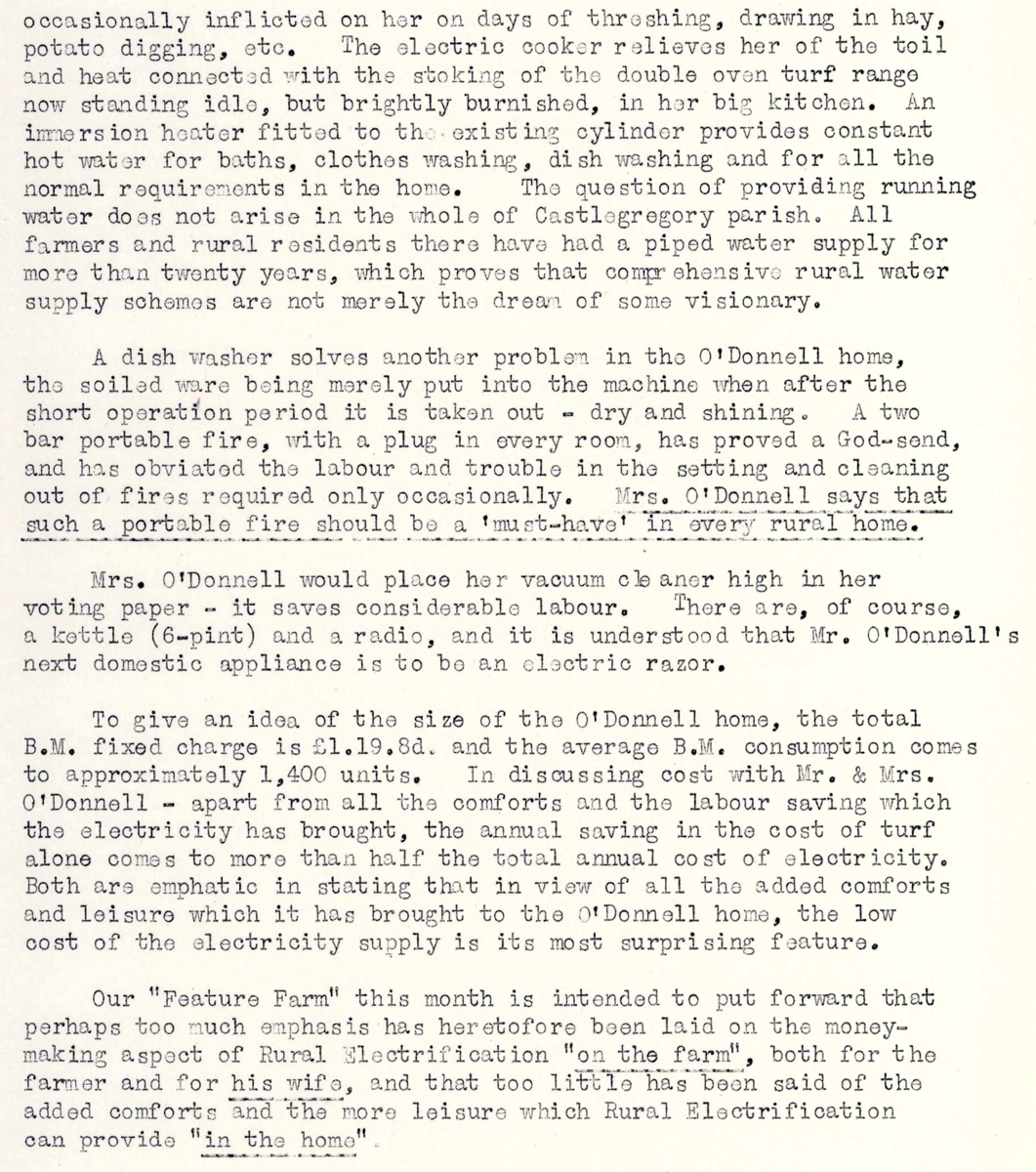 This digital scan from the REO News displays the following text:
"occasionally inflicted on her on days of threshing, drawing in hay, potato digging, etc. The electric cooker relieves her of the toil involved and heat connected with the stoking of the double oven turf range now standing idle, but brightly burnished, in her big kitchen. An immersion heater fitted to the existing cylinder provides constant hot water for baths, clothes washing, dish washing and for all the normal requirements in the home. The question of providing running water does not arise in that west of Castlegregory parish. Almost all farmers and rural residents there have had a piped water supply for more than twenty years, which proves that our extensive rural water supply schemes are not merely the dream of some visionary.
A dish washer solves another problem in the O’Donnell home, the soiled ware being merely put into the machine when after the short operation period it is taken out dry and shining. A two‑bar portable fire, with a plug in every room, has proved a God‑send, and has obviated the labour and trouble in the setting and cleaning out of fires required only occasionally. Mrs. O’Donnell says that “a portable fire should be a must‑have” in every rural home.
Mrs. O’Donnell would place her vacuum cleaner high in her voting paper – it saves considerable labour. There are, of course, a kettle (6‑pint) and a radio, and it is understood that Mr. O’Donnell’s next domestic appliance is to be an electric razor.
To give an idea of the size of the O’Donnell home, the total B.M. fixed charge is £1.19.8d. and the average B.M. consumption comes to approximately 1,400 units. In discussing the cost with Mr. & Mrs. O’Donnell – apart from the comforts and the labour saving which the electricity has brought, the normal saving in the cost of turf alone comes to more than half the current bill for the use of electricity. Both Mr. & Mrs. O’Donnell say that even if all the advantages and comforts and lights were not brought to the O’Donnell home, the low cost of the electricity supply is itself a most surprising fact.
Our “Feature Farm” this month is indeed one that is far forward; that perhaps even further realises has heretofore been laid on the money‑making side of farming, and that too little has been said of the farm and of the wife, and the more leisure which Rural Electrification can provide “in the home”.