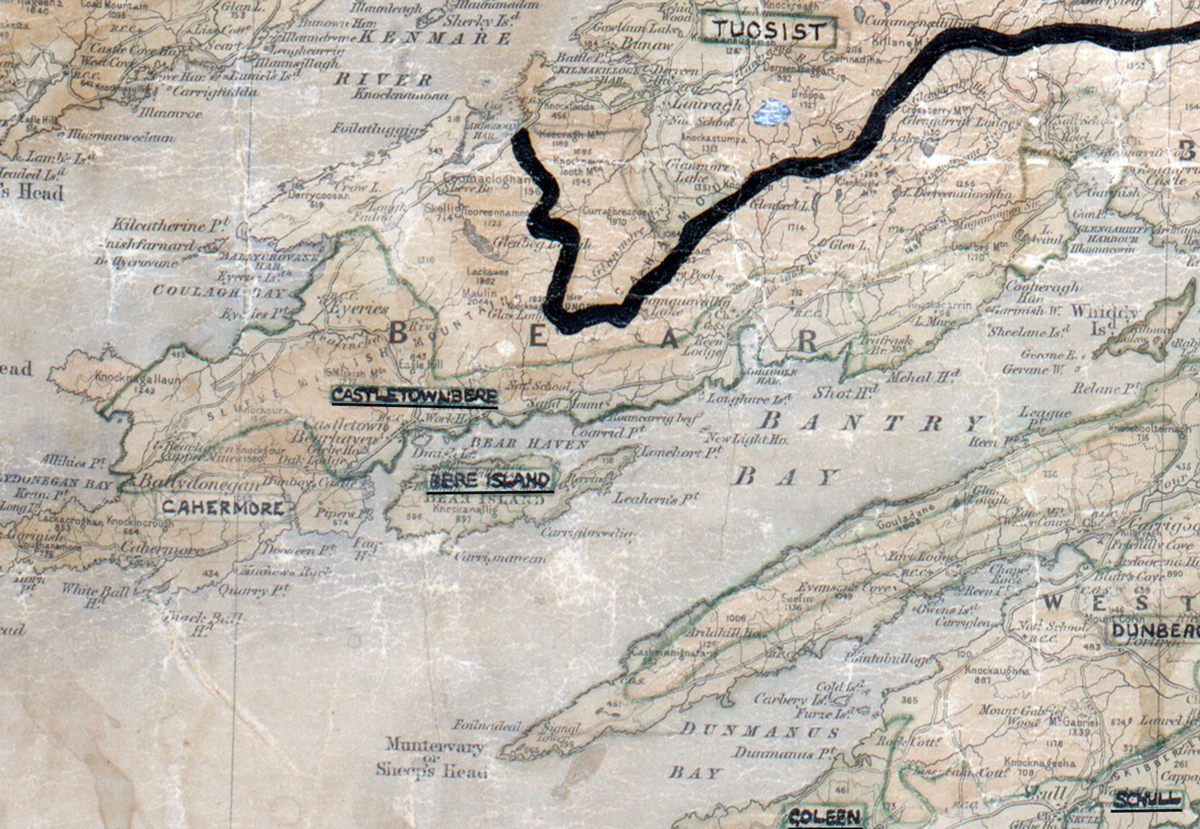
 Area: Castletownbere
Started: June 1951
Finished: December 1952
Poles used: 1044
Line used (km): 93
Premises connected: 340
The figures above were sourced from our REO News magazine, to learn more about what these figures mean, visit our interactive map. The map above shows the area boundary and is from a digitised version of the original map used during the scheme.
The report on Castletownbere in The REO News from March 1953 gives a very detailed insight into the area.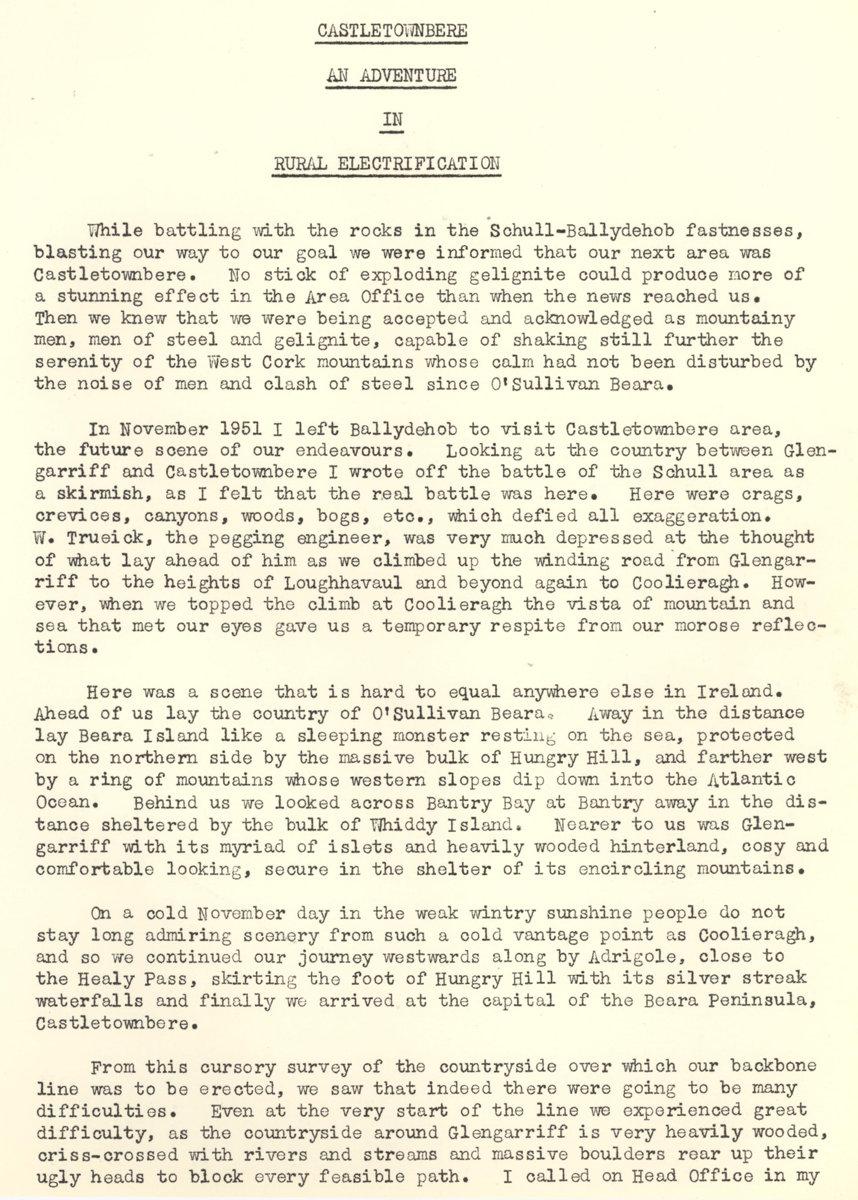 This digital scan from the REO News displays the following text:
"CASTLETOWNBERE AN ADVENTURE IN RURAL ELECTRIFICATION: While battling with the rocks in the Schull‑Ballydehob fastnesses, blasting our way to our goal we were informed that our next area was Castletownbere. No stick of exploding gelignite could produce more of a stunning effect in the Area Office than the news reached us. Then we knew that we were being observed and acknowledged as mountainy men, men of steel and gelignite, capable of shaking still further the serenity of the West Cork mountains whose calm had not been disturbed by the noise of men and clash of steel since O’Sullivan Beara.
In November 1951 I left Ballydehob to visit Castletownbere area, the future scene of our endeavours. Looking at the country between Glengarriff and Castletownbere I wrote off the battle of the Schull area as a skirmish, as I felt that the real battle was now ahead. Huge crags, crevices, canyons, woods, bogs, etc., which defied all exaggeration.
Tuaick, the pegging engineer, was very much depressed at the thought of what lay ahead of him as we climbed the winding road from Glengarriff to the heights of Coomhola and beyond again to the waterfalls. Then the descent past Adrigole, past to Coolegrean Lake, and down to the mountain and sea that met our eyes gave us a temporary respite from our morose reflections.
Here was a scene that is hard to equal anywhere else in Ireland. Ahead of us lay the country of O’Sullivan Beara. We could see Beara Island like a sleeping monster resting on the sunlit waters of Bantry Bay. Nearer to us we saw Berehaven Harbour sheltered by the beautiful island. We saw the shock of the big Atlantic on the rocks. Behind us were the mountains of hungry cliffs. And as we drove on, the road wound itself round heavily wooded hinterland, under the shadow of shaggy cliffs and the narrow roads ran along lovely woods.
On a cold November day in the weak wintry sunshine people stood by and looked curiously from sheltered spots in the mountainy roads and so we continued our journey towards Slidane by Adrigole, close to the Leitrim Bridge, and from the shock of one view to a closer inspection of the other. We finally arrived at the capital of the Beara Peninsula, Castletownbere.
From this cursory survey of the countryside over which our backbone line was to run, it was evident that Castletownbere was going to be a difficult area. At no time was the construction line to be very far west, on account of the high mountains and the Atlantic Ocean. Very wooded, tree‑crossed with huge boulders and immense boulders of different ugly hues tended to block every feasible path. I called on Head Office in"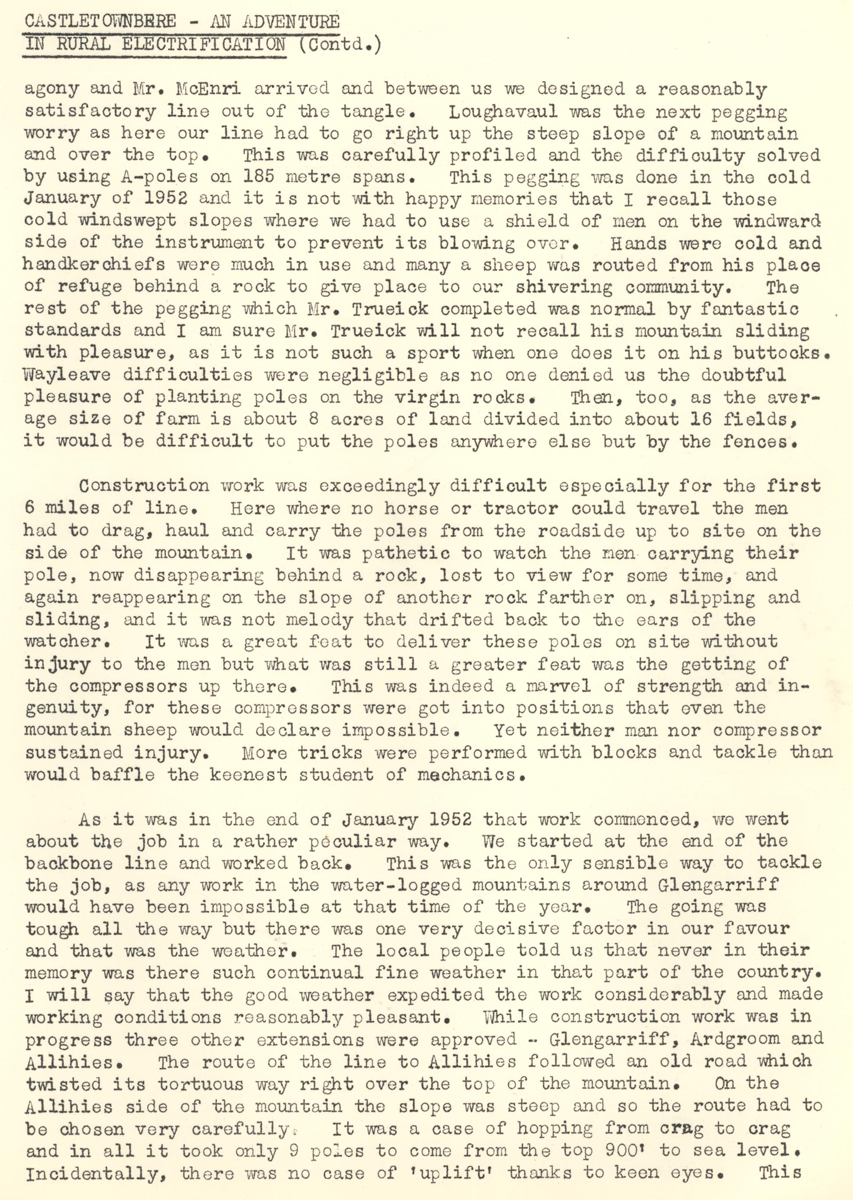 This digital scan from the REO News displays the following text:
"CASTLETOWNBERE – AN ADVENTURE IN RURAL ELECTRIFICATION (Contd.): agony and Mr. McEnari arrived and between us we designed a reasonably satisfactory line out of the tangle. Loughavaul was the next pegging worry as here our line had to go right up the steep slope of a mountain and over the top. This was carefully profiled and the difficulty solved by using A‑poles on 185 metre spans. This pegging was done in the cold January of 1952 and I list it with happy memories in that I recall those cold windswept slopes where we vied with one another for the windward side of the instrument to prevent its blowing over. Hands were cold and chargehands were much in need of tea and buttermilk and always looking for refuge behind a rock to give place to our shivering community. The part of the pegging which Mr. Tuaick most disliked was normal in farming standard and I preface this as he will not recall his worst memories with pleasure, as it is not such a sport when one does it on his buttocks. Wayleave difficulties were negligible as no one denied us the doubtful pleasure of planting poles on the virgin rocks. Then, too, as the average size of farm is about 8 acres of land divided into about 16 fields, it would be difficult to put the poles anywhere else but by the fences.
Construction work was exceedingly difficult especially for the first 6 miles of line. Here where no horse or tractor could travel the men had to drag, haul and carry the poles from the roadside up to the side of the mountain. It was pathetic to watch a man carrying the pole, now disappearing behind a rock, lost to view for some time, and again reappearing on the gay slopes at another rocky part, slipping and sliding, and it was not melogy that drifted back to the ears of the other men. Then the steel part had to be carried and slung off on the side of the mountain. It was this steel which gave the real trouble in the getting of the compressors up there. This was indeed a marvel of strength and ingenuity as the compressors weighed several tons and the drivers of the equipment sheep would declare some job. Yet neither horse nor compressor suffered any injury. More trickies were performed but blocks and boulders would baffle the keenest engineering mechanist.
As it was in the end of January 1952 that work commenced, we went about the job in a rather peculiar way. We started at the mouth of the backbone line and finished our work in the area in the year of 1953. The backbone line was not possible to complete in the winter. The line was diverted over the lower ground of the Castletownbere–Glengarriff road and then near this little village the snow had piled a height of 30 feet and the men worked in it up to the chest. They were ill‑clad for such winter weather and as the local people worked at their own in their own gardens they were considered pleasant to the workers constructing the line. I will say that this work was well liked by the men and all workers made many compliments on the reasonable pleasant winter. The construction work was in the adverse months of 1952, and when the Allihies end was reached and lived in the mountains in mid‑summer we found less strain and more pleasant time. There was more drinking of Allihies Ale then and greater peace in the lives of the men.
We did the area in sections – two sections started in the east, the main line ahead of us. As the first 6 miles had depressed the men, the route had not improved in the next 7 miles to come. The top going from crag to crag. Incidentally, there was no case of ‘uplift’ thanks to keen eyes. This"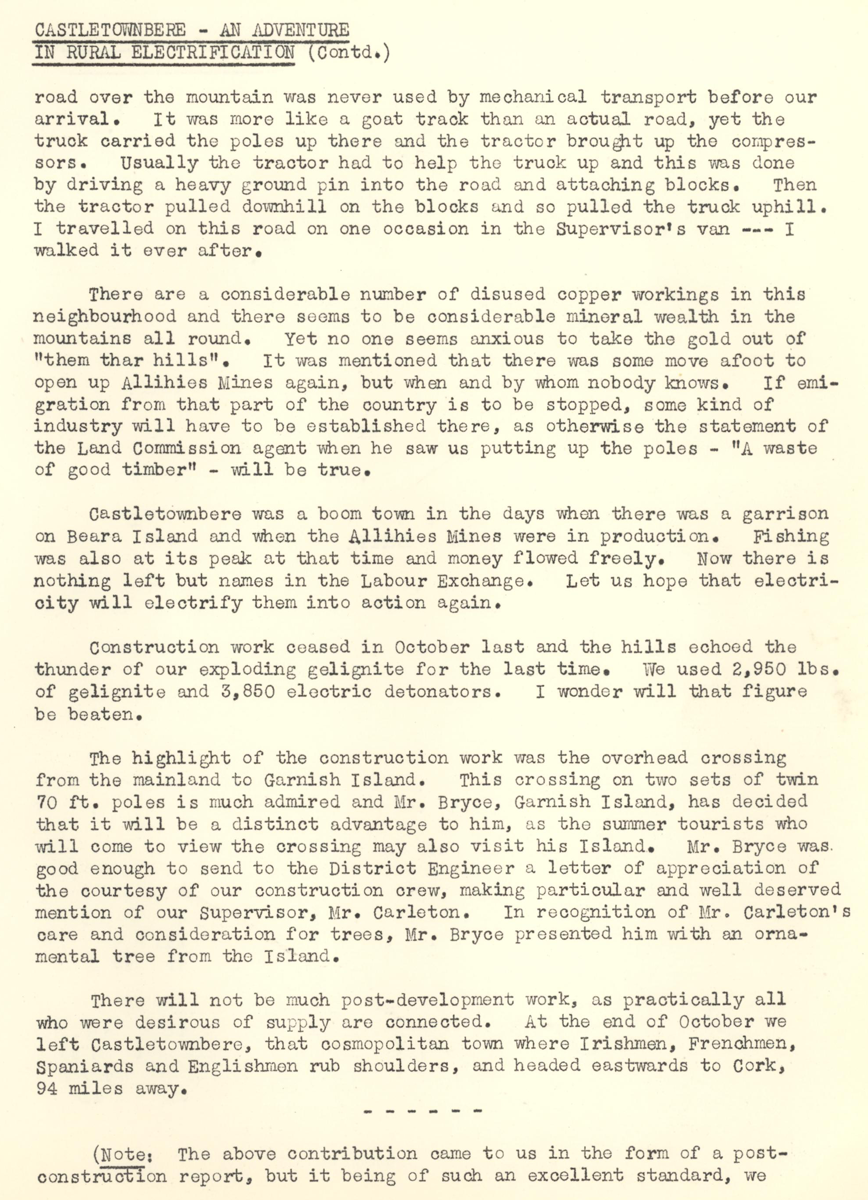 This digital scan from the REO News displays the following text:
"CASTLETOWNBERE – AN ADVENTURE IN RURAL ELECTRIFICATION (Contd.): road over the mountain was never used by mechanical transport before our arrival. It was more like a goat track than an actual road, yet the truck carried the poles up there and the tractor brought up the compressors. Usually the tractor had to help the truck and this was done by driving a heavy ground pin into the road and attaching blocks. Then the tractor pulled downhill on the blocks and so pulled the truck uphill. I travelled on this road on one occasion in the Supervisor’s van – I walked it over after.
There are a considerable number of disused copper workings in the neighbourhood and there seems to be considerable mineral resources in the mountains all round. Yet no one seems anxious to take the gold out of “them thar hills.” It was mentioned that there was some move afoot to open up Allihies Mines again, but when and how remains unknown. If emigration from that part of the country is to be stopped, some kind of industry will have to be established there, otherwise the statement of the Land Commission agent when he saw us putting up the poles – “A waste of good timber” – will be true.
Castletownbere was a boom town in the days when there was a garrison of R.A. Engineers at Bere Island and the Allihies Mines were in production. Fishing was also at its peak at that time and money flowed freely. Now there is nothing left but names in the Labour Exchange. Let us hope that electricity will electrify the men into action again.
Construction work ceased in October last and the hills echoed the thunder of our exploding gelignite for the last time. We used 2,950 lbs. of explosives and 3,850 electric detonators. I wonder will that figure be beaten.
The highlight of the construction work was the overhead crossing from the mainland to Garinish Island. This crossing was one of the twin spans of over 1,000 ft. and over 200 ft. high. On the island, the work was of a very difficult nature as the cliffs on the water’s edge were very friable and some were only temporary in their elevation. Mr. Bryce was the most helpful of our Contractors’ Foremen in the area and on the conclusion of the overhead, the crew had a nice view of the mainland. In appreciation of the work of the construction crew, and in particular of all the co‑operation and consideration of Mr. Bryce as the Contractors’ Foreman and the work of Mr. Carroll, Mr. Bryce presented him with an old turnbolt from the Island.
There will not be much post‑development work, as practically all who were desirous of supply have already been connected. Anyone wishing supply was connected. At the same time, new houses will want supply, and we shall return to Castletownbere ourselves in the near future for “connection” work.
(Note: The above contribution came to us in the form of a post‑construction report, but it being of such an excellent standard, we"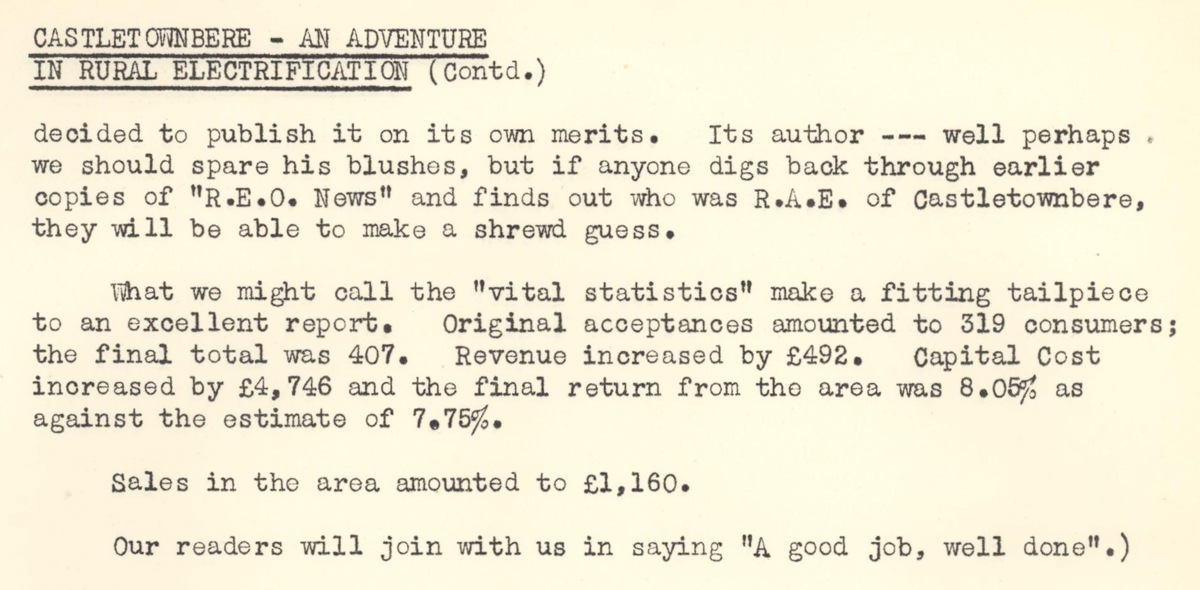 This digital scan from the REO News displays the following text:
"CASTLETOWNBERE – AN ADVENTURE IN RURAL ELECTRIFICATION (Contd.): decided to publish it on its own merits. Its author — well perhaps we should spare his blushes, but if anyone digs back through earlier copies of “R.E.O. News” and finds out who was R.A.E. of Castletownbere, they will be able to make a shrewd guess.
What we might call the “vital statistics” make a fitting tailpiece to an excellent report. Original acceptances amounted to 319 consumers; the final total was 407. Revenue increased by £492. Capital Cost increased by £4,746 and the final return from the area was 8.05% as against the estimate of 7.75%.
Sales in the area amounted to £1,160.
Our readers will join with us in saying “A good job, well done.”)