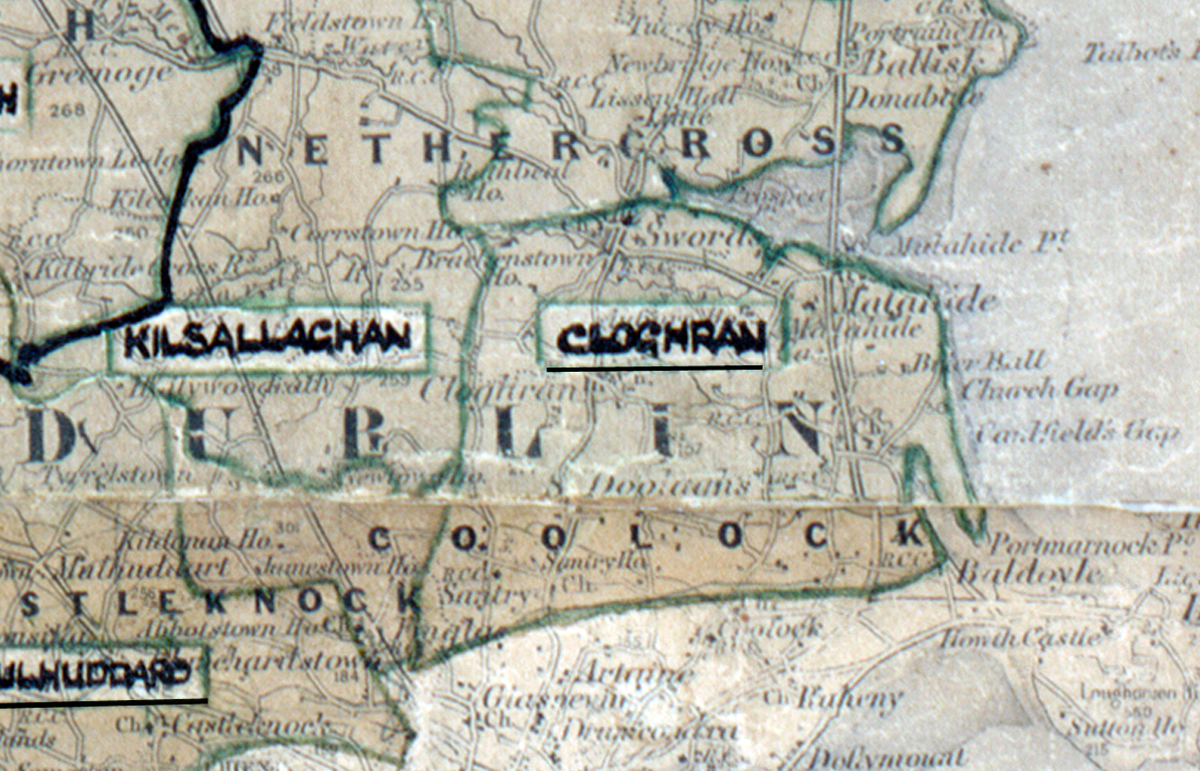
 Area: Cloghran
Started: August 1950
Finished: May 1951
Poles used: 512
Line used (km): 41
Premises connected: 185
The figures above were sourced from our REO News magazine, to learn more about what these figures mean, visit our interactive map. The map above shows the area boundary and is from a digitised version of the original map used during the scheme.
The REO News from June 1951 tells us that there was little opportunity for sales in Cloghran.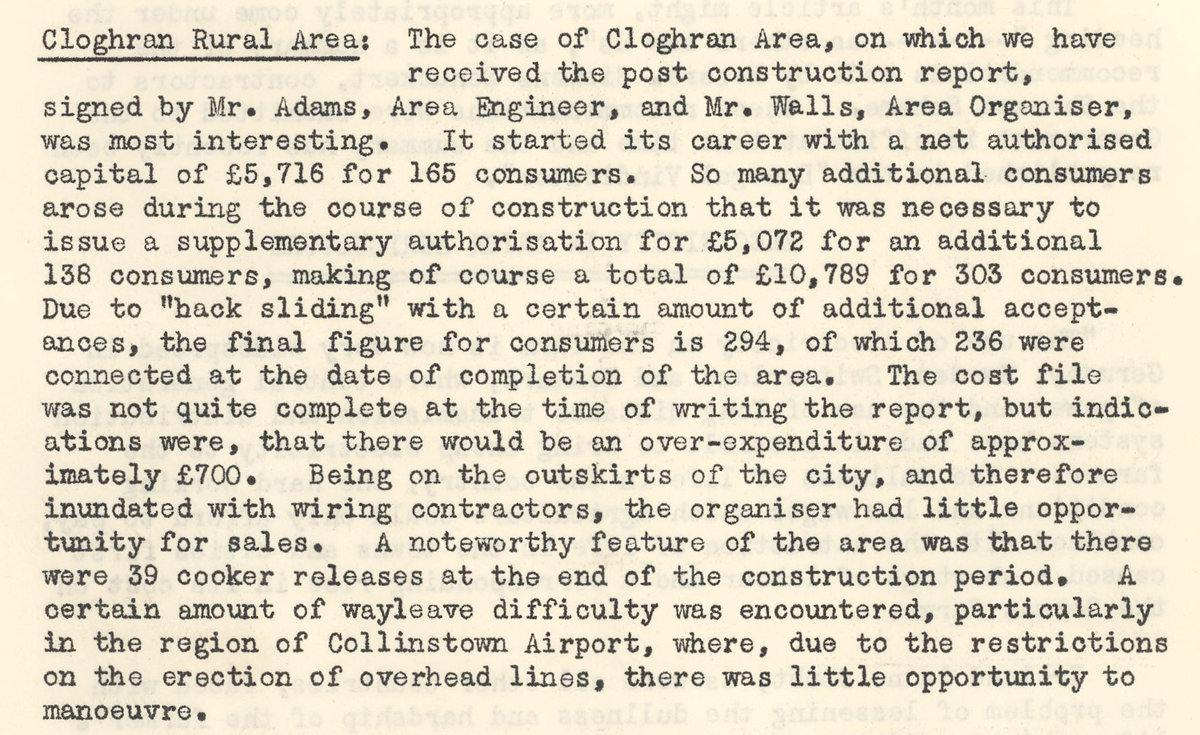 This digital scan from the REO news displays the following text:
"Cloghran Rural Area: The case of Cloghran Area, on which we have received the post construction report, signed by Mr. Adams, Area Engineer, and Mr. Wells, Area Organiser, was most interesting.
It started its career with an authorised capital of £5,716 for 165 consumers. So many additional consumers arose during the course of construction that it was necessary to issue a supplementary authorisation for £5,072 for an additional 138 consumers, making of course a total of £10,789 for 303 consumers.
Due to “back sliding” with a certain amount of additional acceptances, the final figure for consumers is 294, of which 236 were connected at the date of completion of the area. The cost file was not quite complete at the time of writing the report, but indications were that there would be an over-expenditure of approximately £700.
Being on the outskirts of the city, and therefore inundated with wiring contractors, the organiser had little opportunity for sales. A noteworthy feature of the area was that there were 39 cooker releases at the end of the construction period. A certain amount of wayleave difficulty was encountered, particularly in the region of Collinstown Airport, where, due to the restrictions on the erection of overhead lines, there was little opportunity to manoeuvre."
The Wad Farm in Cloghran was featured in The REO News from August 1953.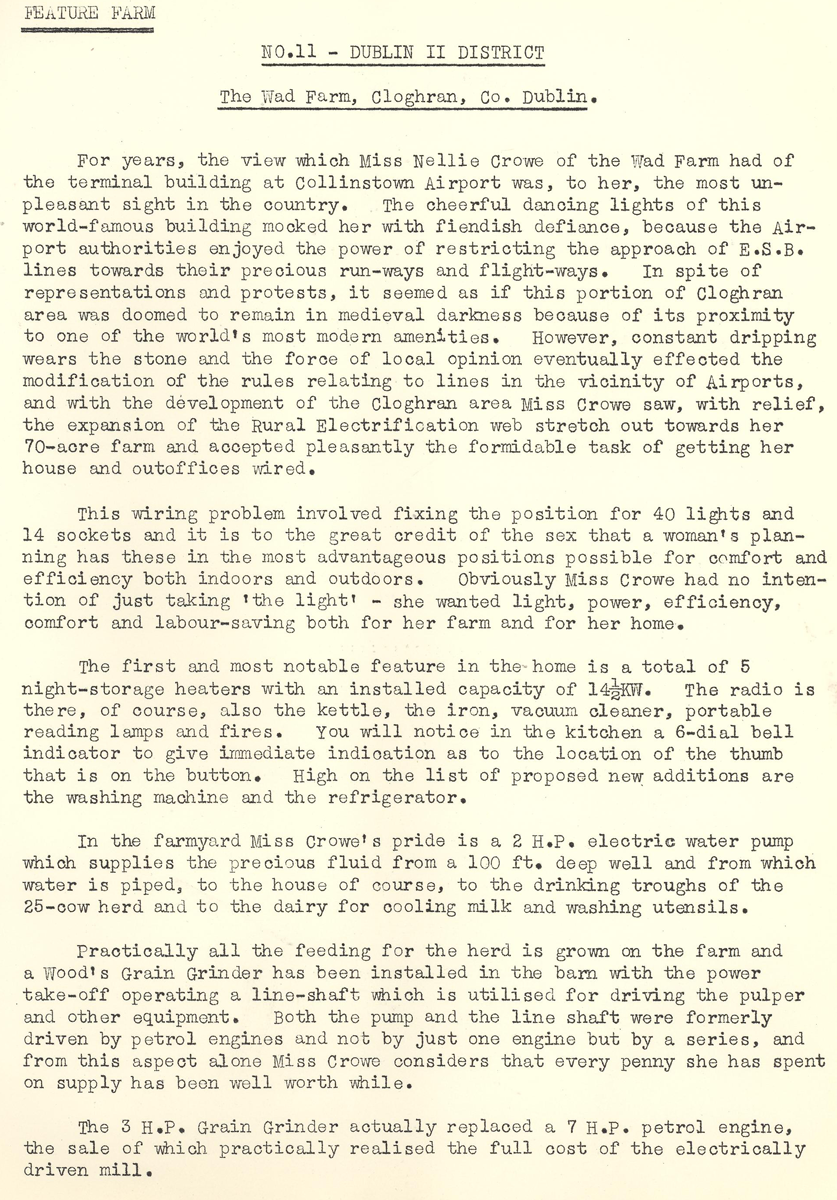
 This digital scan from the REO news displays the following text:
"FEATURE FARM
No. 11 – DUBLIN II DISTRICT
The Wad Farm, Cloghran, Co. Dublin.
For years, the view which Miss Nellie Crowe of the Wad Farm had of the terminal building at Collinstown Airport was, to her, the most unpleasant sight in the country. The cheerful dancing lights of this world‑famous building mocked her who at Flewth distance, because the Airport authorities enjoyed the power of restricting the approach of E.S.B. lines towards their precious run‑ways and flight‑ways. In spite of representations and protests, it seemed as if this portion of Cloghran area was doomed to remain in medieval darkness because of its proximity to one of the world’s most modern amenities. However, constant dripping wears the stone and the force of local opinion eventually effected the modification of the rules relating to lines in the vicinity of airports, and with the development of the Cloghran Area Miss Crowe saw, with relief, the expansion of the rural electrification web stretch out towards her 70‑acre farm and accepted pleasantly the formidable task of getting her house and outoffices wired.
This wiring problem involved fixing the position for 40 lights and 14 sockets and it is to the great credit of those who had a woman’s planning as these in the most advantageous position possible for comfort and efficiency both indoors and outdoors. Obviously Miss Crowe had no intention of “just taking the light”; she wanted light, power, efficiency, comfort and labour‑saving both for her farm and for her home.
The first and most notable feature in the home is a total of 5 night‑storage heaters with an installed capacity of 14½ kW. The radio is an E.S.B. radio. She has, besides, a vacuum cleaner, portable warming lamps and fires. You will note in the kitchen a 6‑dial bell indicator to give immediate indication as to the location of the servants in the house at any time. In this respect of proposed new additions are the washing machine and the refrigerators.
In the farmyard Miss Crowe’s pride is a 2 H.P. electric water pump which supplies the pressure of the water to the well and from which 25‑w.p. is piped to the house of course, to the drinking troughs of the 25‑cow herd and to the dairy for cooling milk and washing utensils.
Practically all the feeding for the herd is grown on the farm and a Wood’s Grain Grinder has been installed in the barn with the power take‑off of the tractor. This is used as a flat belt for driving the pulper and grain mortars. Both the grinder and the pulper were formerly driven by the small Lister engines which were in no way comparable to the cleaner and efficiency of the electric power and the many hours she has spent at the grinder speak for themselves.
The 3 H.P. Grain Grinder actually replaced a 7 H.P. petrol engine, the sale of which practically realised the full cost of the electrically driven mill."
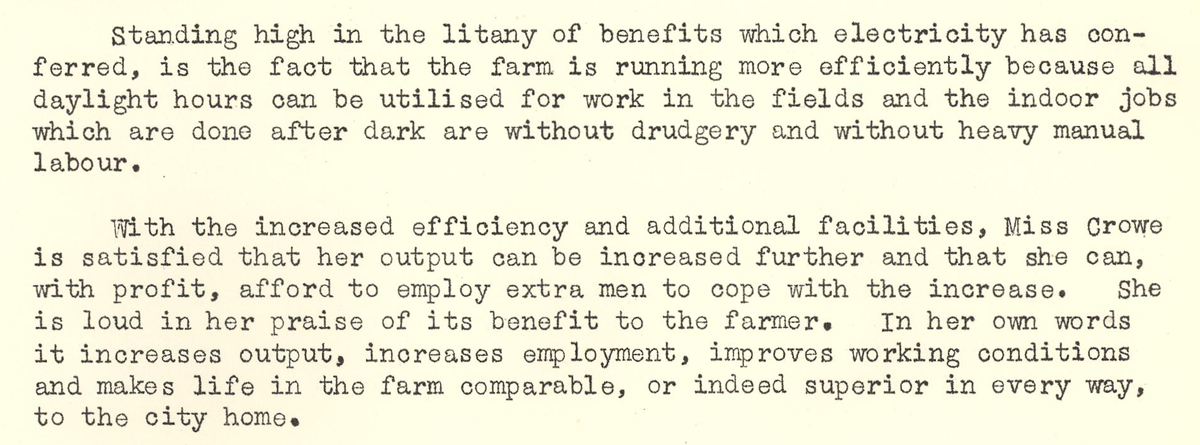
"Standing high in the litany of benefits which electricity has conferred, is the fact that the farm is running more efficiently because all daylight hours can be utilised for work in the fields and the indoor jobs which are done after dark are without drudgery and without heavy manual labour.
With the increased efficiency and additional facilities, Miss Crowe is satisfied that her output can be increased further and that she can, with profit, afford to employ extra men to cope with the increase. She is loud in her praise of its benefit to the farmer. In her own words it increases output, increases employment, improves working conditions and makes life in the farm comparable, or indeed superior in every way, to the city home."