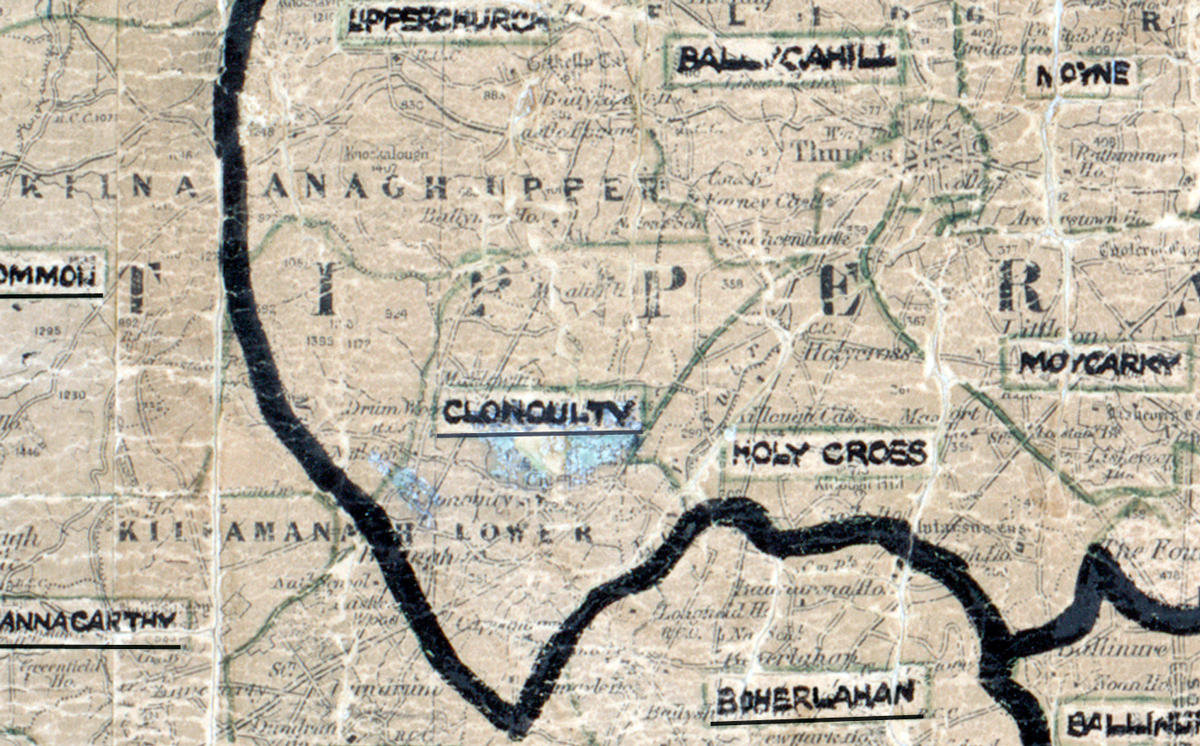
 Area: Clonoulty
Started: January 1953
Finished: April 1954
Poles used: 1646
Line used (km): 152
Premises connected: 451
The figures above were sourced from our REO News magazine, to learn more about what these figures mean, visit our interactive map. The map above shows the area boundary and is from a digitised version of the original map used during the scheme.
The REO News from May 1954 reports that cattle, greyhounds and hurling were popular in Clonoulty.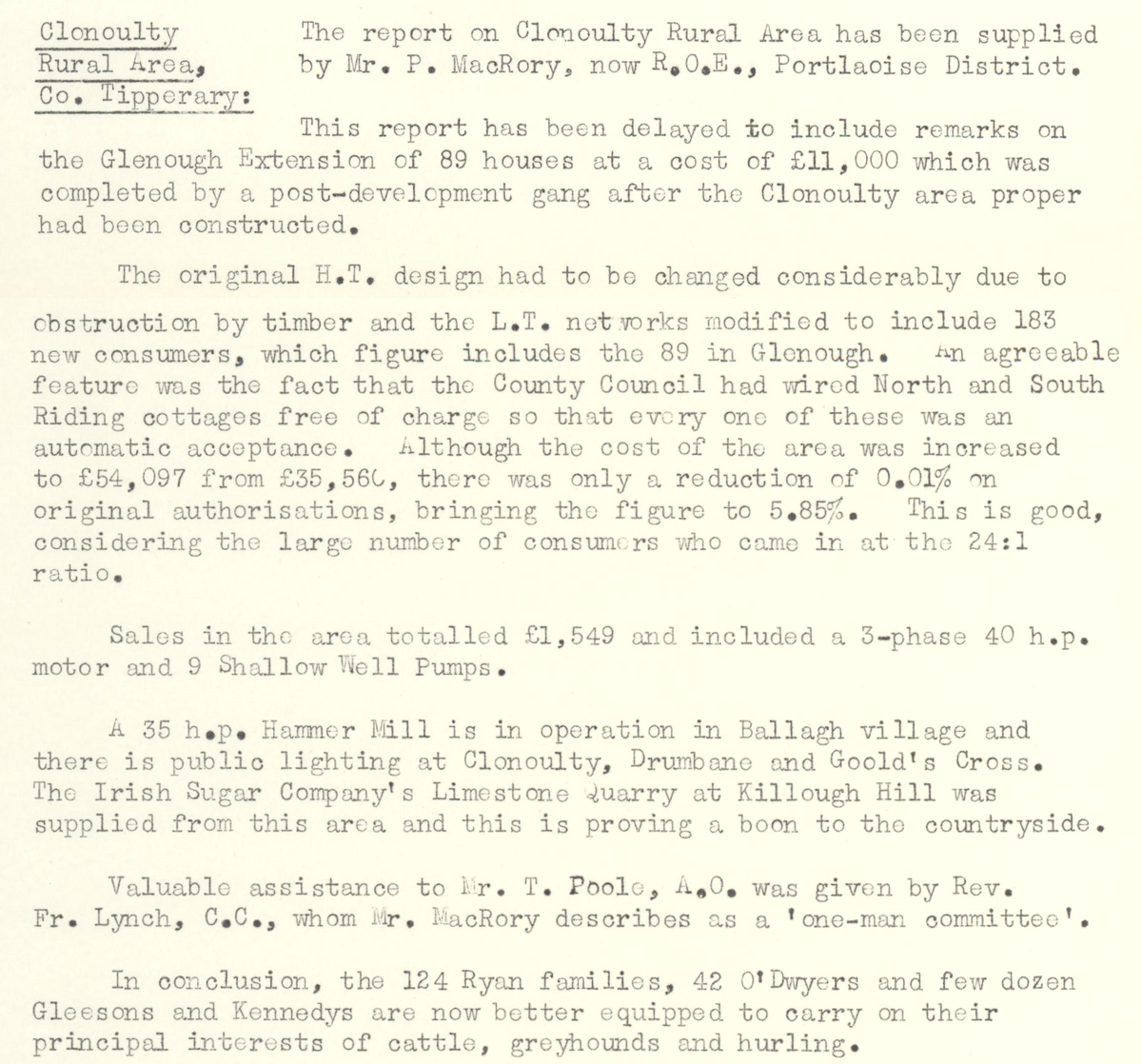 This digital scan from the REO News displays the following text:
“Clonoulty Rural Area, Co. Tipperary: The report on Clonoulty Rural Area has been supplied by Mr. P. MacRory, now R.O.E., Portlaoise District.
This report has been delayed to include remarks on the Glenough Extension of 89 houses at a cost of £11,000 which was completed by a post‑development gang after the Clonoulty area proper had been constructed.
The original H.T. design had to be changed considerably due to obstruction by timber and the L.T. networks modified to include 183 new consumers, which figure includes the 89 in Glenough. An agreeable feature was the fact that the County Council had wired North and South Riding cottages free of charge so that every one of these was an automatic acceptance. Although the cost of the area was increased to £54,097 from £35,566, there was only a reduction of 0.01% on original authorisations, bringing the figure to 5.85%. This is good, considering the large number of consumers who came in at the 24:1 ratio.
Sales in the area totalled £1,549 and included a 3‑phase 40 h.p. motor and 9 Shallow Well Pumps.
A 35 h.p. Hammer Mill is in operation in Ballagh village and there is public lighting at Clonoulty, Drumdane and Gould’s Cross. The Irish Sugar Company’s Limestone Quarry at Killough Hill was supplied from this area and this in turn is proving a boon to the countryside.
Valuable assistance to Mr. T. Poole, A.O., was given by Rev. Fr. Lynch, C.C., whom Mr. MacRory describes as a ‘one‑man committee’.
In conclusion, the 124 Ryan families, 42 O’Dwyers and few dozen Gleesons and Kennedys are now better equipped to carry on their inherited industries of cattle, greyhounds and hurling.”