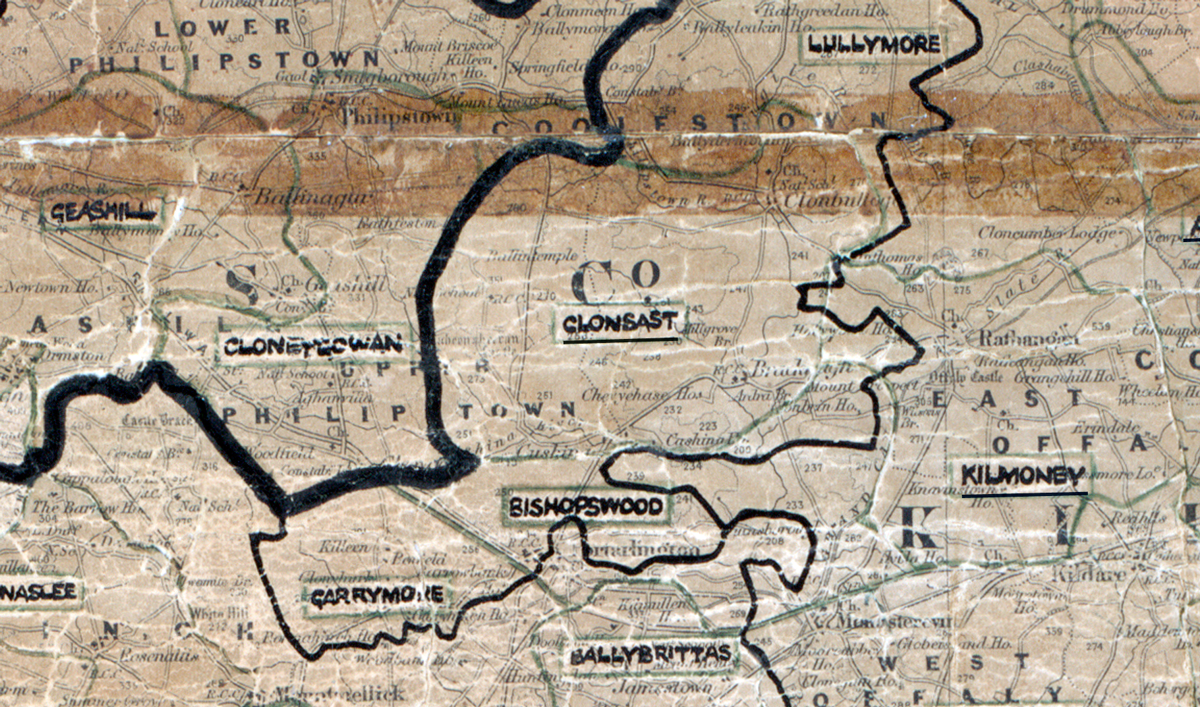
 Area: Clonsast
Started: October 1952
Finished: June 1953
Poles used: 707
Line used (km): 64
Premises connected: 178
The figures above were sourced from our REO News magazine, to learn more about what these figures mean, visit our interactive map. The map above shows the area boundary and is from a digitised version of the original map used during the scheme.
Silt caused a problem in Clonsast as reported in The REO News from August 1953.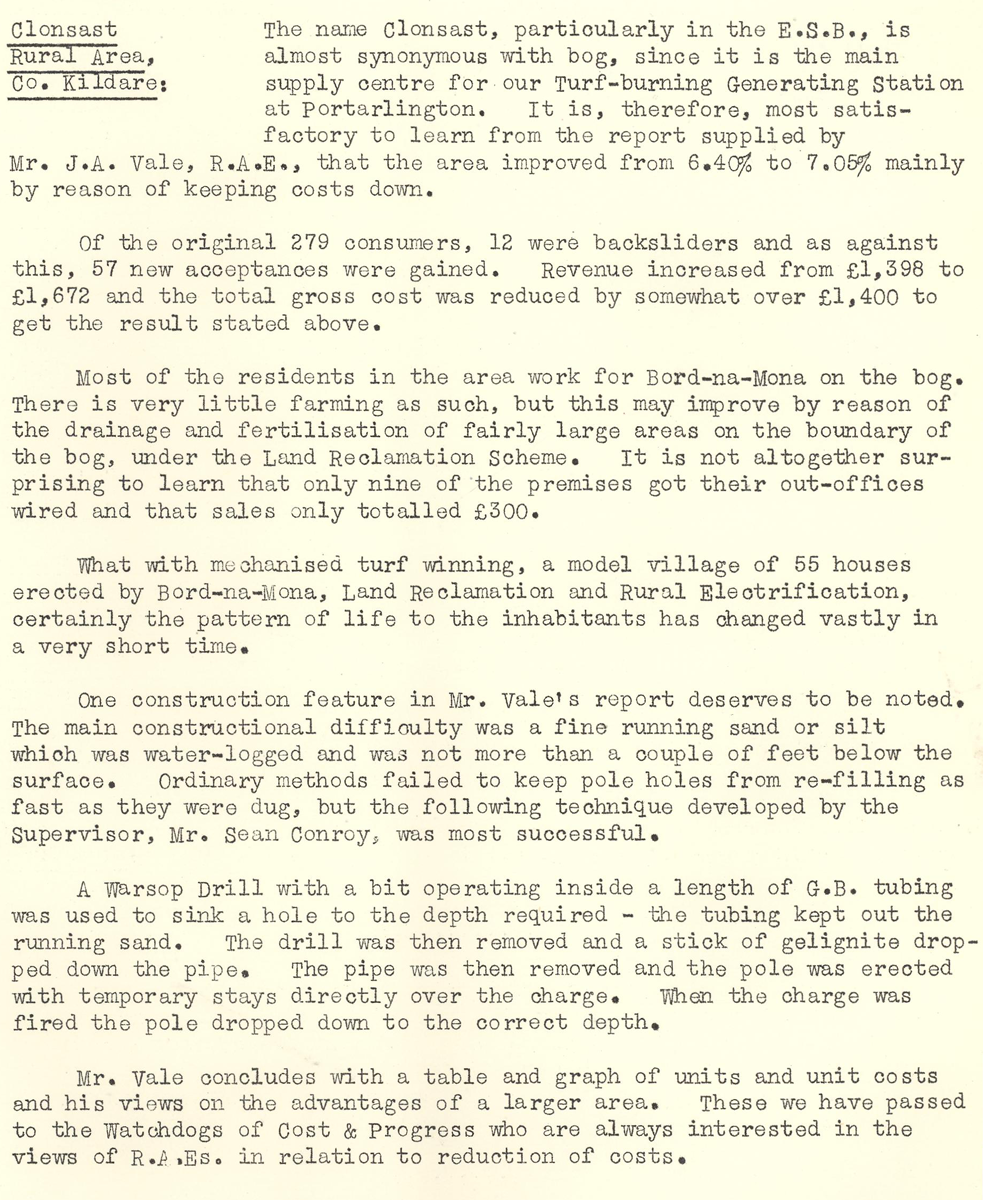 This digital scan from the REO News displays the following text:
"Clonsast Rural Area, Co. Kildare: The name Clonsast, particularly in the E.S.B., is almost synonymous with bog, since it is the main supply centre for our turf‑burning Generating Station at Portarlington. It is, therefore, most satisfactory to learn from the report supplied by Mr. J.A. Vale, R.A.E., that the area improved from 6.46% to 7.05% mainly by reason of keeping costs down.
Of the original 279 consumers, 12 were backsliders and as against this, 57 new acceptances were gained. Revenue increased from £1,398 to £1,672 and the total gross cost was reduced by somewhat over £1,400 to get the result stated above.
Most of the residents in the area work for Bord‑na‑Móna on the bog. There is very little farming as such, but this may improve by reason of the drainage and fertilisation of fairly large areas on the boundary of the bog, under the Land Reclamation Scheme. It is not altogether surprising to learn that only nine of the premises got their out‑offices wired and that sales only totalled £300.
What with mechanised turf winning, a model village of 55 houses erected by Bord‑na‑Móna, Land Reclamation and Rural Electrification, certainly the pattern of life to the inhabitants has changed vastly in a very short time.
One construction feature in Mr. Vale’s report deserves to be noted. The main constructional difficulty was a fine running sand or silt which was water‑logged and was not more than a couple of feet below the surface. Ordinary methods failed to keep pole holes from re‑filling as fast as they were dug, but the following technique developed by the Supervisor, Mr. Sean Conroy, was most successful:
A Warsop Drill with a bit projecting a short distance inside a length of G.B. tubing was used. A hole to the depth required was drilled, the tubing kept in position by its own weight. The drill was then removed and the foot of the gelling strut was tamped. The tubing was withdrawn at the same time, while the men dealt with down‑dragging of the struts as the charge was run. When the charge was fired, the approaches of the holes were cleared.
Mr. Vale concludes with a table and graph of units and unit costs and his views on the work, which are those of a larger area. These have been passed to Head Office and will be considered as a valuable interpretation of the views of R.A.E.s in relation to reduction of costs."