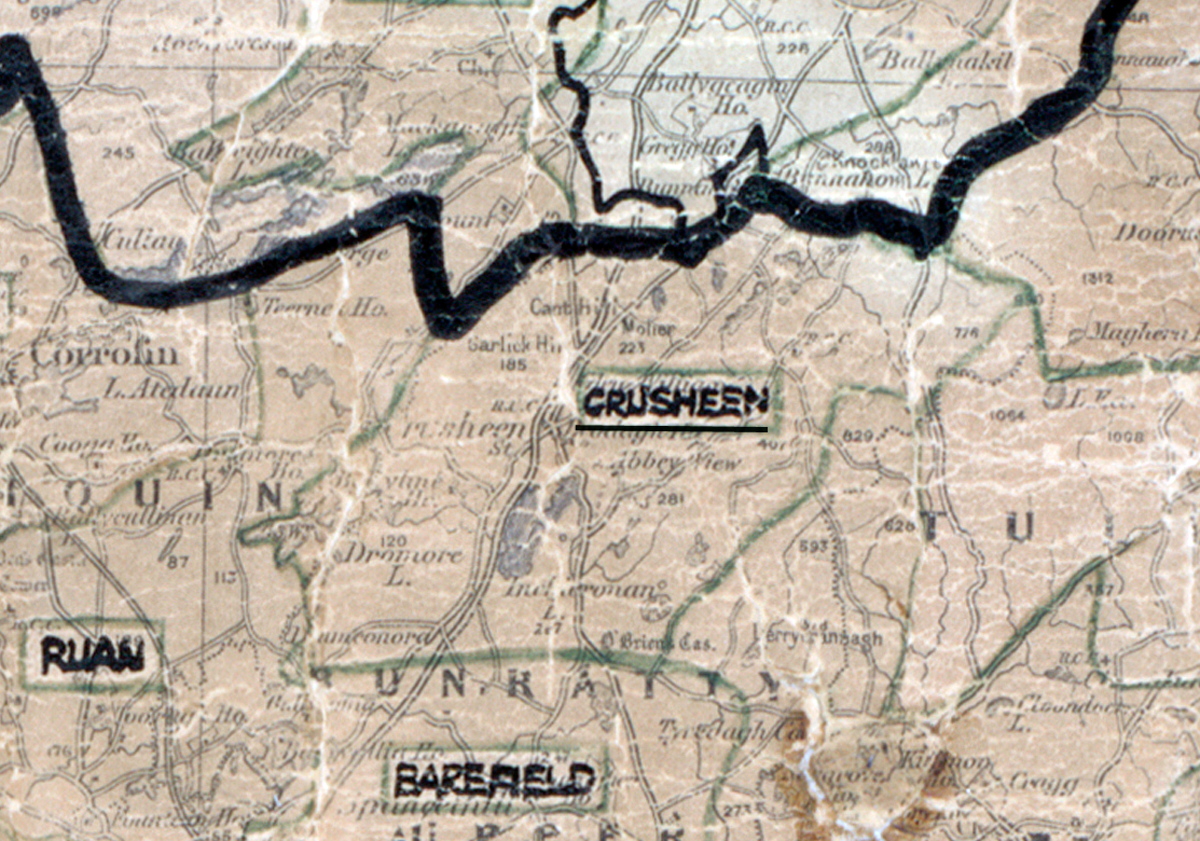
 Area: Crusheen
Started: December 1959
Finished: May 1960
Poles used: 778
Line used (km): 65
Premises connected: 182
The figures above were sourced from our REO News magazine, to learn more about what these figures mean, visit our interactive map. The map above shows the area boundary and is from a digitised version of the original map used during the scheme.
The REO News from March 1960 featured a report on a group water scheme in Crusheen.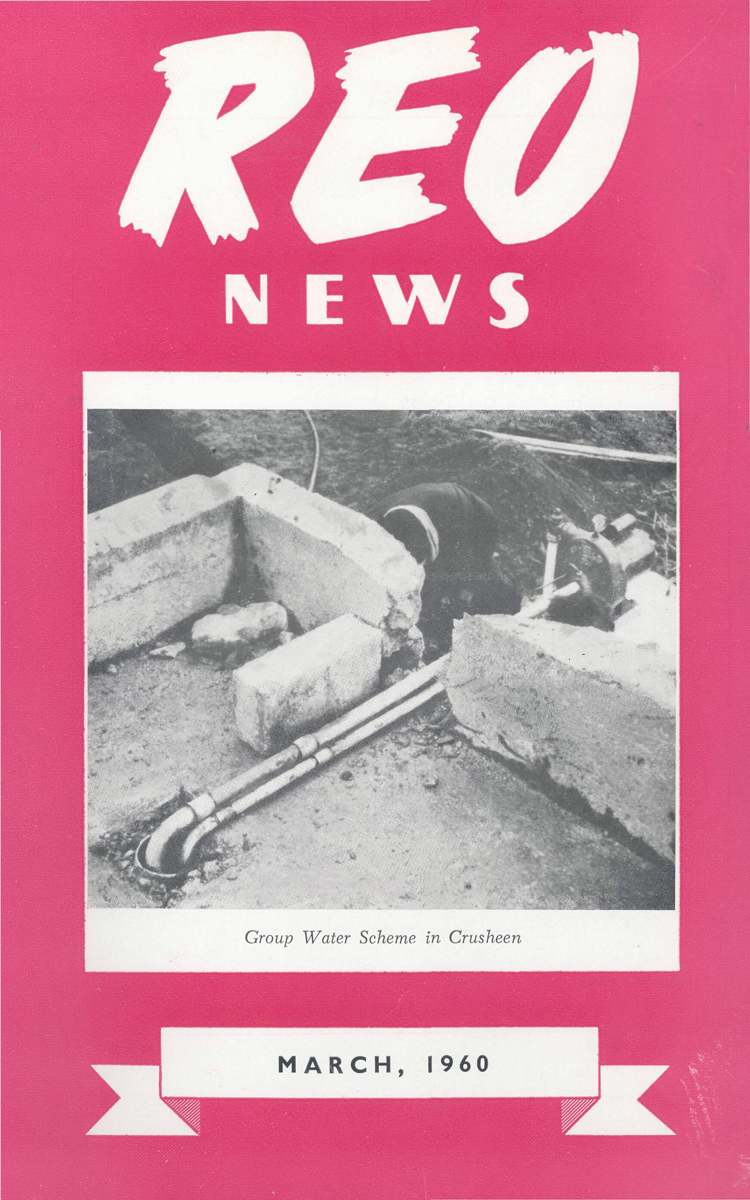
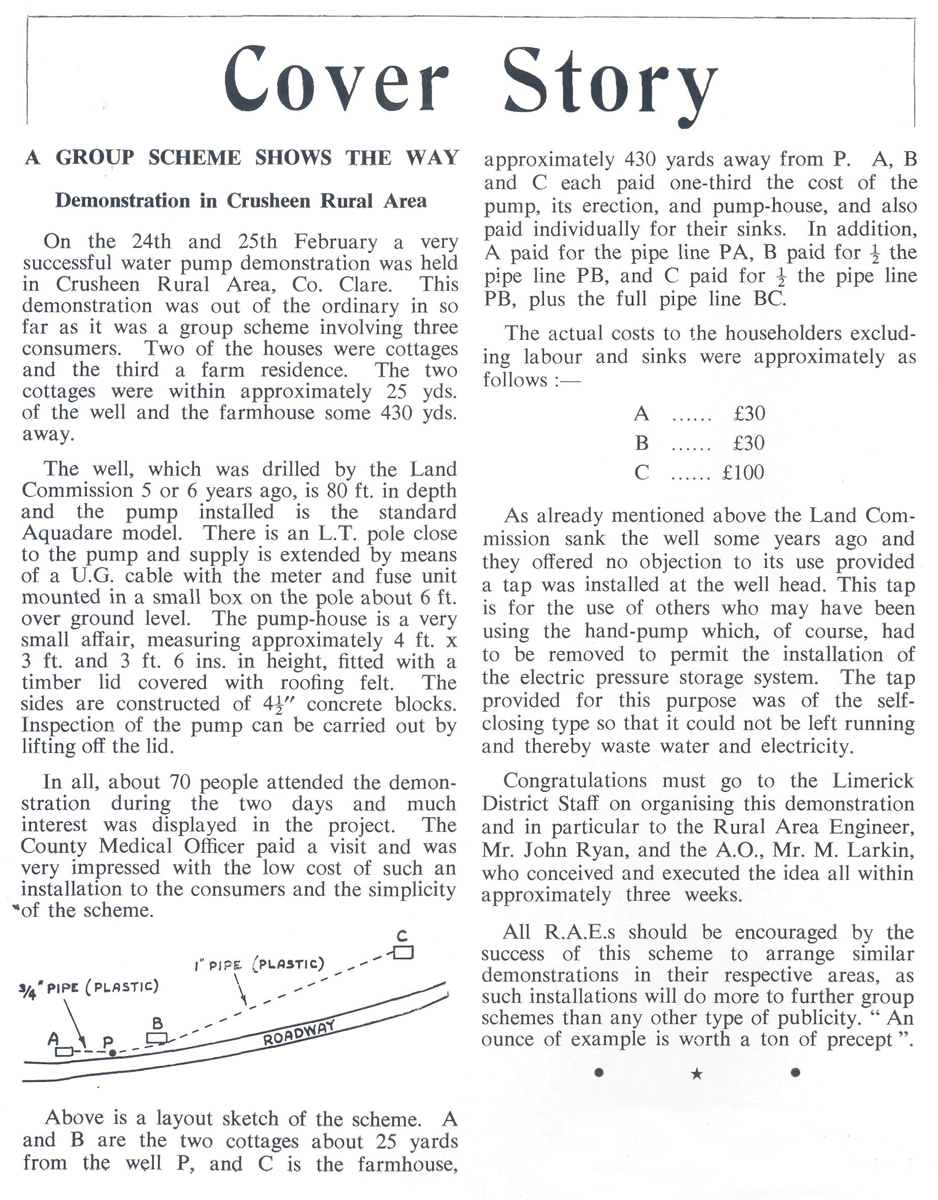 This digital scan from the REO News displays the following text:
“Cover Story: A GROUP SCHEME SHOWS THE WAY — Demonstration in Crusheen Rural Area
On the 24th and 25th February a very successful water pump demonstration was held in Crusheen Rural Area, Co. Clare. This demonstration was out of the ordinary in so far as it was a group scheme involving three consumers. Two of the houses were cottages and the third a farm residence. The two cottages were within approximately 25 yds. of the well and the farmhouse some 430 yds. away.
The well, which was drilled by the Land Commission 5 or 6 years ago, is 80 ft. in depth and the pump installed is the standard Aquadare model. There is an L.T. pole close to the pump and supply is extended by means of a U.G. cable with the meter and fuse unit mounted in a small box on the pole about 6 ft. over ground level. The pump‑house is a very small affair, measuring approximately 4 ft. x 3 ft. and 3 ft. 6 ins. in height, fitted with a timber lid covered with roofing felt. The sides are constructed of 4½” concrete blocks. Inspection of the pump can be carried out by lifting off the lid.
In all, about 70 people attended the demonstration during the two days and much interest was displayed in the project. The County Medical Officer paid a visit and was very impressed with the low cost of such an installation to the consumers and the simplicity of the scheme.
Above is a layout sketch of the scheme. A and B are the two cottages about 25 yards from the well P, and C is the farmhouse, approximately 430 yards away from P. A, B and C each paid one‑third the cost of the pump, its erection, and pump‑house, and also paid individually for their sinks. In addition, A paid for the pipe line PA, B paid for ½ the pipe line PB, and C paid for ½ the pipe line PB, plus the full pipe line BC.
The actual costs to the householders excluding labour and sinks were approximately as follows:—
A …… £30
B …… £30
C …… £100
As already mentioned above the Land Commission sank the well some years ago and they offered no objection to its use provided a tap was installed at the well head. This tap is for the use of others who may have been using the hand‑pump which, of course, had to be removed to permit the installation of the electric pressure storage system. The tap provided for this purpose was of the self‑closing type so that it could not be left running and thereby waste water and electricity.
Congratulations must go to the Limerick District Staff for organising this demonstration and in particular to the Rural Area Engineer, Mr. John Ryan, and the A.O., Mr. M. Larkin, who conceived and executed the idea all within approximately three weeks.
All R.A.E.s should be encouraged by the success of this scheme to arrange similar demonstrations in their respective areas, as such installations will do more to further group schemes than any other type of publicity. ‘An ounce of example is worth a ton of precept’.”