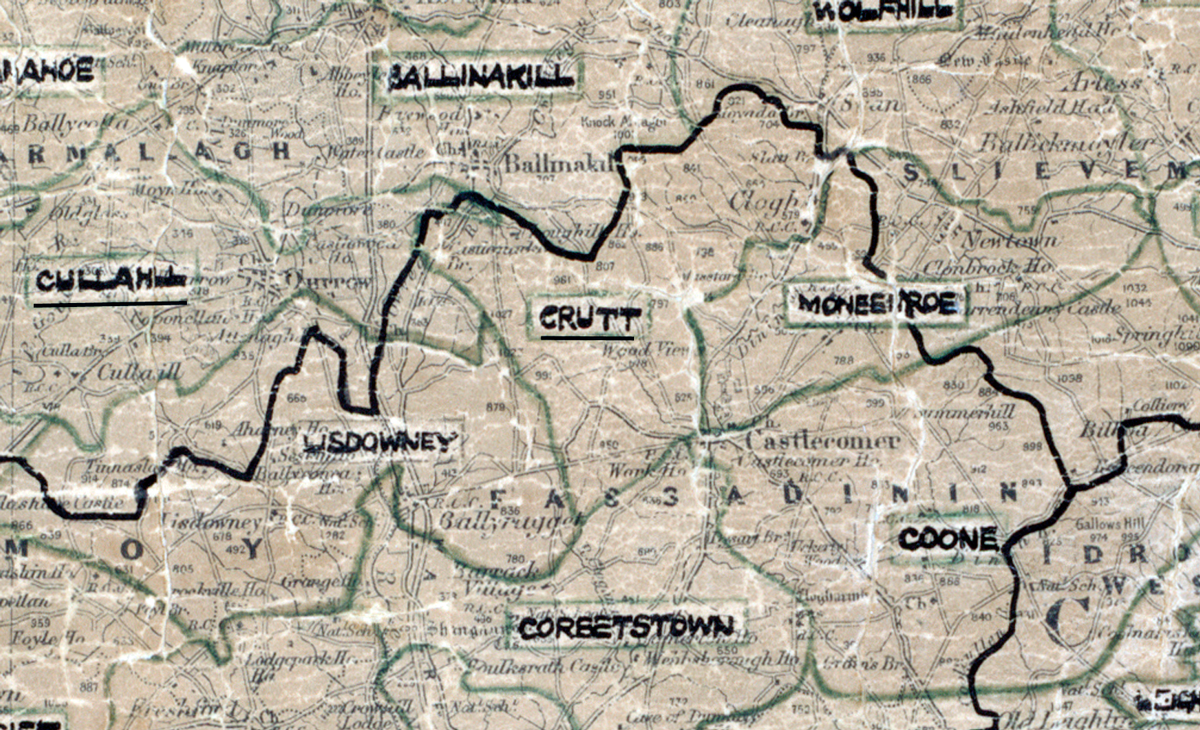
 Area: Crutt
Started: April 1959
Finished: November 1959
Poles used: 513
Line used (km): 46
Premises connected: 93
The figures above were sourced from our REO News magazine, to learn more about what these figures mean, visit our interactive map. The map above shows the area boundary and is from a digitised version of the original map used during the scheme.
The REO News from August 1959 reports on a trip to Crutt.
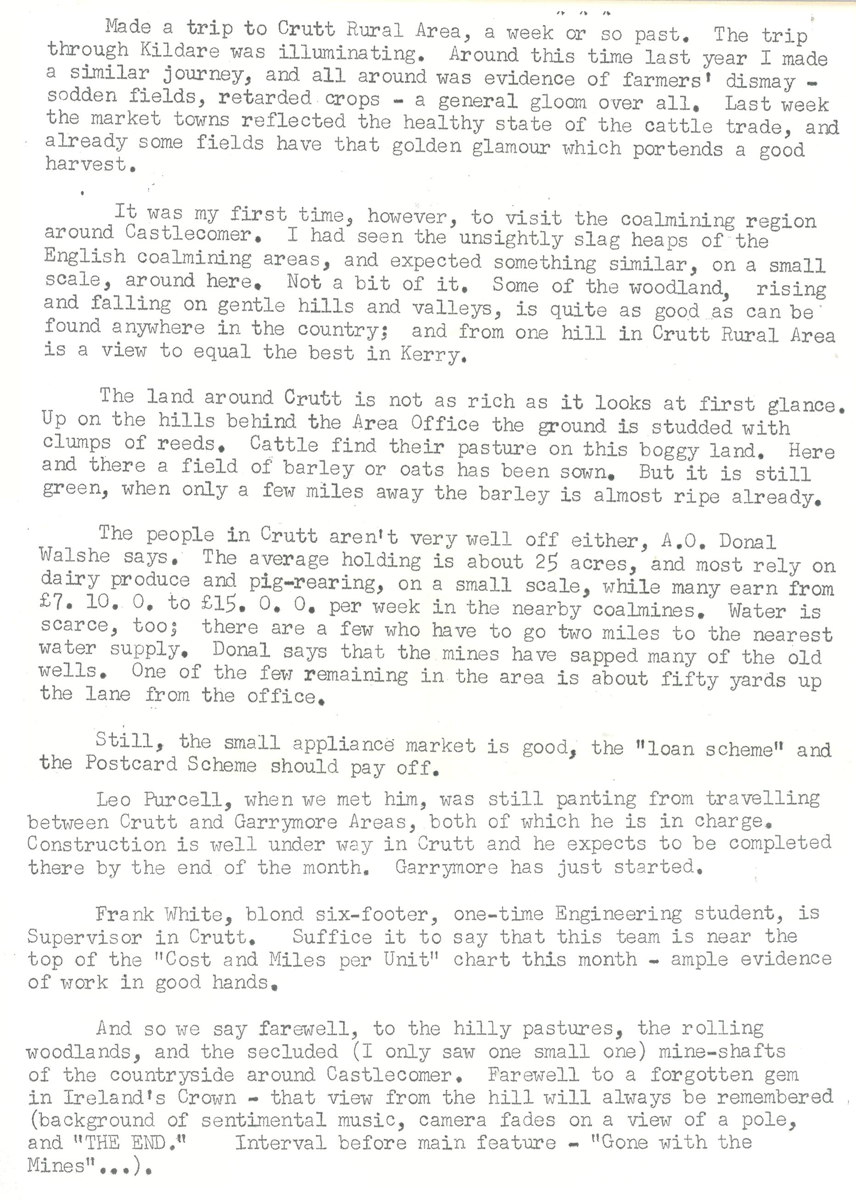 This digital scan from the REO News displays the following text:
“Crutt Rural Area, Co. Mayo: Made a trip to Crutt Rural Area, a week or so past. The trip through Kildare was illuminating. Around this time last year I made a similar journey, and all around was evidence of farmers’ dismay – sodden fields, retarded crops – a general gloom over all. At least the market towns reflected the healthy state of the cattle trade, and, strangely, some fields have that golden glamour which portends a good harvest.
It was my first time, however, to visit the coalmining region around Castlecomer. I had seen the unsightly slag heaps of the English coalmining areas, and expected something similar on a small scale around here. Not a bit of it. Some of the woodland, rising and falling on gentle hills and valleys, is just as good as can be found anywhere in the country; and from one hill in Crutt Rural Area is a view to equal the best in Kerry.
The land around Crutt is not as rich as it looks at first glance. Up on the hills behind the Area Office the ground is studded with clumps of reeds. Cattle find their pasture on this bog land. Here and there a field of barley or oats has been sown, but it is still green, while only a few miles away the barley is almost ripe already.
The people in Crutt aren’t very well off on the whole; A.O. Donal Walsh says so. The average holding is about 25 acres, and most rely on dairy produce and pig‑rearing on a small scale, making from £7.10.0. to £15.0.0. per week in the nearby coalmines. Water is scarce, too; there are a few who have to go two miles to the nearest water supply. On the other hand Mr. Walsh has tapped what may be one of the best wells in the area. One of the few remaining in the area is about fifty yards up the lane from the Office.
Still, the small appliances market is good; the ‘loan scheme’ and the Postcard Scheme may yet pay off.
Leo Pursell, when we met him, was still panting from travelling between Crutt and Garrymore Areas, both of which he is in charge of. Construction is well under way in Crutt and he expects to be completed within a few months. Garrymore has been finished.
Frank White, blond six‑footer, one‑time Engineering student, is Supervisor in Crutt. Suffice it to say that this team has one of the top ‘Cost and Miles per Unit’ charts this month – ample evidence of work in good hands.
And so we say farewell, to the hilly pastures, the rolling woodlands and the secluded (I only saw one) mine‑shaft as the countryside around Castlecomer. Farewell to a region green in Ireland’s Green map. Farewell. The final area will always be remembered, (background of sentimental music, camera fades on a row of poles, and THE END.) Interval before main feature – ‘Gone with the Mines!’…”