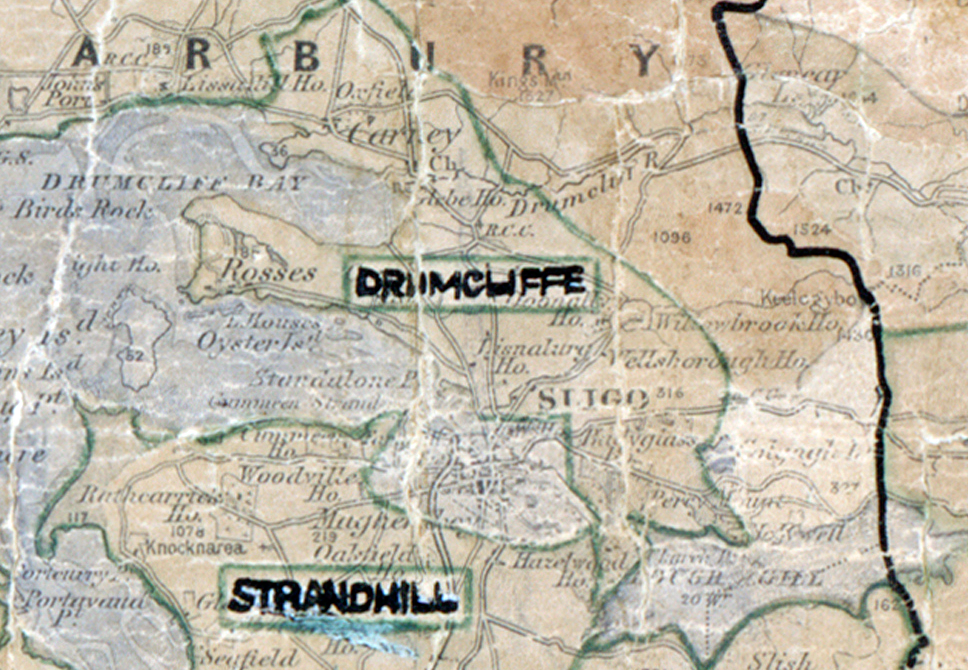
 Area: Drumcliffe
Started: August 1948
Finished: August 1949
Poles used: 680
Line used (km): 56
Premises connected: 65
The figures above were sourced from our REO News magazine, to learn more about what these figures mean, visit our interactive map. The map above shows the area boundary and is from a digitised version of the original map used during the scheme.
An article in The REO News from May 1949 talks about the timing and benefits of a demonstration especially in Drumcliffe.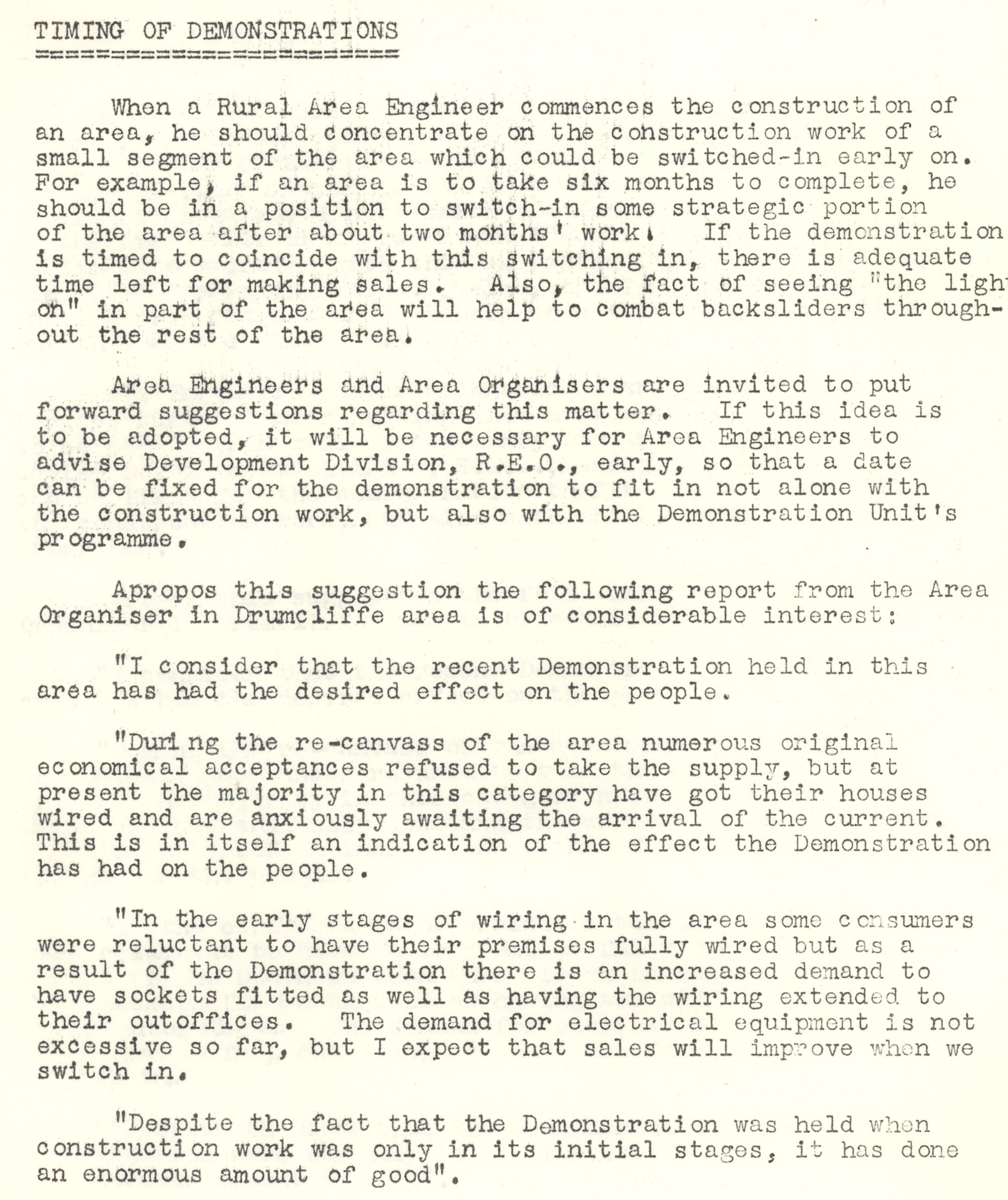 This digital scan from the REO News displays the following text:
"TIMING OF DEMONSTRATIONS
When a Rural Area Engineer commences the construction of an area, he should concentrate on the construction work of a small segment of the area which could be “switched‑in” early on. For example, if an area is to take six months to complete, he should be in a position to switch‑in some strategic portion of the area after about two months’ work. If the demonstration is timed to coincide with this switching in, there is adequate time left for making sales. Also, the fact of seeing “the light on” in part of the area will help to combat backsliders throughout the rest of the area.
Area Engineers and Area Organisers are invited to put forward suggestions regarding this matter. If this idea is to be adopted, it will be necessary for Area Engineers to advise Development Division, R.E.O., early, so that a date can be fixed for the demonstration to fit in not alone with the construction work, but also with the Demonstration Unit’s programme.
Apropos this suggestion the following report from the Area Organiser in Drumcliffe area is of considerable interest:
“I consider that the recent Demonstration held in this area has had the desired effect on the people.
“During the re‑canvass of the area numerous original economic acceptances refused to take the supply, but at present the acceptances in this category have got their houses wired and are anxiously awaiting the arrival of the current. This is in itself an indication of the effect the Demonstration has had on the people.
“In the early stages of wiring in the area some consumers were reluctant to have their premises fully wired but the results of the Demonstration in this area have increased the number of houses fitted as well as having the wiring extended to out‑offices. Outstanding orders for irons, kettles, etc., are in excess so far, but I expect that sales will improve now.”
“Despite the fact that the Demonstration was held when construction work was only in its initial stages, it has done an enormous amount of good.”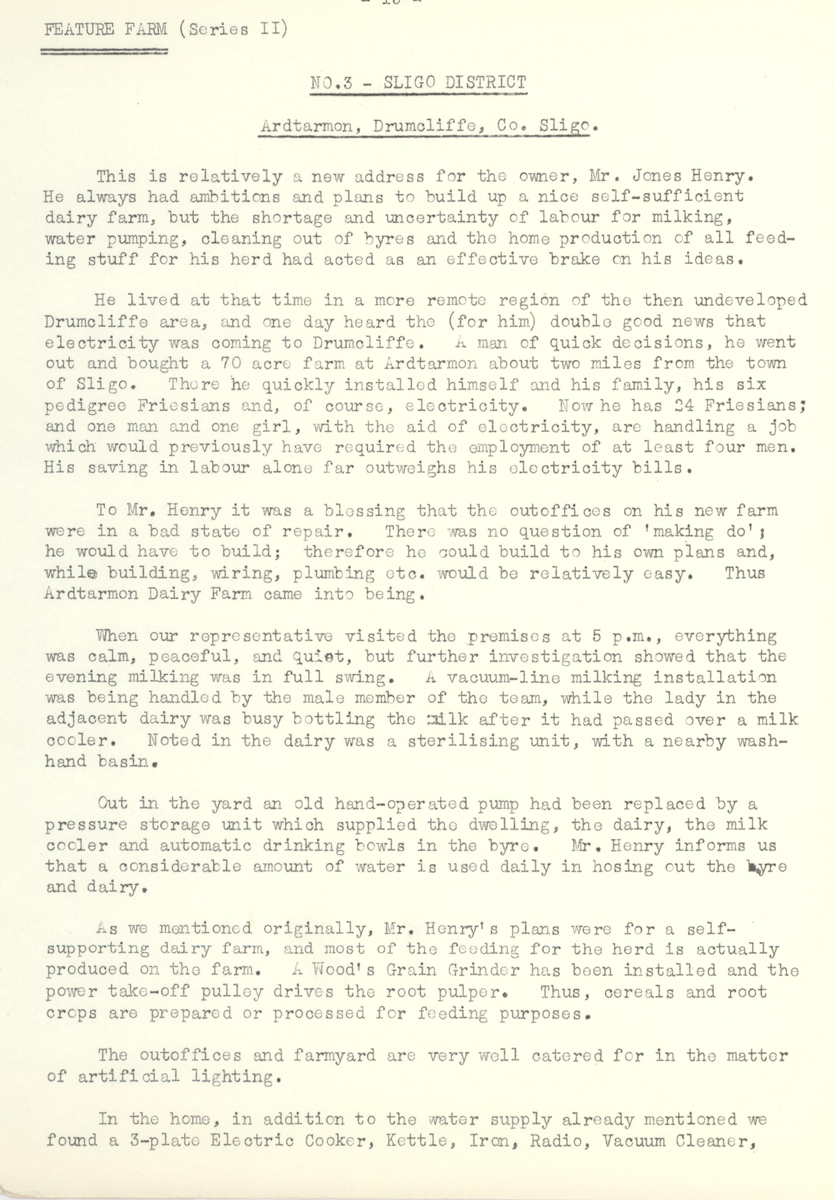 This digital scan from the REO News displays the following text:
"FEATURE FARM (Series II)
No. 3 – SLIGO DISTRICT Ardtarmon, Drumcliffe, Co. Sligo: This is relatively a new address for the owner, Mr. Jones Henry. He always had ambitions and plans to build up a nice self‑sufficient dairy farm, but the shortage and uncertainty of labour for milking, water pumping, cleaning out of byres and the home production of all feeding stuff for his herd acted as an effective brake on his ideas.
He lived at that time in a more remote region of the then undeveloped Drumcliffe area, and one day heard the (for him) doubly good news that electricity was coming to Drumcliffe. A man of quick decisions, he went out and bought a 70 acre farm at Ardtarmon about two miles from the town of Sligo. There he quickly installed himself and his family, his six pedigree Friesians and, of course, electricity. Now he has 24 Friesians; and one man and one girl, with the aid of electricity, are handling a job which would previously have required the employment of at least four men. His saving in labour alone far outweighs his electricity bills.
To Mr. Henry it was a blessing that the out‑offices on his new farm were in a bad state of repair. There was no question of “making do”; he would have to build; therefore he could build to his own plans, and all building, wiring, plumbing etc. would be relatively easy. Thus Ardtarmon Dairy Farm came into being.
When our representative visited the premises at 5 p.m., everything was calm, peaceful, and quiet, but further investigation showed that the evening milking was in full swing. A vacuum‑line milking installation was being handled by the male member of the team while the girl in the adjacent dairy was cleaning the milk‑tank after it had passed through a milk cooler. Noted in the dairy was a sterilising unit, with a nearby wash‑hand basin.
Out in the yard an old hand‑operated pump had been replaced by a pressure storage pump which provided the house, the dairy, the milk cooler and automatic drinking bowls in the byre. Mr. Henry informs us that a considerable amount of water is used daily in his home, the byre and dairy."
As we mentioned originally, Mr. Henry’s plans were for a self‑supporting dairy farm, and most of the feeding for the herd is actually produced on the farm itself. A Grain Grinder has been installed and power take‑off pulley is used to root‑pulp. Thus, cereals and root crops are prepared or processed for feeding purposes.
The out‑offices and farmyard are very well catered for in the matter of artificial lighting.
In the home, in addition to the water supply already mentioned we found a 3‑plate Electric Cooker, Kettle, Iron, Radio, Vacuum Cleaner, ..." This digital scan from the REO News displays the following text:
"FEATURE FARM (Contd.)
Washing Machine and two Electric Fires. Here also an Immersion Group has been installed to supply the hot water needs of the household and of the dairy.
It is scarcely necessary to say, in conclusion, that Mr. Henry is more than pleased to have been able to realise his ambitions and that he has no doubts whatever of the value of electricity, with a very real appreciation of what the Scheme has done to make his dairy farm possible."