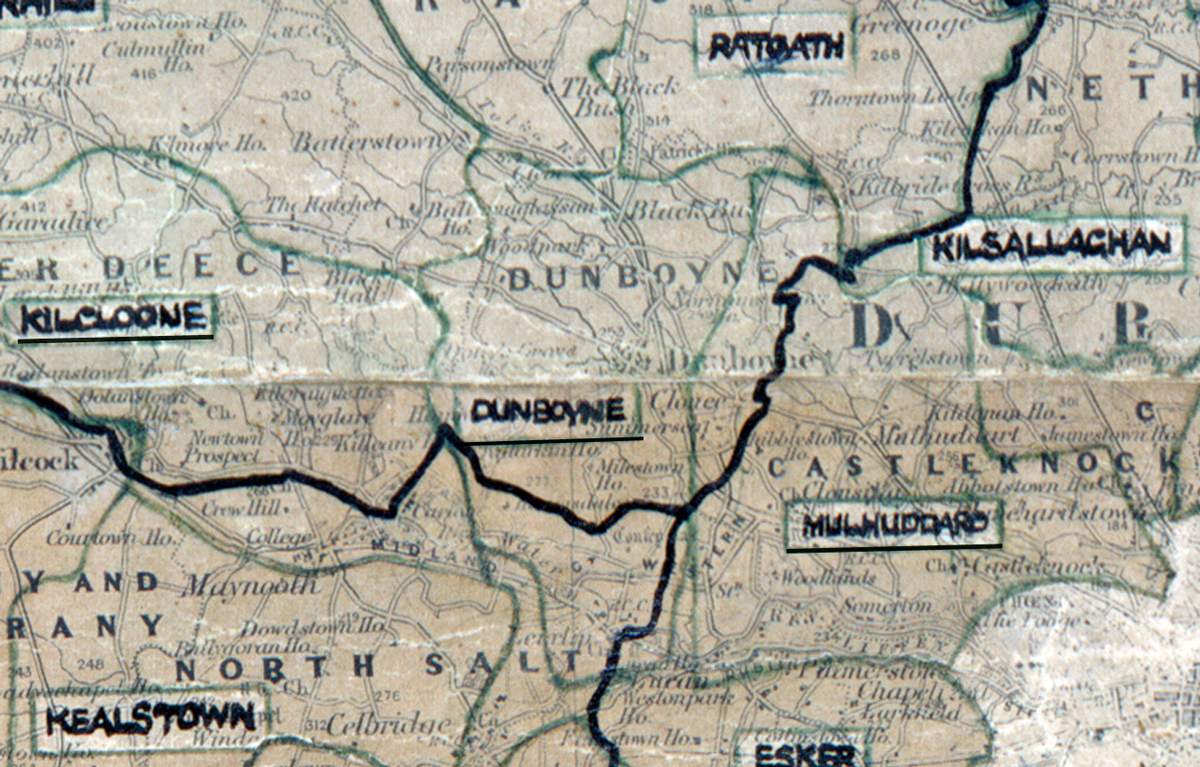
 Area: Dunboyne
Started: February 1952
Finished: August 1952
Poles used: 726
Line used (km): 65
Premises connected: 156
The figures above were sourced from our REO News magazine, to learn more about what these figures mean, visit our interactive map. The map above shows the area boundary and is from a digitised version of the original map used during the scheme.
The residents of Dunboyne took a lively interest in their own affairs according to The REO News from August 1952.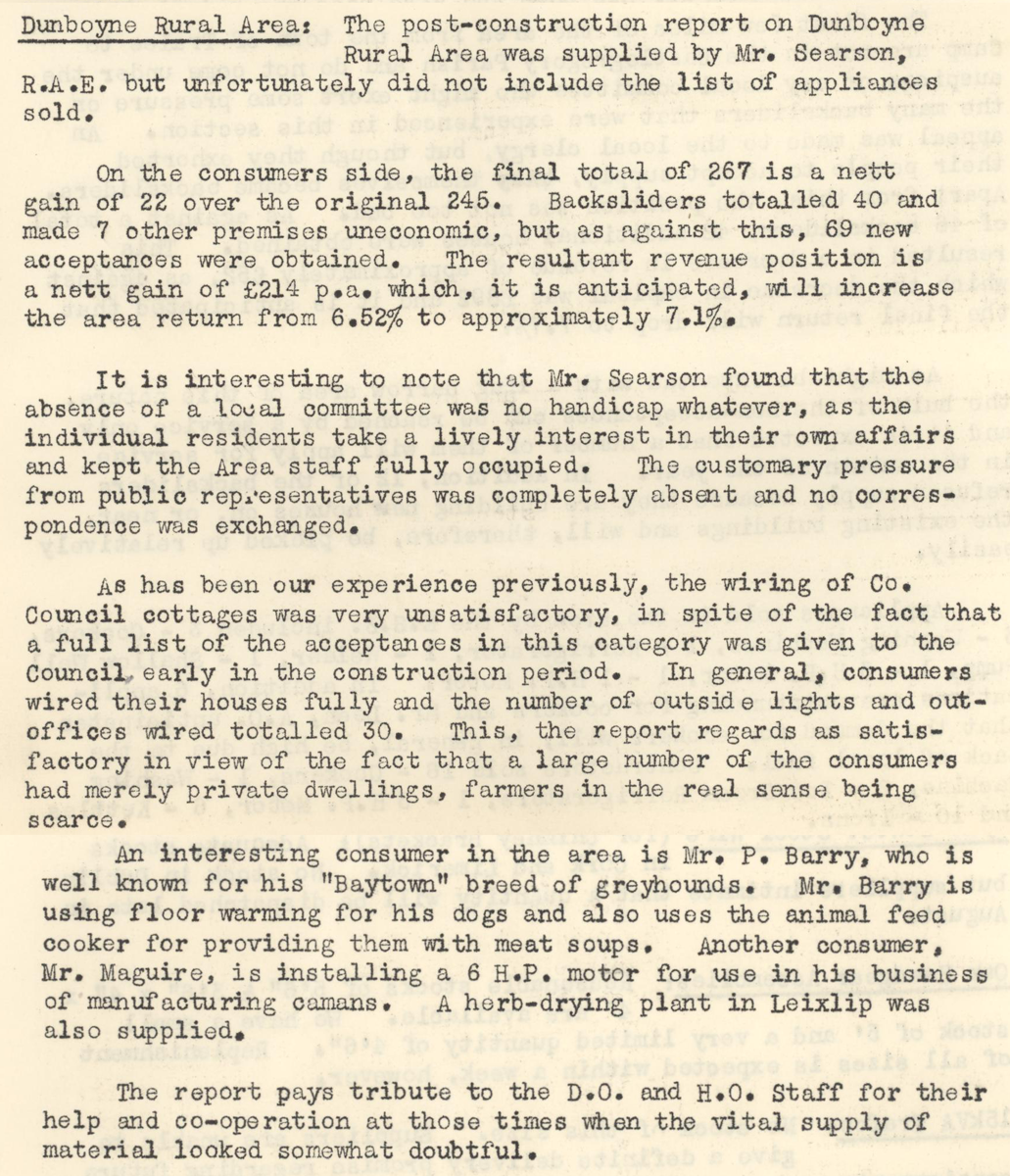 This digital scan from the REO News displays the following text:
"Dunboyne Rural Area: The post‑construction report on Dunboyne Rural Area was supplied by Mr. Searson, R.A.E. but unfortunately did not include the list of appliances sold.
On the consumers side, the final total of 267 is a nett gain of 22 over the original 245. Backsliders totalled 40 and made 7 other premises uneconomic, but as against this, 69 new acceptances were obtained. The resultant revenue position is a nett gain of £214 P.a. which, it is anticipated, will increase the area return from 6.52% to approximately 7.1%.
It is interesting to note that Mr. Searson found that the absence of a local committee was no handicap whatever, as the individual residents take a lively interest in their own affairs and kept the Area staff fully occupied. The customary pressure from public representatives was completely absent and no correspondence was exchanged.
As has been our experience previously, the wiring of Co. Council cottages was very unsatisfactory, in spite of the fact that a full list of the acceptances in this category was given to the Council, early in the construction period. In general, consumers wired their houses fully and the number of outside lights and out‑offices wired totalled 30. This, the report regards as satisfactory in view of the fact that a large number of the consumers had merely private dwellings, farmers in the real sense being scarce.
An interesting consumer in the area is Mr. P. Barry, who is well known for his “Baytown” breed of greyhounds. Mr. Barry is using floor warming for his dogs and also uses the animal feed cooker for providing the hot mash and soups. Another consumer, Mr. Maguire, is installing a 6 H.P. motor for use in his business and other machines. A herb‑drying plant in Leixlip was also supplied.
The report pays tribute to the D.O. and H.O. Staff for their help and co‑operation at those times when the vital supply of material looked somewhat doubtful."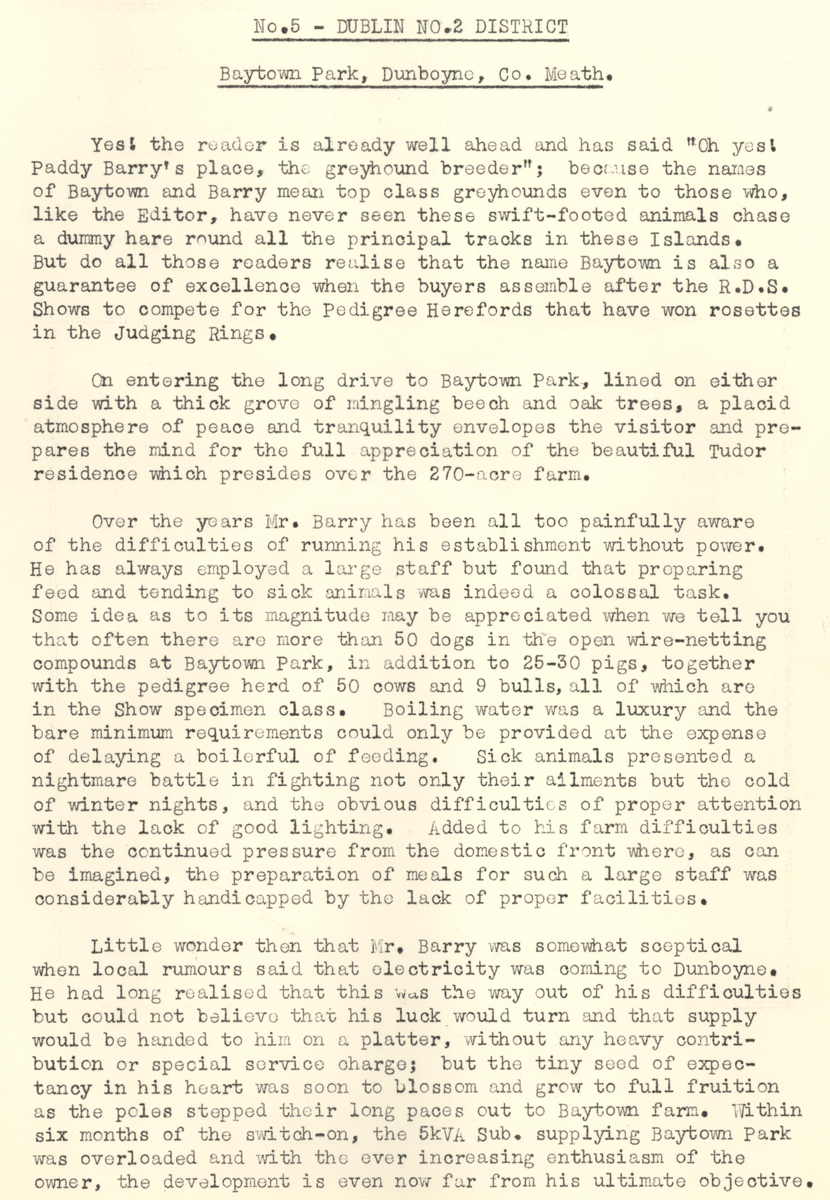 This digital scan from the REO News displays the following text:
"No. 5 – DUBLIN NO. 2 DISTRICT
Baytown Park, Dunboyne, Co. Meath: Yes! the reader is already well ahead and has said “Oh yes! Paddy Barry’s place, the greyhound breeder!”, because the names of Baytown and Barry mean top class greyhounds even to those who, like the Editor, have never seen these swift‑footed animals chase a dummy hare round all the principal tracks in these Islands. But do all those readers realise that the name Baytown is also a guarantee of excellence when the buyers assemble after the R.D.S. Shows to compete for the Pedigree Herefords that have won rosettes in the Judging Rings.
On entering the long drive to Baytown Park, lined on either side with a thick grove of mingling beech and oak trees, a placid atmosphere of peace and tranquillity envelops the visitor and prepares the mind for the full appreciation of the beautiful Tudor residence which presides over the 270‑acre farm.
Over the years Mr. Barry has been all too painfully aware of the difficulties of running his establishment without power. He has always employed a large staff but found that preparing feed and tending to sick animals involved a colossal amount of time. Some idea as to its magnitude may be gained when we tell you that often there are more than 50 dogs in the open wire‑netting compounds at Baytown Park. In addition to this, together with the pedigree herd of 50 cows and 9 bulls, all of which are on the Show specimen class. Boiling water was a luxury and the bare minimum requirements could only be provided at the expense of the delay in his household of feeding. Sick animals presented complications, and were confined to surgery in the gardens until the continued pressures from the domestic front where, as always, the lack of labour during the long hard war years was further considerably handicapped by the lack of proper facilities.
Little wonder then that Mr. Barry was somewhat sceptical when informed that an electricity network was to reach Dunboyne. He had long realised that it was only by mechanisation that utilities would be able to achieve full advantage in utility and speed. Though somewhat loath to dispose of his charming antiquated kitchen boiler for a modern electric one, but the tiny new boiler was built by contract on the hilltop, and was gradually replaced after the poles were put up. The lines got as far as Baytown farm with a firmness that was well planned out. Upon the supply reaching Baytown Park was overloaded, and the years of increasing enthusiasm of the owner, the development is even now far from his ultimate objective."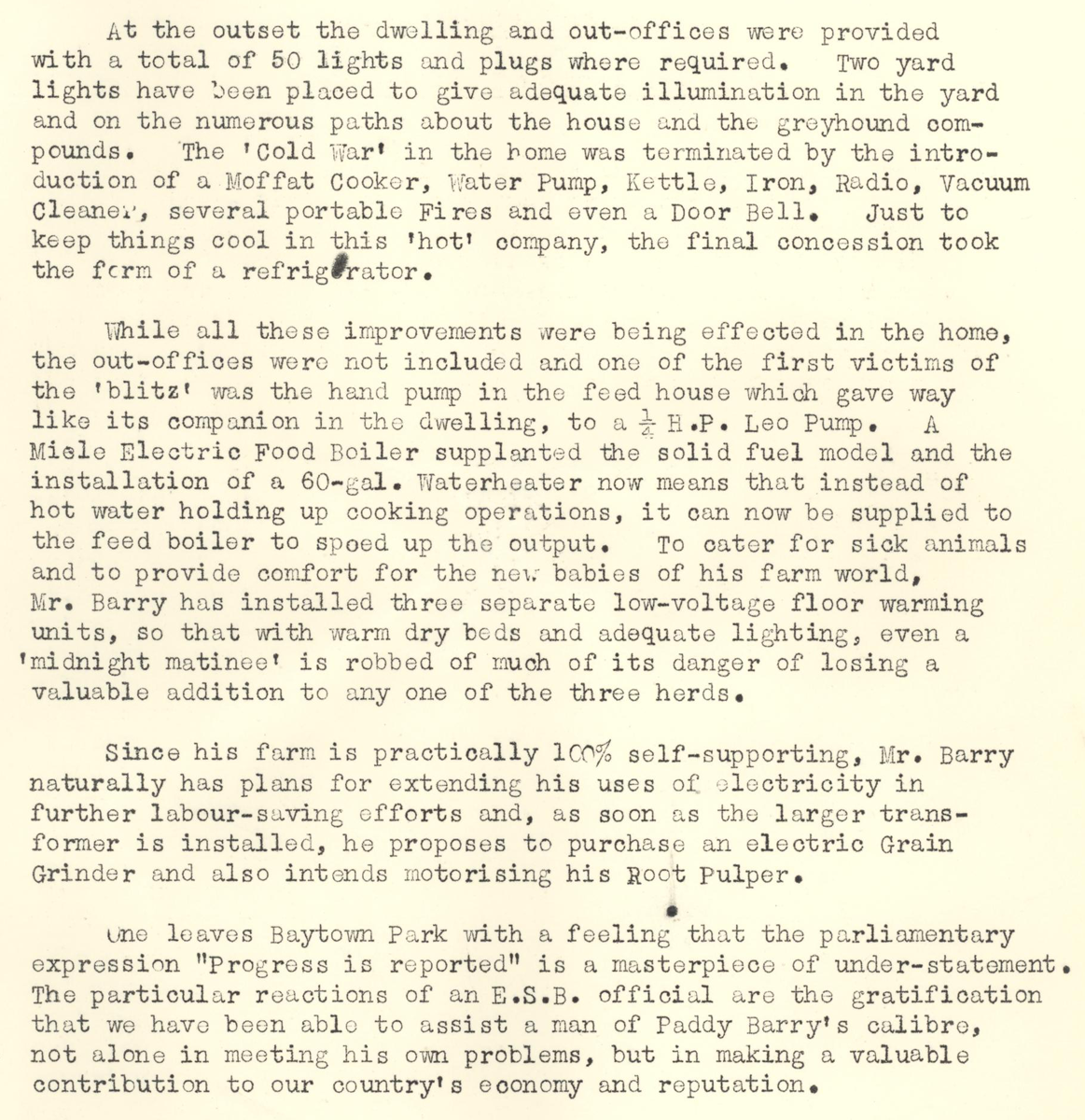 This digital scan from the REO News displays the following text:
"At the outset the dwelling and out‑offices were provided with a total of 50 lights and plugs where required. Two yard lights have been placed to give adequate illumination in the yard and on the numerous paths about the house and the greyhound compounds. The “Cold War” in the home was terminated by the introduction of a Moffat Cooker, Water Pump, Kettle, Iron, Radio, Vacuum Cleaner, several portable Fires and even a Door Bell. Just to keep things cool in this “hot” company, the final concession took the form of a refrigerator.
While all these improvements were being effected in the home, the out‑offices were not included and one of the first victims of the “blitz” was the hand pump in the feed house which gave way like its companion in the dwelling, to a 1½ H.P. Leo Pump. A Miele Electric Food Boiler supplanted the solid fuel model and the installation of a 60‑gal. Waterheater now means that instead of hot water holding up cooking operations, it can now be supplied to the feed boiler to speed up the output of hot water for sick animals and to provide comfort for the new‑born. In the farm world, Mr. Barry has installed three separate and adequate low‑voltage floor warming units, so that with warm dry beds and adequate lighting, even a “midnight matinee” is robbed of much of its danger of losing a valuable addition to any one of the three herds.
Since his farm is practically 100% self‑supporting, Mr. Barry naturally has plans for extending his uses of electricity in further labour‑saving efforts, and as soon as the larger transformer is installed, he proposes to purchase an electric Grain Grinder and also intends motorising his Root Pulper.
One leaves Baytown Park with a feeling that the parliamentary expression “Progress is reported” is in this case no under‑statement. The particular resourcefulness of the E.S.B. staff responsible for the work at Baytown Park has given the widest co‑operation to the owner, who are able to assist the son of Paddy Barry’s establishment in its own problems, and provide a valuable contribution to our country’s economy and reputation."