 Area: Galbally
Started: December 1955
Finished: October 1956
Poles used: 773
Line used (km): 81
Premises connected: 21
The figures above were sourced from our REO News magazine. Click interactive map to find out more on what the figures mean. The map above shows the area boundary and is from a digitised version of the original map used during the scheme.
John Richardson’s farm in Galbally was featured in the cover story from the REO News of May 1960:
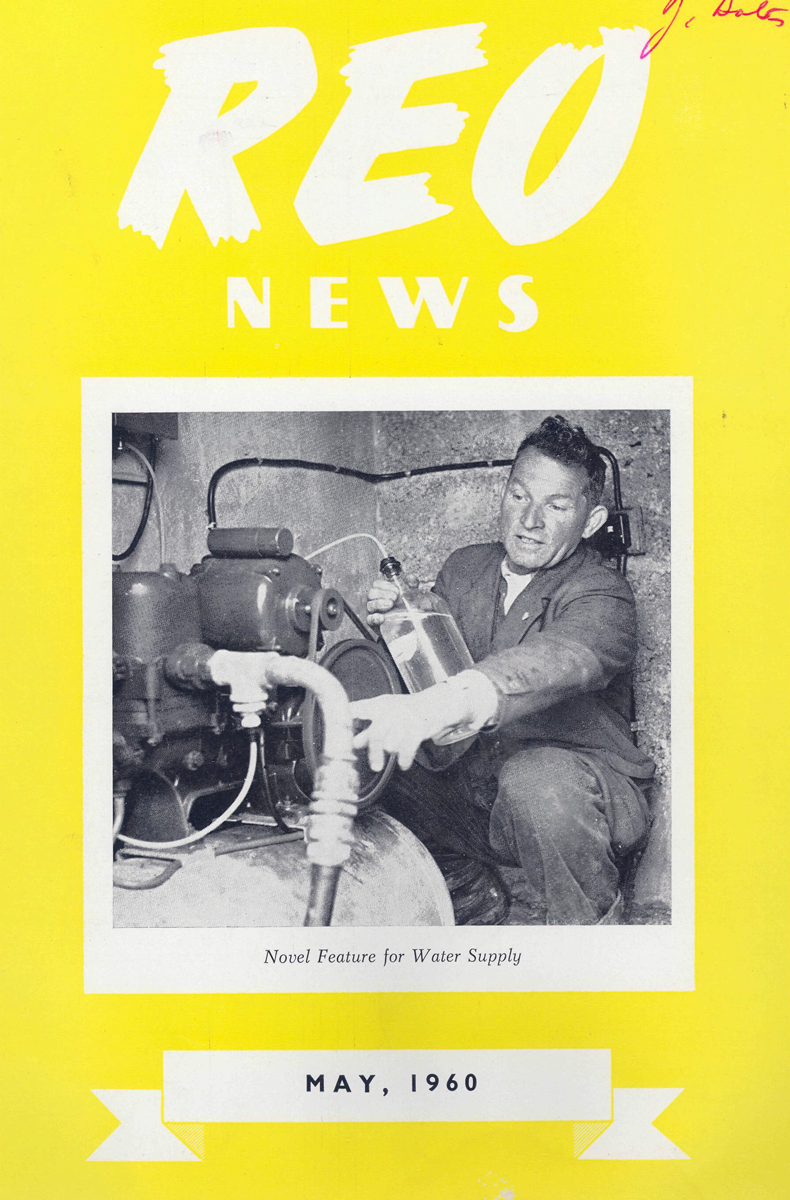
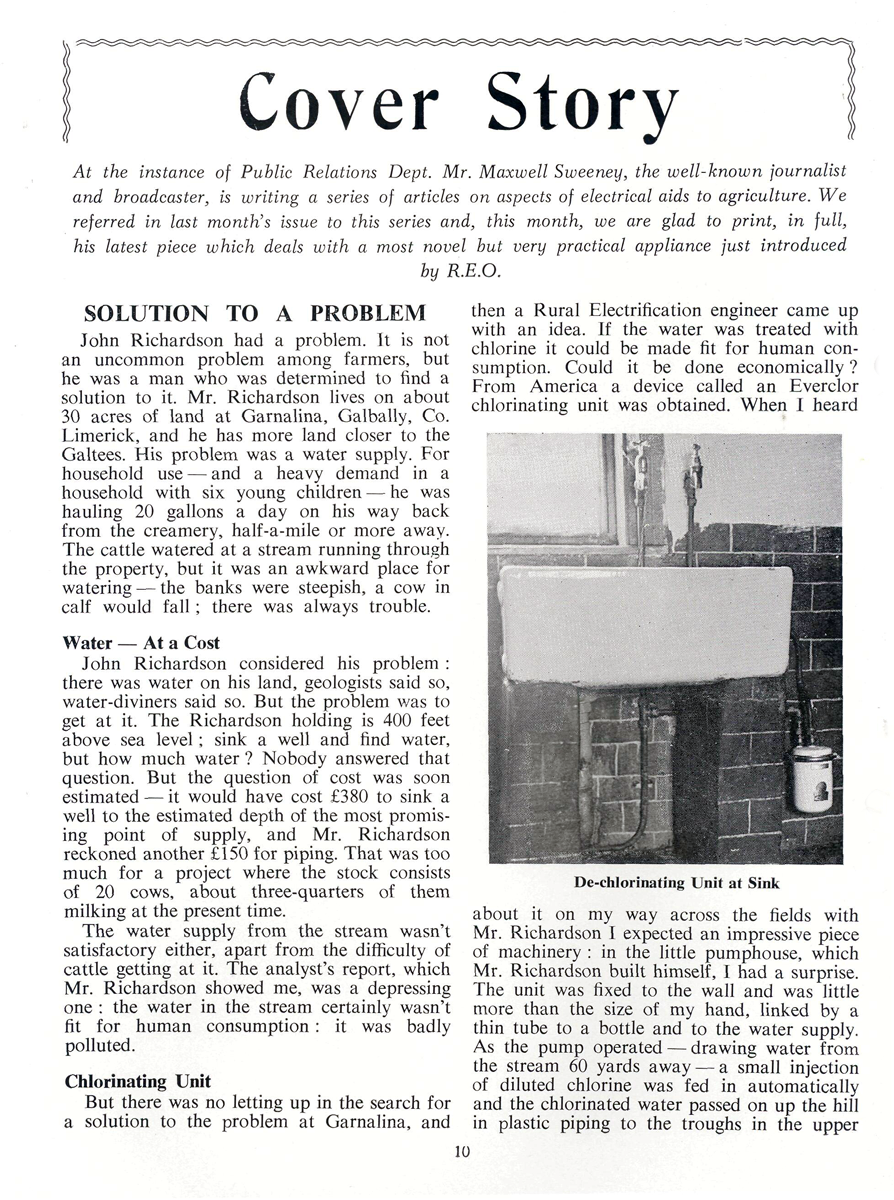
This digital scan from the REO News displays the following text:
"Cover Story
At the instance of Public Relations Dept. Mr. Maxwell Sweeney, the well-known journalist and broadcaster, is writing a series of articles on aspects of electrical aids to agriculture. We referred in last month's issue to this series and, this month, we are glad to print, in full, his latest piece which deals with a most novel but very practical appliance just introduced by R.E.O.
Solution to a Problem
John Richardson had a problem. It is not an uncommon problem among farmers, but he was a man who was determined to find a solution to it. Mr. Richardson lives on about 30 acres of land at Garnalina, Galbally, Co. Limerick, and he has more land closer to the Galtees. His problem was a water supply. For household use, and a heavy demand in a household with six young children, he was hauling 20 gallons a day on his way back from the creamery, half-a-mile or more away. The cattle watered at a stream running through the property, but it was an awkward place for watering. The banks were steepish, a cow in calf would fall; there was always trouble.
Water - At a Cost
John Richardson considered his problem: there was water on his land, geologists said so, water-diviners said so. But the problem was to get at it. The Richardson holding is 400 feet above sea level; sink a well and find water, but how much water? Nobody answered that question. But the question of cost was soon estimated. It would have cost £380 to sink a well to the estimated depth of the most promising point of supply, and Mr. Richardson reckoned another £150 for piping. That was too much for a project where the stock consists of 20 cows, about three-quarters of them milking at the present time.
The water supply from the stream wasn't satisfactory either, apart from the difficulty of cattle getting at it. The analyst's report, which Mr. Richardson showed me, was a depressing one: the water in the stream certainly wasn't fit for human consumption; it was badly polluted.
Chlorinating Unit
But there was no letting up in the search for a solution to the problem at Garnalina, and then a Rural Electrification engineer came up with an idea. If the water was treated with chlorine it could be made fit for human consumption. Could it be done economically?
From America a device called an Everclor chlorinating unit was obtained. When I heard about it on my way across the fields with Mr. Richardson I expected an impressive piece of machinery. In the little pumphouse, which Mr. Richardson built himself, I had a surprise. The unit was fixed to the wall and was little more than the size of my hand, linked by a thin tube to a bottle and to the water supply. As the pump operated, drawing water from the stream 60 yards away, a small injection of diluted chlorine was fed in automatically and the chlorinated water passed on up the hill in plastic piping to the troughs in the upper...
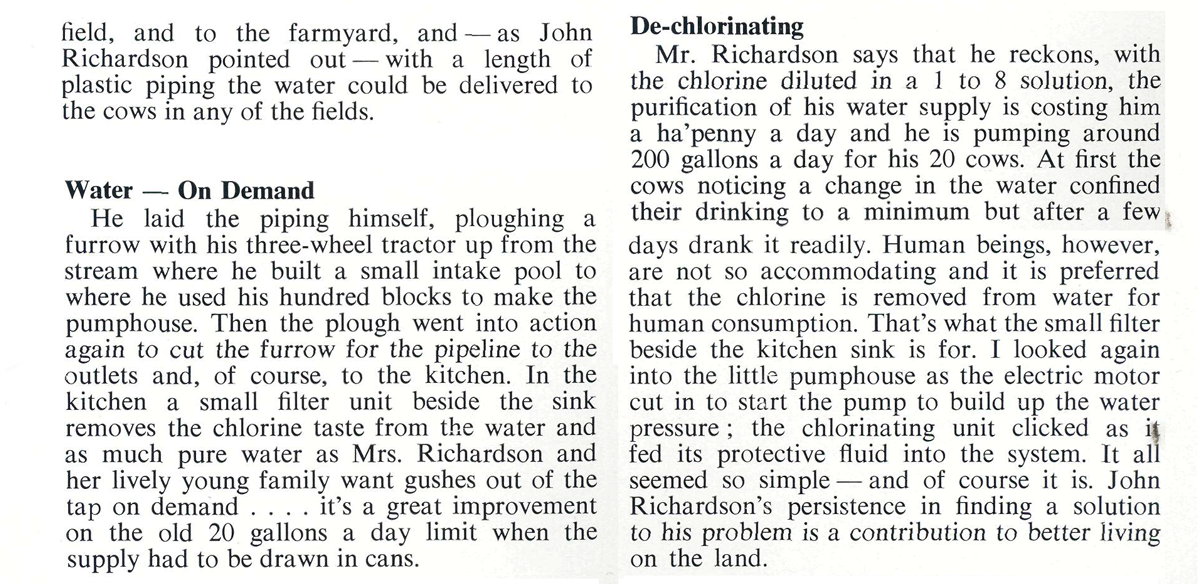
Water - On Demand
He laid the piping himself, ploughing a furrow with his three-wheel tractor up from the stream where he built a small intake pool to where he used his hundred blocks to make the pumphouse. Then the plough went into action again to cut the furrow for the pipeline to the outlets and, of course, to the kitchen. In the kitchen a small filter unit beside the sink removes the chlorine taste from the water and as much pure water as Mrs. Richardson and her lively young family want gushes out of the tap on demand. It's a great improvement on the old 20 gallons a day limit when the supply had to be drawn in cans.
De-chlorinating
Mr. Richardson says that he reckons, with the chlorine diluted in a 1 to 8 solution, the purification of his water supply is costing him a ha'penny a day and he is pumping around 200 gallons a day for his 20 cows. At first the cows noticed a change in the water and confined their drinking to a minimum but after a few days drank it readily. Human beings, however, are not so accommodating and it is preferred that the chlorine is removed from water for human consumption. That's what the small filter beside the kitchen sink is for. I looked again into the little pumphouse as the electric motor cut in to start the pump to build up the water pressure; the chlorinating unit clicked as it fed its protective fluid into the system. It all seemed so simple and of course it is. John Richardson's persistence in finding a solution to his problem is a contribution to better living on the land."