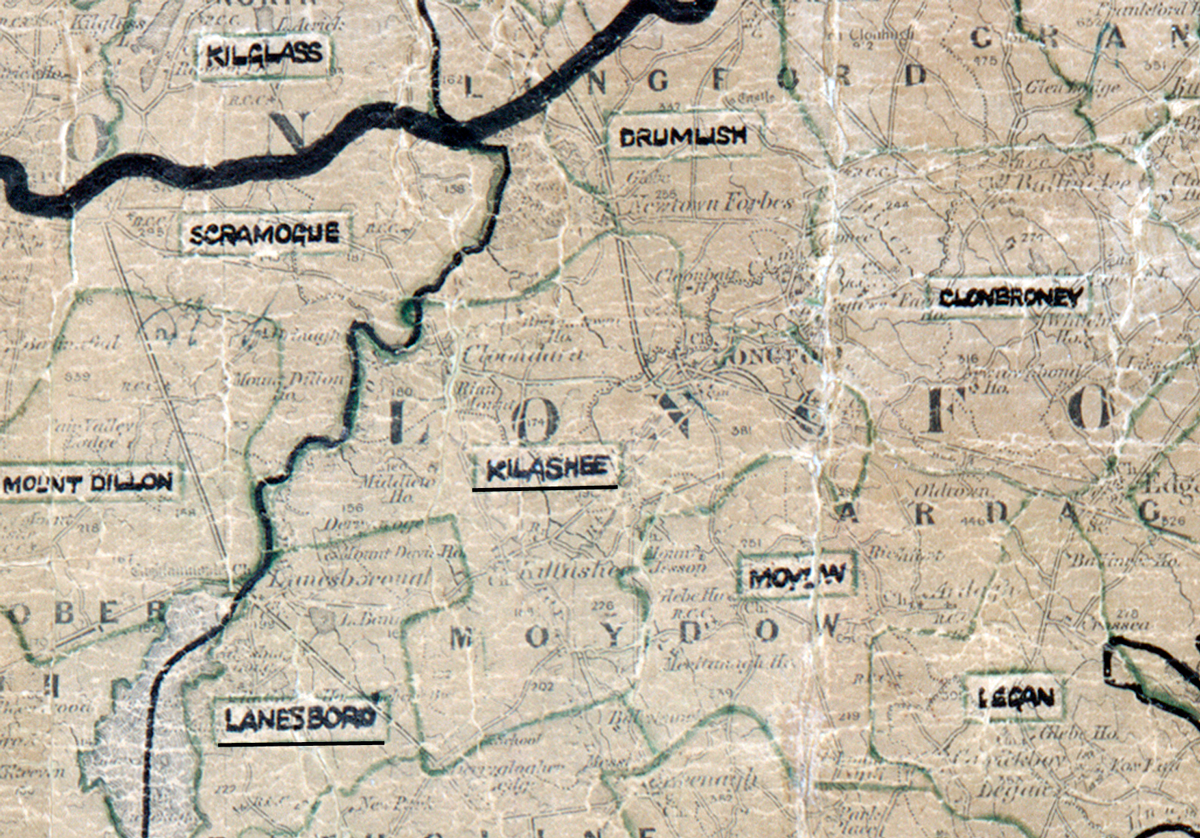
 Area: Kilashee
Started: October 1951
Finished: May 1952
Poles used: 1105
Line used (km): 105
Premises connected: 105
The figures above were sourced from our REO News magazine, to learn more about what these figures mean, visit our interactive map. The map above shows the area boundary and is from a digitised version of the original map used during the scheme.
The REO News from March 1952 reports on the switch on ceremony in Kilashee
 This digital scan from the REO News displays the following text:
"We attended a very pleasant function in the Tower Ballroom, Tarmonbarry, on the occasion of the switching on of the Killashee Rural Area. A noteworthy feature of the speeches was that propaganda by the Board as to the advantages of electricity seems now almost unnecessary. Each of the speakers in turn dealt with these advantages in a concise and competent manner. The Minister for Posts & Telegraphs, who was the principal guest, spoke of the advantages of a sister scheme of rural telephones. After the formalities a supper was provided and the very large attendance took part in a most enjoyable dance until the small and early hours of the morning. The ballroom, which seemed to us to be as large as that in the Gresham Hotel, is certainly a credit to local enterprise, and there is every indication that the same enterprise will be extended to the electrical field."
The majority of consumers in Kilashee were small farmers according to The REO News from October 1952
 This digital scan from the REO News displays the following text:
"Killashee Rural Area: Mr. G. Dunnion, R.A.E., has forwarded us a copy of his report, originally composed on the 1st July. As in the case of Owens, we regret that we did not receive the original.
As designed, the area provided for a total of 330 economic consumers but the alteration to the 5s basis brought in 73 additional consumers. 45 of these 403 consumers were lost, comprising 8 houses which had become vacant, 30 backsliders, and 7 additional consumers thus rendered uneconomic. As against this, 97 new consumers were obtained, bringing the total to 455. As a result, the capital cost increased from £23,370 to £35,680, with a corresponding increase in Fixed Charge Revenue from £1,855 to £2,760. The percentage return fell only from 7.96% to 7.75%, which was a noteworthy achievement in view of the fact that 130 of the new consumers were supplied at the minimum 5s return.
For an area where the majority of consumers are small farmers, the sales total of £1,165 was indeed satisfactory. Principal items included 12 Cookers; 3 Washing Machines; 5 Power Packets; 5 Pumps; 2 Grain Grinders; 2 Burco Boilers; 1 10 H.P. Motor; 1 1 H.P. Motor; 2 1/3 H.P. Motors and an assortment of Irons, Kettles, etc. Sales by independent contractors were confined mainly to small appliances.
It is sad to note that of the 120 County Council cottages in the area, only 20 availed of the Co. Council Wiring Scheme. About 50 consumers installed yard lighting.
Construction difficulties in bog land were great and Mr. Dunnion notes that 111 of total poles which had to be erected in bog gave more difficulty than the 39 where blasting was required. Indeed, planks had to be laid in the bog to enable the poles to be carried in, and the local wits exercised their talents to the fullest degree at the expense of the construction crew. However, in spite of soft going and hard words, the poles went up. Naturally, so also did the labour cost but the increase in labour is expected to be compensated by the saving in material.
We cannot but quote one paragraph from Mr. Dunnion’s own pen:
“A Shannon crossing was erected at Tarmonbarry, 22M poles being used. This crossing is now one of the local sights and often crowds gather on the nearby bridge to gaze and wonder at these stately sticks. Large corks were fitted on the conductors and 6 ft. crossarms to prevent ‘swan trouble’. I refer to the bird, not to the conductor, which could now be more appropriately renamed ‘Dodo’.”
Post development prospects are good as there are about 100 houses within easy reach of the existing lines."