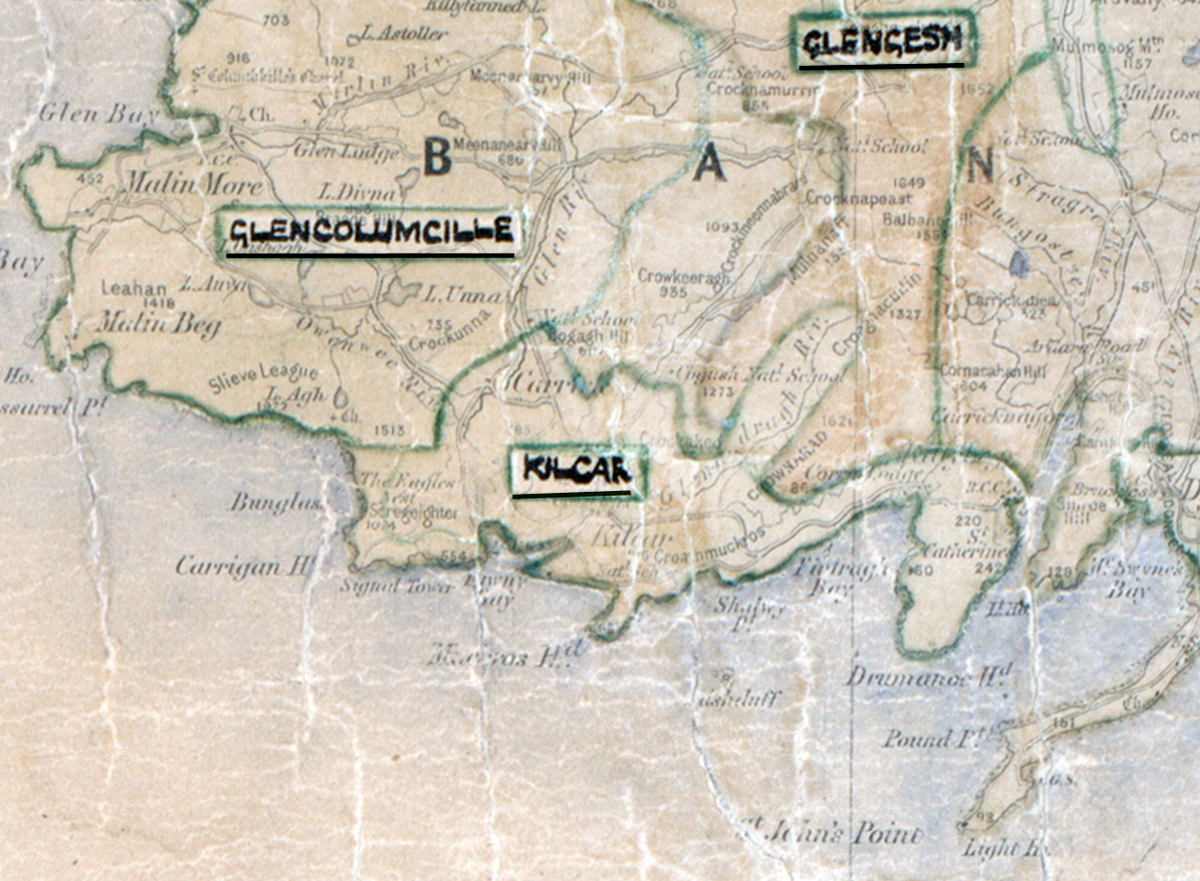
 Area: Kilcar
Started: December 1950
Finished: March 1952
Poles used: 822
Line used (km): 71
Premises connected: 248
The figures above were sourced from our REO News magazine, to learn more about what these figures mean, visit our interactive map. The map above shows the area boundary and is from a digitised version of the original map used during the scheme.
There was only one backslider in Kilcar according to The REO News from November 1952
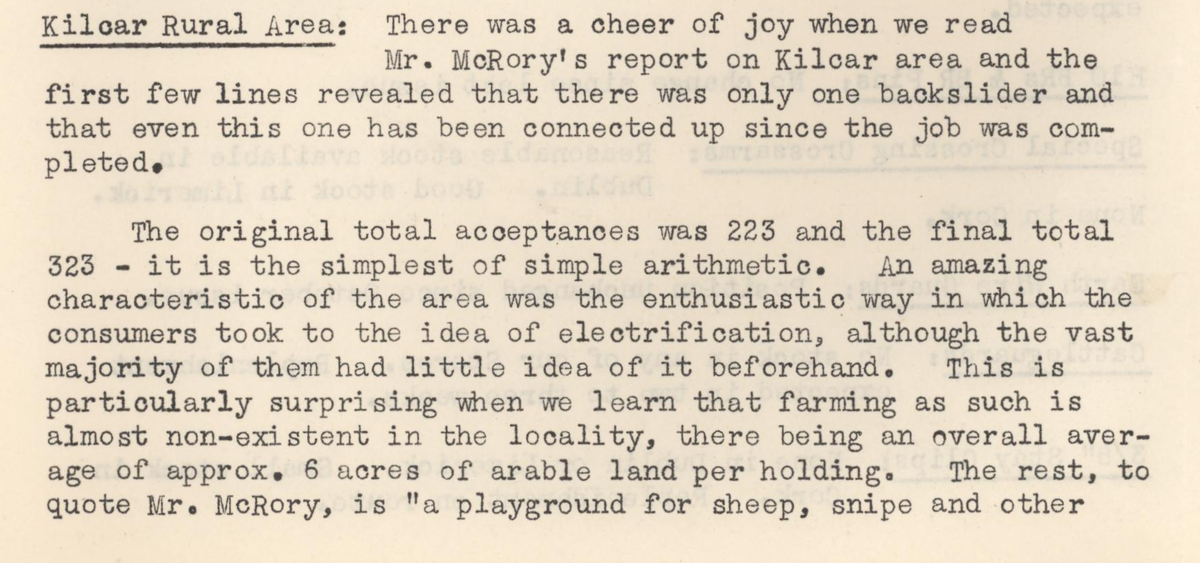 This digital scan from the REO News displays the following text:
"Kilcar Rural Area: There was a cheer of joy when we read Mr. McRory’s report on Kilcar area and the first few lines revealed that there was only one backslider and that even this one has been connected up since the job was completed.
The original total acceptances was 223 and the final total 323 – it is the simplest of simple arithmetic. An amazing characteristic of the area was the enthusiastic way in which the consumers took to the idea of electrification, although the vast majority of them had little idea of it beforehand. This is particularly surprising when we learn that farming as such is almost non‑existent in the locality, there being an overall average of approx. 6 acres of arable land per holding. The rest, to quote Mr. McRory, is “a playground for sheep, snipe and other …”"
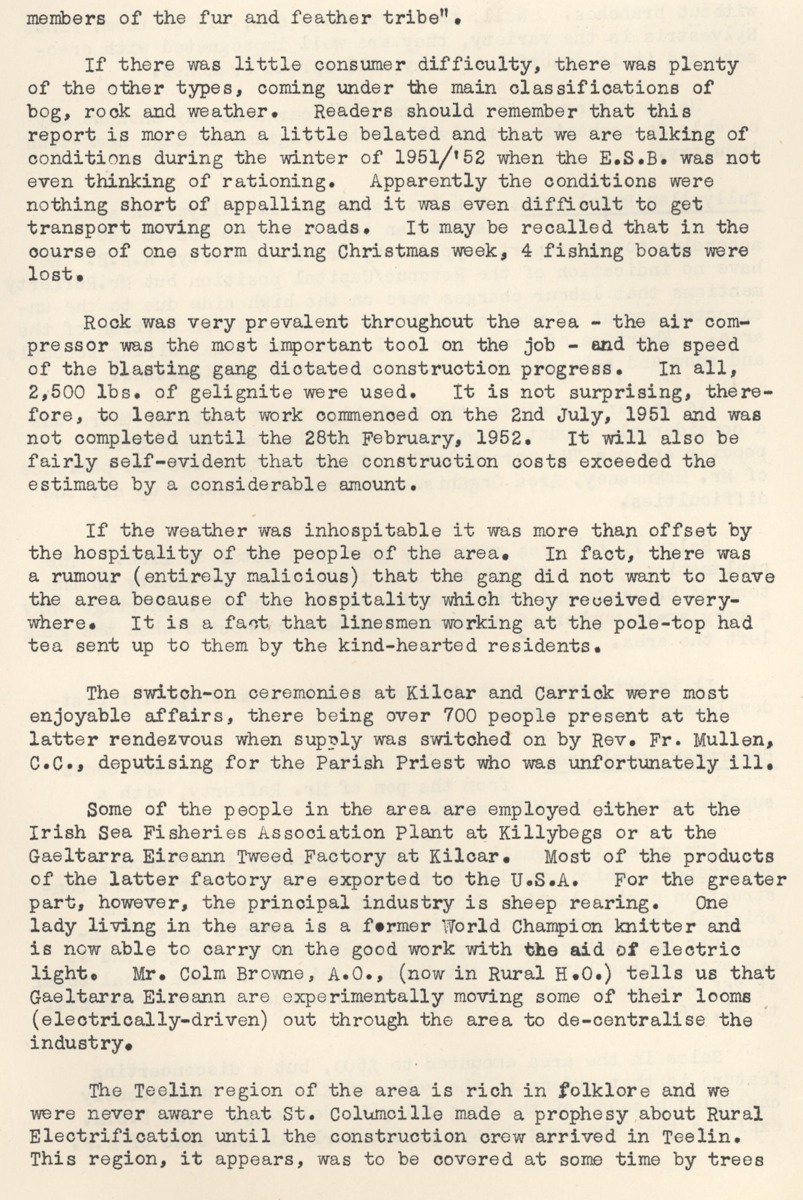 This digital scan from the REO News displays the following text:
"members of the fur and feather tribe”.
If there was little consumer difficulty, there was plenty of other types, coming under the main classifications of bog, rock and weather. Readers should remember that this report is more than a little belated and that we are talking of conditions during the winter of 1951/52 when the E.S.B. was not even thinking of rationing. Apparently the conditions were nothing short of appalling and it was even difficult to get transport moving on the roads. It may be recalled that in the course of one storm during Christmas week, 4 fishing boats were lost.
Rock was very prevalent throughout the area – the air compressor was the most important tool on the job – and the speed of the blasting gang dictated construction progress. In all, 2,500 lbs. of gelignite were used. It is not surprising, therefore, to learn that work commenced on the 2nd July, 1951 and was not completed until the 28th February, 1952. It will also be fairly self‑evident that the construction costs exceeded the estimate by a considerable amount.
If the weather was inhospitable, it was more than offset by the hospitality of the people of the area. In fact, there was a rumour (entirely malicious) that the gang did not want to leave the area because of the hospitality which they received everywhere. It is a fact that linesmen working at the pole‑top had tea sent up to them by the kind‑hearted residents.
The switch‑on ceremonies at Kilcar and Carrick were most enjoyable affairs, there being over 700 people present at the latter rendezvous when supply was switched on by Rev. Fr. Mullen, C.C., deputising for the Parish Priest who was unfortunately ill.
Some of the people in the area are employed either at the Irish Sea Fisheries Association Plant at Killybegs or at the Gaeltarra Eireann Tweed Factory at Kilcar. Most of the products of the latter factory are exported to the U.S.A. For the greater part, however, the principal industry is sheep rearing. One lady living in the area is a former World Champion knitter and is now able to carry on the good work with the aid of electric light. Mr. Colm Browne, A.O., (now in Rural H.Q.) tells us that Gaeltarra Eireann are experimenting moving some of their looms (electrically‑driven) out through the area to de‑centralise the industry.
The Teelin region of the area is rich in folklore and we were never aware that St. Columcille made a prophesy about Rural Electrification until the construction crew arrived in Teelin. This region, it appears, was to be covered at some time by trees."
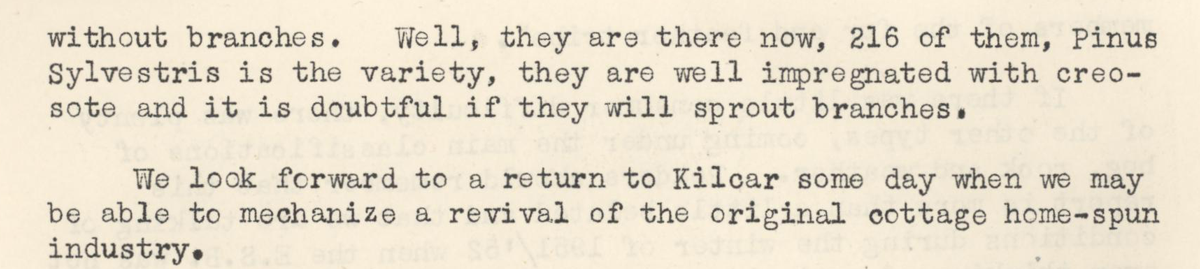 This digital scan from the REO News displays the following text:
"without branches. Well, they are there now, 216 of them, Pinus sylvestris is the variety, they are well impregnated with creosote and it is doubtful if they will sprout branches.
We look forward to a return to Kilcar some day when we may be able to mechanize a revival of the original cottage home‑spun industry."