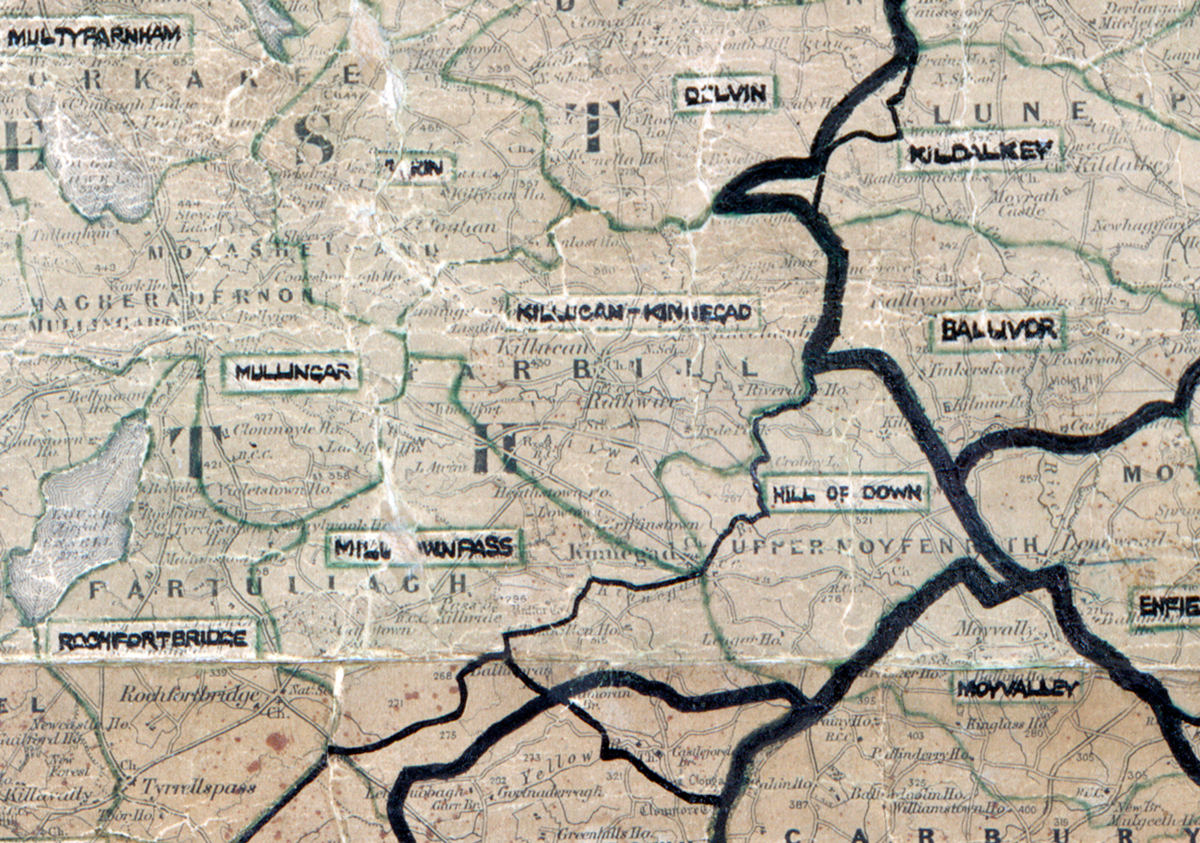
 Area: Killucan-Kinnegad
Started: September 1949
Finished: May 1950
Poles used: 1363
Line used (km): 118
Premises connected: 220
The figures above were sourced from our REO News magazine, to learn more about what these figures mean, visit our interactive map. The map above shows the area boundary and is from a digitised version of the original map used during the scheme.
A report on Killucan-Kinnegad made heartening reading according to The REO News from July 1950
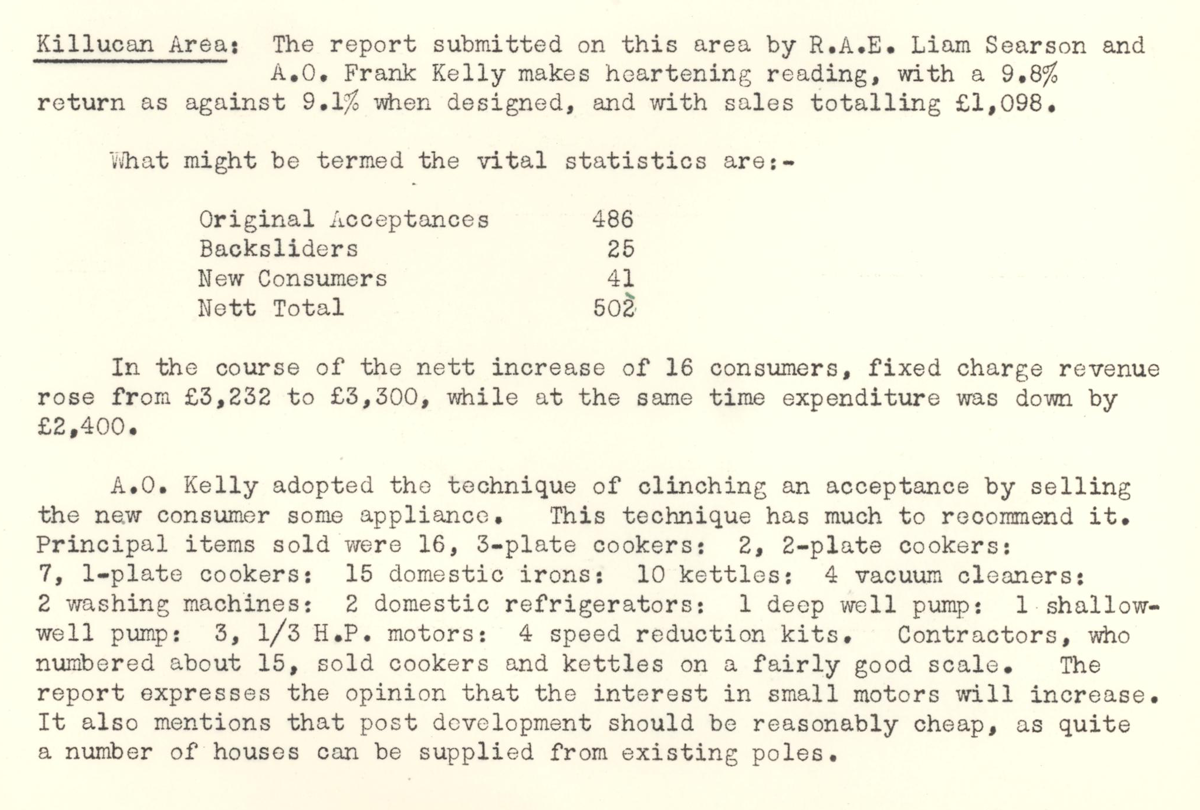 This digital scan from the REO News displays the following text:
"Killucan Area: The report submitted on this area by R.A.E. Liam Searson and A.O. Frank Kelly makes heartening reading, with a 9.8% return as against 9.1% when designed, and with sales totalling £1,098.
What might be termed the vital statistics are:
Original acceptances — 486
Backsliders — 25
New consumers — 41
Nett total — 502
In the course of the nett increase of 16 consumers, fixed charge revenue rose from £3,232 to £3,300, while at the same time expenditure was down by £2,400.
A.O. Kelly adopted the technique of clinching an acceptance by selling the new consumer some appliance. This technique has much to recommend it. Principal items sold were: 16 three‑plate cookers; 2 two‑plate cookers; 7 one‑plate cookers; 15 domestic irons; 10 kettles; 4 vacuum cleaners; 2 washing machines; 2 domestic refrigerators; 1 deep well pump; 1 shallow well pump; 3 one‑third H.P. motors; 4 speed‑reduction kits. Contractors, who numbered about 15, sold cookers and kettles on a fairly good scale. The report expresses the opinion that interest in small motors will increase. It also mentions that post‑development should be reasonably cheap, as quite a number of houses can be supplied from existing poles."
Bracklyn Farm Killucan was the featured farm in The REO News from June 1953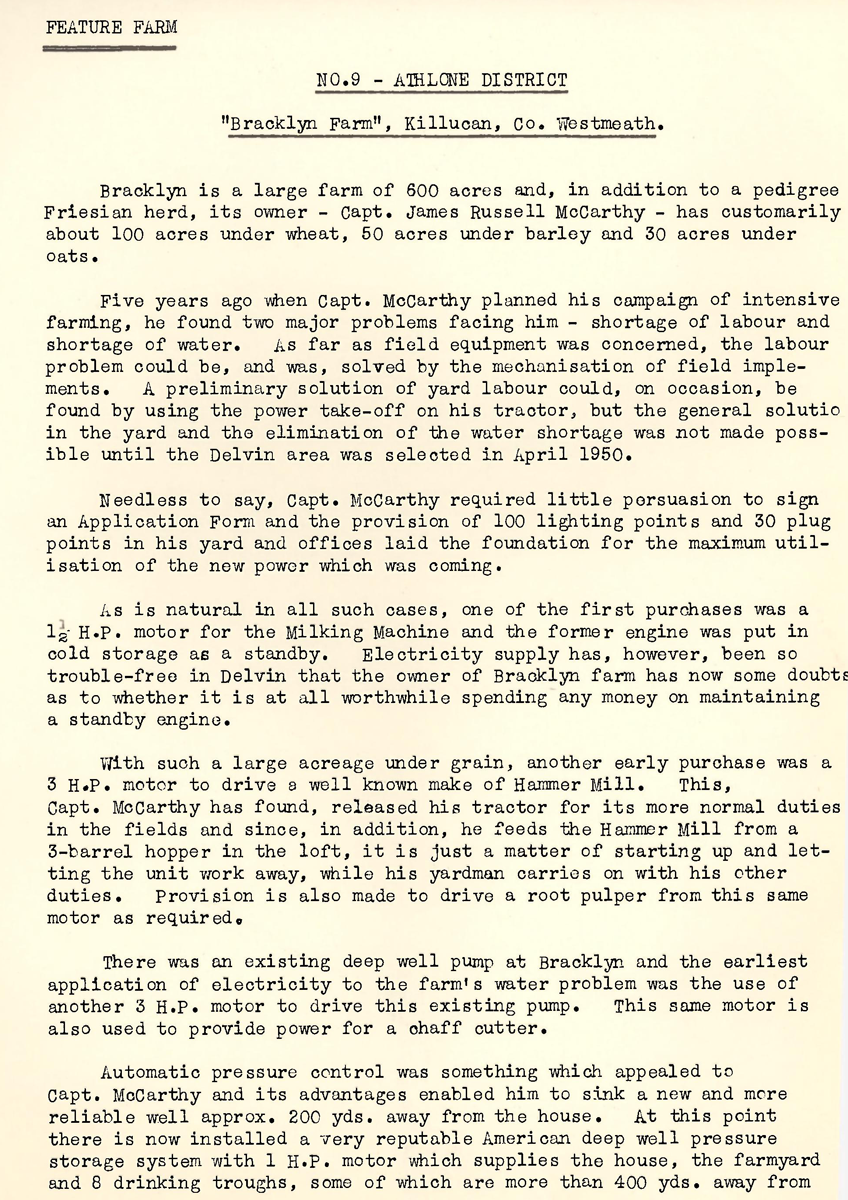 This digital scan from the REO News displays the following text:
"FEATURE FARM — No. 9, Athlone District
“Bracklyn Farm”, Killucan, Co. Westmeath.
Bracklyn is a large farm of 600 acres and, in addition to a pedigree Friesian herd, its owner — Capt. James Russell McCarthy — has customarily about 100 acres under wheat, 50 acres under barley and 30 acres under oats.
Five years ago when Capt. McCarthy planned his campaign of intensive farming, he found two major problems facing him — shortage of labour and shortage of water. As far as field equipment was concerned, the labour problem could be, and was, solved by the mechanisation of field implements. A preliminary solution of yard labour could, on occasion, be found by using the power take‑off on his tractor, but the general solution in the yard and the elimination of the water shortage was not made possible until the Delvin area was selected in April 1950.
Needless to say, Capt. McCarthy required little persuasion to sign an Application Form and the provision of 100 lighting points and 30 plug points in his yard and offices laid the foundation for the maximum utilisation of the new power which was coming.
As is natural in all such cases, one of the first purchases was a 1½ H.P. motor for the Milking Machine and the former engine was put in cold storage as a standby. Electricity supply has, however, been so trouble‑free in Delvin that the owner of Bracklyn farm has now some doubts as to whether it is at all worthwhile spending any money on maintaining a standby engine.
With such a large acreage under grain, another early purchase was a 3 H.P. motor to drive a well‑known make of Hammer Mill. This, Capt. McCarthy has found, released his tractor for its more normal duties in the fields and since, in addition, he feeds the Hammer Mill from a 3‑barrel hopper in the loft, it is just a matter of starting up and letting the unit work away, while his yardman carries on with his other duties. Provision is also made to drive a root pulper from this same motor as required.
There was an existing deep well pump at Bracklyn and the earliest application of electricity to the farm’s water problem was the use of another 3 H.P. motor to drive this existing pump. This same motor is also used to provide power for a chaff cutter.
Automatic pressure control was something which appealed to Capt. McCarthy and its advantages enabled him to sink a new and more reliable well approx. 200 yds. away from the house. At this point there is now installed a very reputable American deep well pressure storage system with 1 H.P. motor which supplies the house, the farmyard and 8 drinking troughs, some of which are more than 400 yds. away from"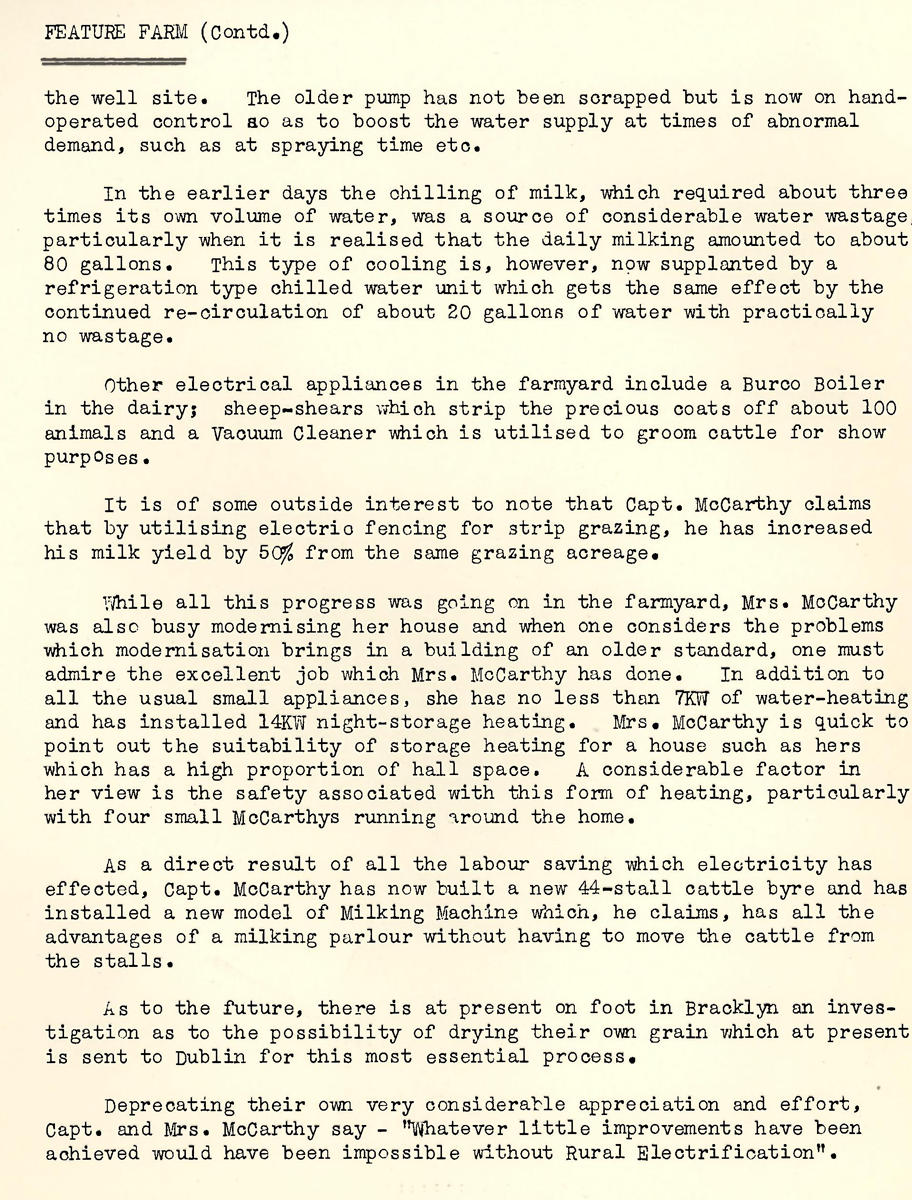 This digital scan from the REO News displays the following text:
"FEATURE FARM (Contd.)
The well site. The older pump has not been scrapped but is now on hand‑operated control so as to boost the water supply at times of abnormal demand, such as spraying time etc.
In the earlier days the chilling of milk, which required about three times its own volume of water, was a source of considerable water wastage particularly when it is realised that the daily milking amounted to about 80 gallons. This type of cooling is, however, now supplanted by a refrigeration type chilled water unit which gets the same effect by the continued re‑circulation of about 20 gallons of water with practically no wastage.
Other electrical appliances in the farmyard include a Burco Boiler in the dairy; sheep‑shears which strip the precious coats off about 100 animals; and a Vacuum Cleaner which is utilised to groom cattle for show purposes.
It is of some outside interest to note that Capt. McCarthy claims that by utilising electric fencing for strip grazing, he has increased his milk yield by 50% from the same grazing acreage.
While all this progress was going on in the farmyard, Mrs. McCarthy was also busy modernising her house and when one considers the problems which modernisation brings in a building of an older standard, one must admire the excellent job which Mrs. McCarthy has done. In addition to all the usual small appliances, she has no less than 7KW of water‑heating and has installed 14KW night‑storage heating. Mrs. McCarthy is quick to point out the suitability of storage heating for a house such as hers which has a high proportion of hall space. A considerable factor in her view is the safety associated with this form of heating, particularly with four small McCarthys running around the home.
As a direct result of all the labour saving which electricity has effected, Capt. McCarthy has now built a new 44‑stall cattle byre and has installed a new model of Milking Machine which, he claims, has all the advantages of a milking parlour without having to move the cattle from the stalls.
As to the future, there is at present on foot in Bracklyn an investigation as to the possibility of drying their own grain which at present is sent to Dublin for this most essential process.
Deprecating their own very considerable appreciation and effort, Capt. and Mrs. McCarthy say—“Whatever little improvements have been achieved would have been impossible without Rural Electrification”."