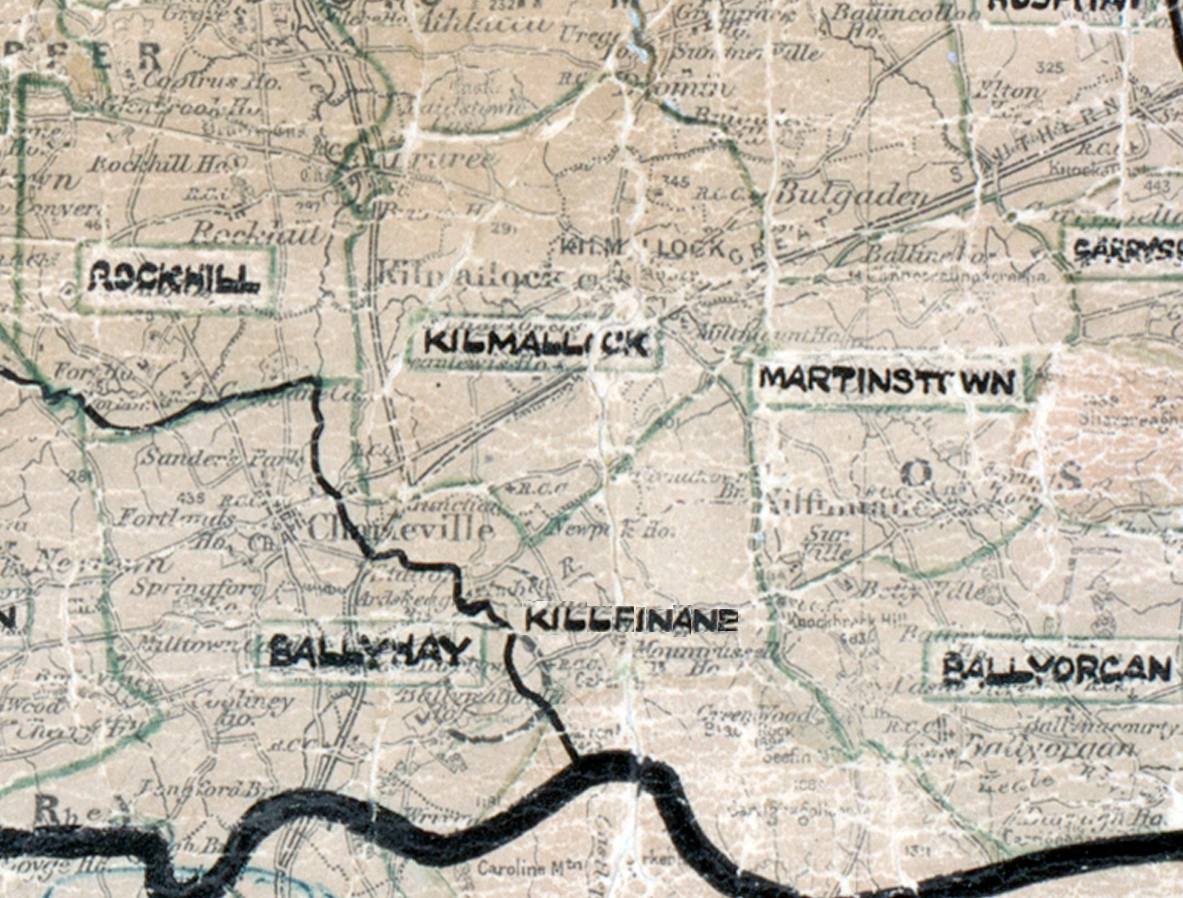
 Area: Kilmallock
Started: July 1949
Finished: February 1950
Poles used: 1021
Line used (km): 92
Premises connected: 270
The figures above were sourced from our REO News magazine, to learn more about what these figures mean, visit our interactive map. The map above shows the area boundary and is from a digitised version of the original map used during the scheme.
The REO News from January 1950 mentions Kilmallock in an article on rural demonstrations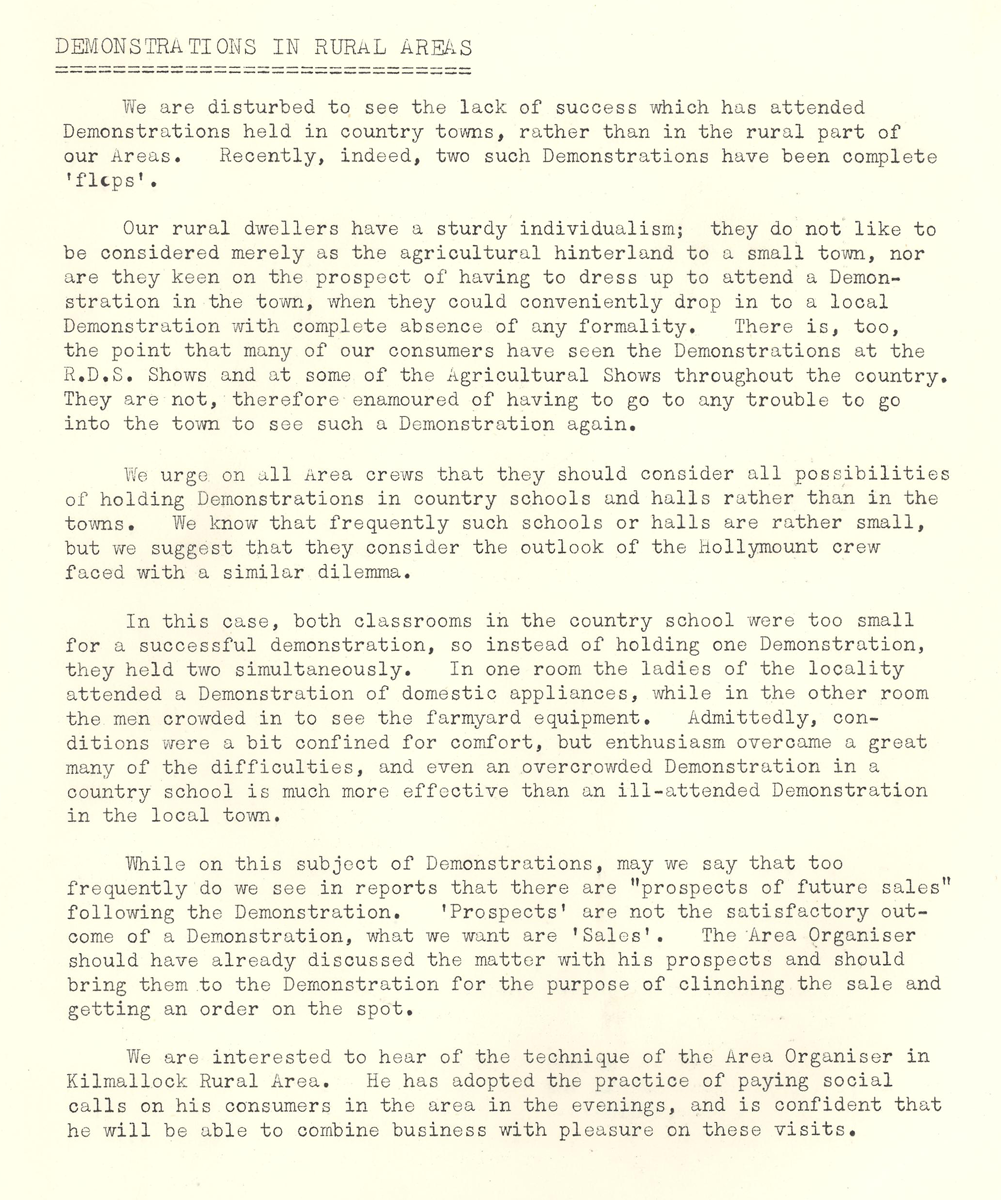 This digital scan from the REO News displays the following text:
"DEMONSTRATIONS IN RURAL AREAS
We are disturbed to see the lack of success which has attended Demonstrations held in country towns, rather than in the rural part of our areas. Recently, indeed, two such Demonstrations have been complete “flops”.
Our rural dwellers have a sturdy individualism: they do not like to be considered merely as the agricultural hinterland to a small town, nor are they keen on the prospect of having to dress up to attend a Demonstration in the town, when they could conveniently drop in to a local Demonstration with complete absence of any formality. There is, too, the point that many of our consumers have seen the Demonstrations at the R.D.S. Shows and at some of the agricultural shows throughout the country. They are not, therefore, enamoured of having to go to any trouble to go into the town to see such a Demonstration again.
We urge on all area crews that they should consider all possibilities of holding Demonstrations in country schools and halls rather than in the towns. We know that frequently such schools or halls are rather small, but we suggest that they consider the outlook of the country crew faced with a similar dilemma.
In this case, both classrooms in the country school were too small for a successful demonstration, so instead of holding one Demonstration, they held two simultaneously. In one room the ladies of the locality attended a Demonstration of domestic appliances, while in the other room men crowded in to see the farmyard equipment. Admittedly, the conditions were a bit confined for comfort, but enthusiasm overcame any minor difficulties, and even an overcrowded Demonstration in the country school is much more effective than an ill‑attended Demonstration in the local town.
While on the subject of Demonstrations, may we say that too frequently do we see in reports that there are “prospects of future sales” following a Demonstration. “Prospects” are not the satisfactory outcome of a Demonstration, what we want are “Sales”. The Area Organiser should have already discussed the matter with his prospects and should bring them to the Demonstration for the purpose of clinching the sale and getting an order on the spot.
We are interested to hear of the technique of the Area Organiser in Kilmallock Rural Area. He has adopted the practice of paying social calls on his consumers in the area in the evenings, and is confident that he will be able to combine business with pleasure on these visits."