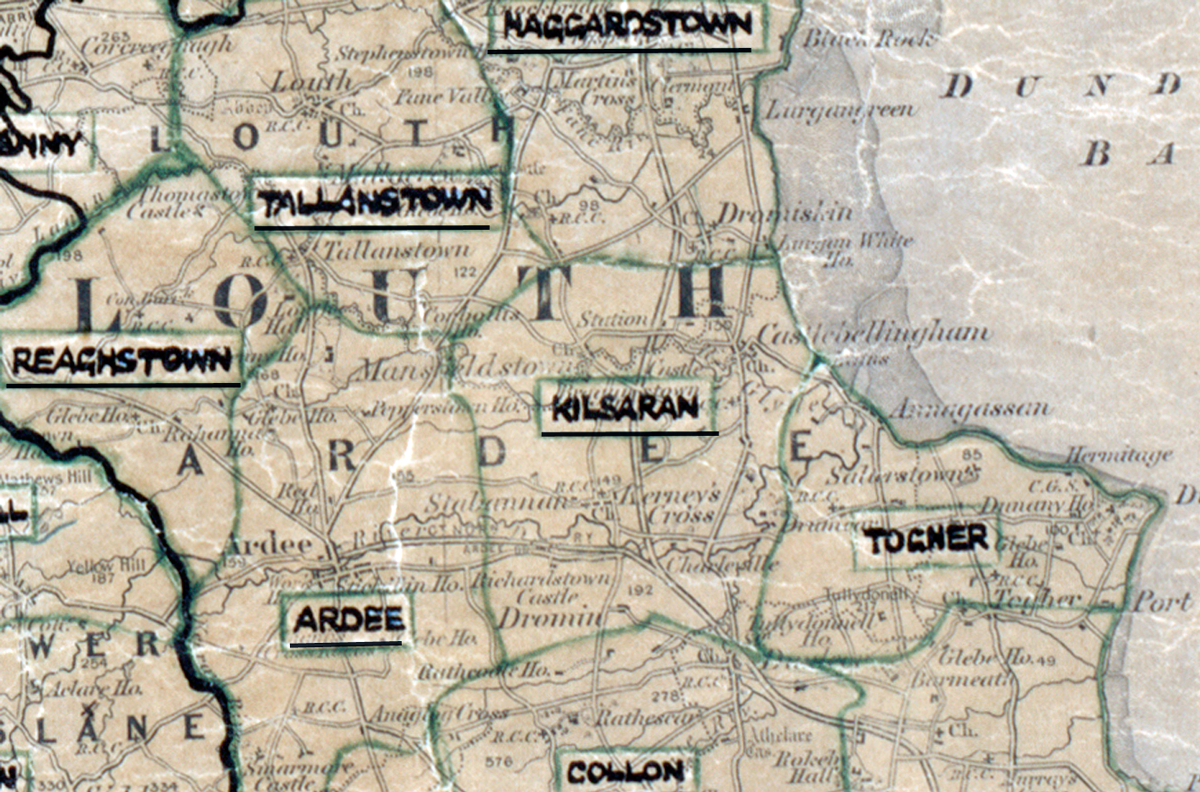
 Area: Kilsaran
Started: June 1951
Finished: March 1952
Poles used: 934
Line used (km): 83
Premises connected: 223
The figures above were sourced from our REO News magazine. Click interactive map to find out more on what the figures mean. The map above shows the area boundary and is from a digitised version of the original map used during the scheme.
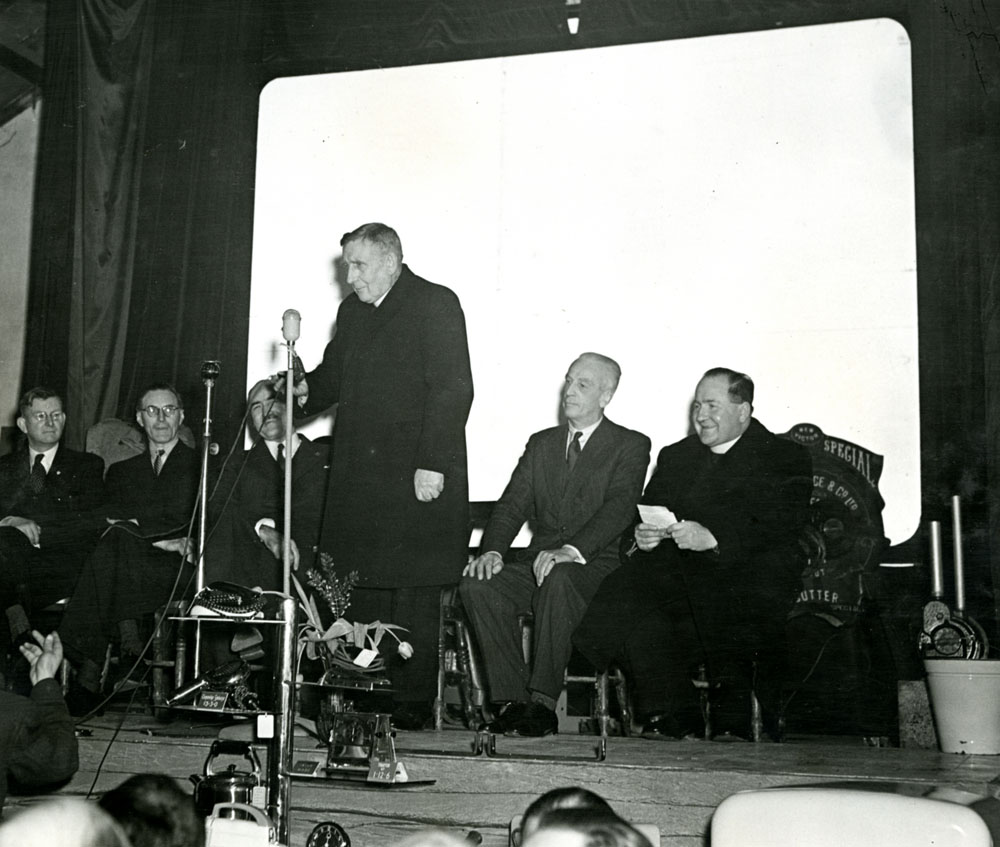 Switching on the 55,000th consumer, 29 January 1952. Fr McEvoy, Parish Priest, switching on the Parish Hall in Kilsaran, accompanied by Frank Aiken TD, Minister for External Affairs, as well as ESB representatives: RF Browne, Chairman; WF Roe and PJ Dowling.
The Switch on ceremony in Kilsaran was a special occasion as it also marked the fifth anniversary of the start of the rural scheme and was reported on extensively in The REO News from February 1952:
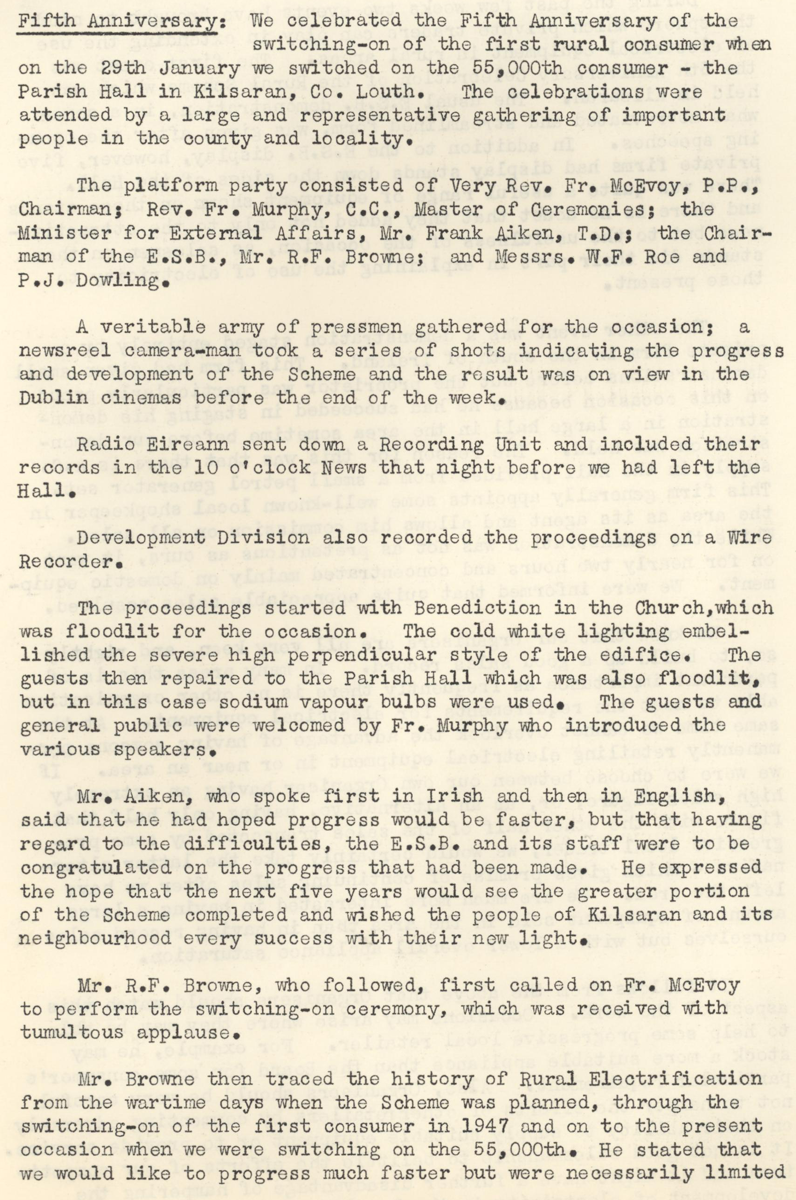
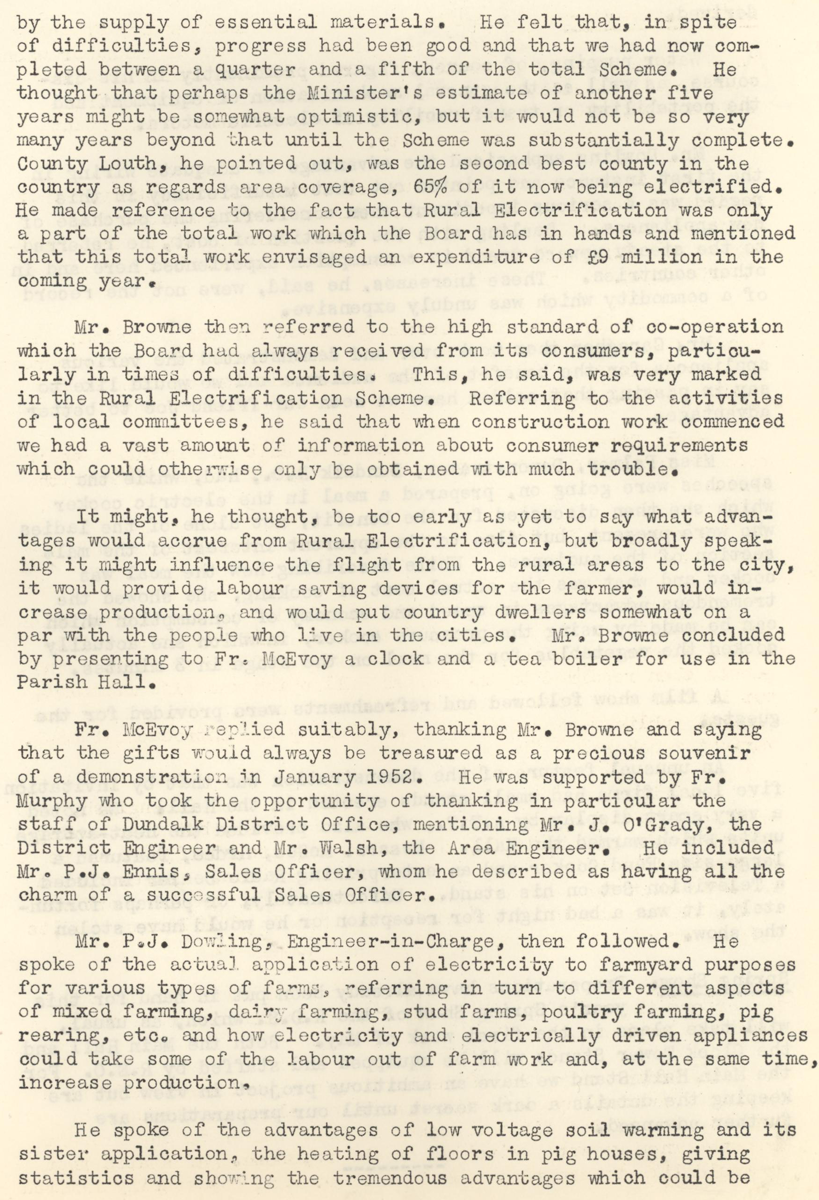
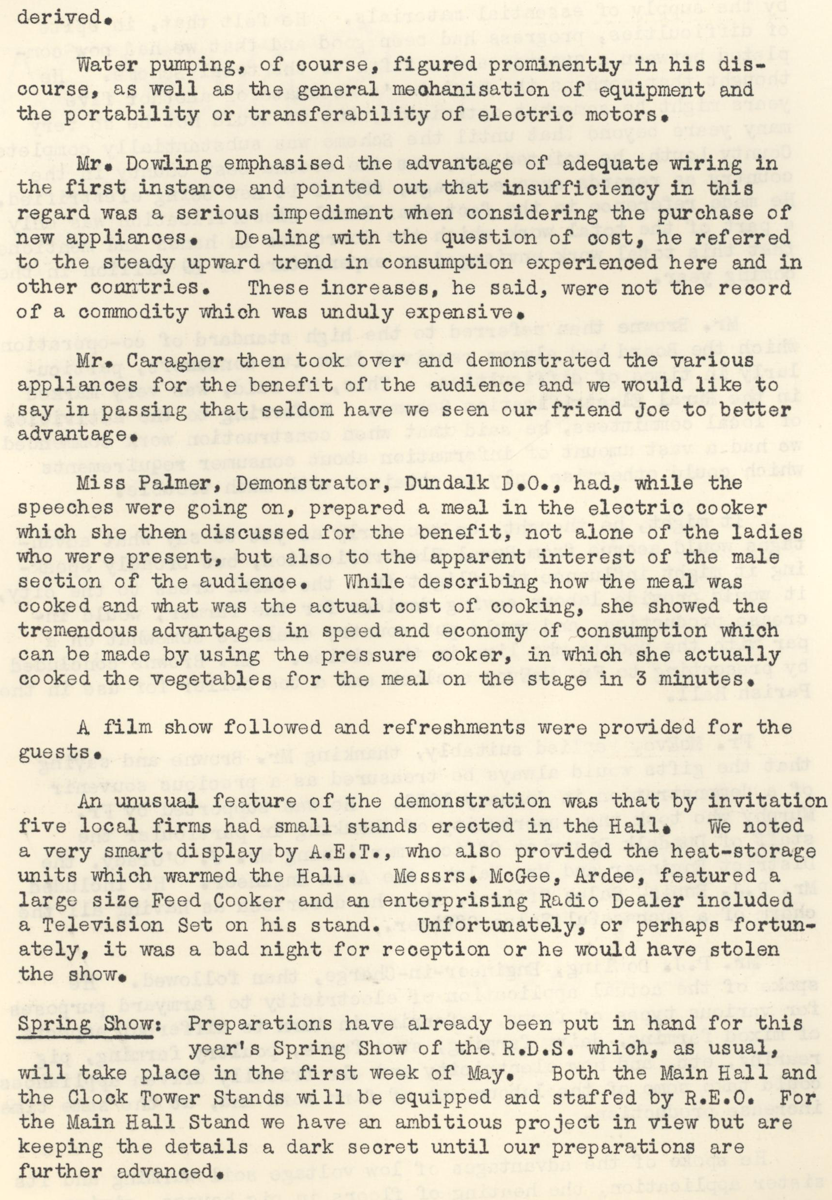
This digital scan from the REO News displays the following text:
"Fifth Anniversary
We celebrated the fifth anniversary of the switching-on of the first rural consumer when, on the 29th January, we switched on the 55,000th consumer, the Parish Hall in Kilsaran, Co. Louth. The celebrations were attended by a large and representative gathering of important people in the county and locality.
The platform party consisted of Very Rev. Fr. McEvoy, P.P., Chairman; Rev. Fr. Murphy, C.C., Master of Ceremonies; the Minister for External Affairs, Mr. Frank Aiken, T.D.; the Chairman of the E.S.B., Mr. R.F. Browne; and Messrs. W.F. Roe and P.J. Dowling.
A veritable army of pressmen gathered for the occasion; a newsreel cameraman took a series of shots indicating the progress and development of the Scheme and the result was on view in the Dublin cinemas before the end of the week.
Radio Eireann sent down a Recording Unit and included their records in the 10 o'clock News that night before we had left the Hall.
Development Division also recorded the proceedings on a Wire Recorder.
The proceedings started with Benediction in the Church, which was floodlit for the occasion. The cold white lighting embellished the severe high perpendicular style of the edifice. The guests then repaired to the Parish Hall which was also floodlit, but in this case sodium vapour bulbs were used. The guests and general public were welcomed by Fr. Murphy who introduced the various speakers.
Mr. Aiken, who spoke first in Irish and then in English, said that he had hoped progress would be faster, but that having regard to the difficulties, the E.S.B. and its staff were to be congratulated on the progress that had been made. He expressed the hope that the next five years would see the greater portion of the Scheme completed and wished the people of Kilsaran and its neighbourhood every success with their new light.
Mr. R.F. Browne, who followed, first called on Fr. McEvoy to perform the switching-on ceremony, which was received with tumultuous applause.
Mr. Browne then traced the history of Rural Electrification from the wartime days when the Scheme was planned, through the switching-on of the first consumer in 1947 and on to the present occasion when we were switching on the 55,000th. He stated that we would like to progress much faster but were necessarily limited by the supply of essential materials. He felt that, in spite of difficulties, progress had been good and that we had now completed between a quarter and a fifth of the total Scheme. He thought that perhaps the Minister's estimate of another five years might be somewhat optimistic, but it would not be so very many years beyond that until the Scheme was substantially complete. County Louth, he pointed out, was the second best county in the country as regards area coverage, 65% of it now being electrified. He made reference to the fact that Rural Electrification was only a part of the total work which the Board has in hand and mentioned that this total work envisaged an expenditure of £9 million in the coming year.
Mr. Browne then referred to the high standard of co-operation which the Board had always received from its consumers, particularly in times of difficulties. This, he said, was very marked in the Rural Electrification Scheme. Referring to the activities of local committees, he said that when construction work commenced we had a vast amount of information about consumer requirements which could otherwise only be obtained with much trouble.
It might, he thought, be too early as yet to say what advantages would accrue from Rural Electrification, but broadly speaking it might influence the flight from the rural areas to the city, it would provide labour-saving devices for the farmer, would increase production, and would put country dwellers somewhat on a par with the people who live in the cities. Mr. Browne concluded by presenting to Fr. McEvoy a clock and a tea boiler for use in the Parish Hall.
Fr. McEvoy replied suitably, thanking Mr. Browne and saying that the gifts would always be treasured as a precious souvenir of a demonstration in January 1952. He was supported by Fr. Murphy who took the opportunity of thanking in particular the staff of Dundalk District Office, mentioning Mr. J. O'Grady, the District Engineer and Mr. Walsh, the Area Engineer. He included Mr. P.J. Ennis, Sales Officer, whom he described as having all the charm of a successful Sales Officer.
Mr. P.J. Dowling, Engineer-in-Charge, then followed. He spoke of the actual application of electricity to farmyard purposes for various types of farms, referring in turn to different aspects of mixed farming, dairy farming, stud farms, poultry farming, pig rearing, etc., and how electricity and electrically driven appliances could take some of the labour out of farm work and, at the same time, increase production.
He spoke of the advantages of low voltage soil warming and its sister application, the heating of floors in pig houses, giving statistics and showing the tremendous advantages which could be derived.
Water pumping, of course, figured prominently in his discourse, as well as the general mechanisation of equipment and the portability or transferability of electric motors.
Mr. Dowling emphasised the advantage of adequate wiring in the first instance and pointed out that insufficiency in this regard was a serious impediment when considering the purchase of new appliances. Dealing with the question of cost, he referred to the steady upward trend in consumption experienced here and in other countries. These increases, he said, were not the record of a commodity which was unduly expensive.
Mr. Caragher then took over and demonstrated the various appliances for the benefit of the audience and we would like to say in passing that seldom have we seen our friend Joe to better advantage.
Miss Palmer, Demonstrator, Dundalk D.O., had, while the speeches were going on, prepared a meal in the electric cooker which she then discussed for the benefit, not alone of the ladies who were present, but also to the apparent interest of the male section of the audience. While describing how the meal was cooked and what was the actual cost of cooking, she showed the tremendous advantages in speed and economy of consumption which can be made by using the pressure cooker, in which she actually cooked the vegetables for the meal on the stage in 3 minutes.
A film show followed and refreshments were provided for the guests.
An unusual feature of the demonstration was that by invitation five local firms had small stands erected in the Hall. We noted a very smart display by A.E.T., who also provided the heat-storage units which warmed the Hall. Messrs. McGee, Ardee, featured a large size Feed Cooker and an enterprising Radio Dealer included a Television Set on his stand. Unfortunately, or perhaps fortunately, it was a bad night for reception or he would have stolen the show."