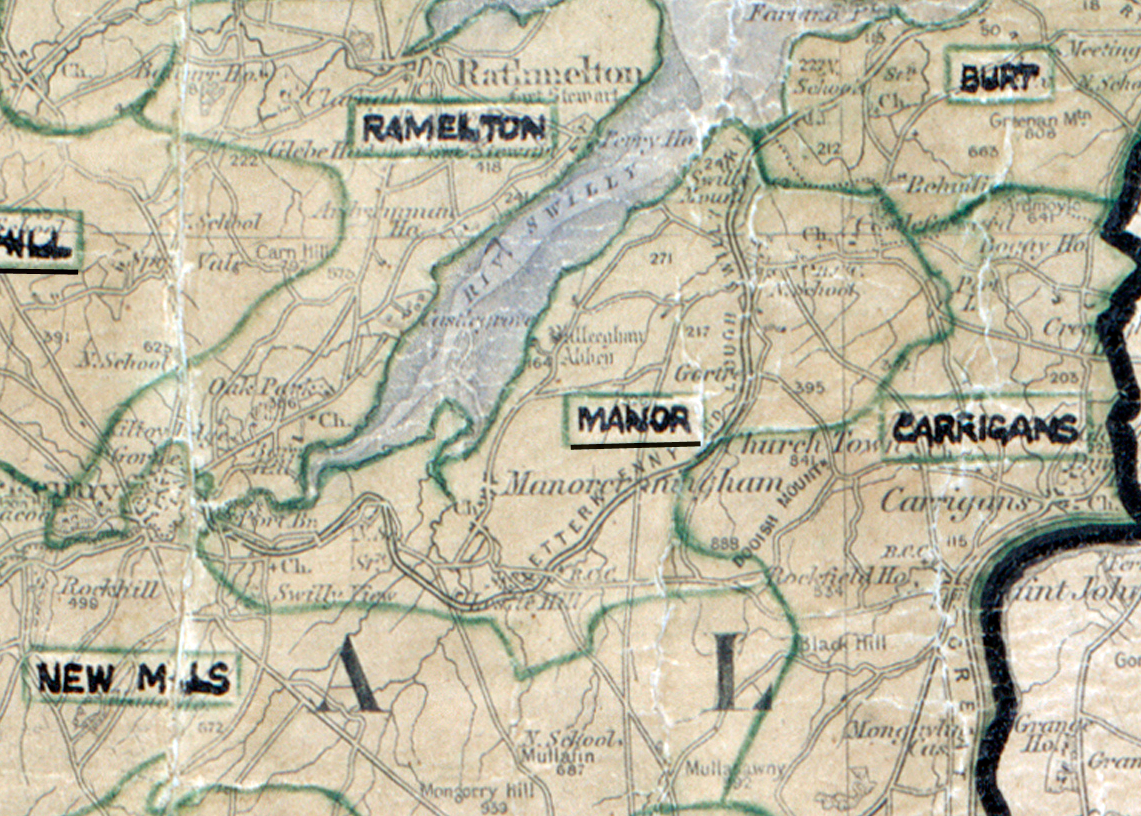
 Area: Manor
Started: June 1951
Finished: August 1952
Poles used: 1130
Line used (km): 91
Premises connected: 37
The figures above were sourced from our REO News magazine, to learn more about what these figures mean, visit our interactive map. The map above shows the area boundary and is from a digitised version of the original map used during the scheme.
The REO News from October 1952 tells us of a cup full of woe in Manor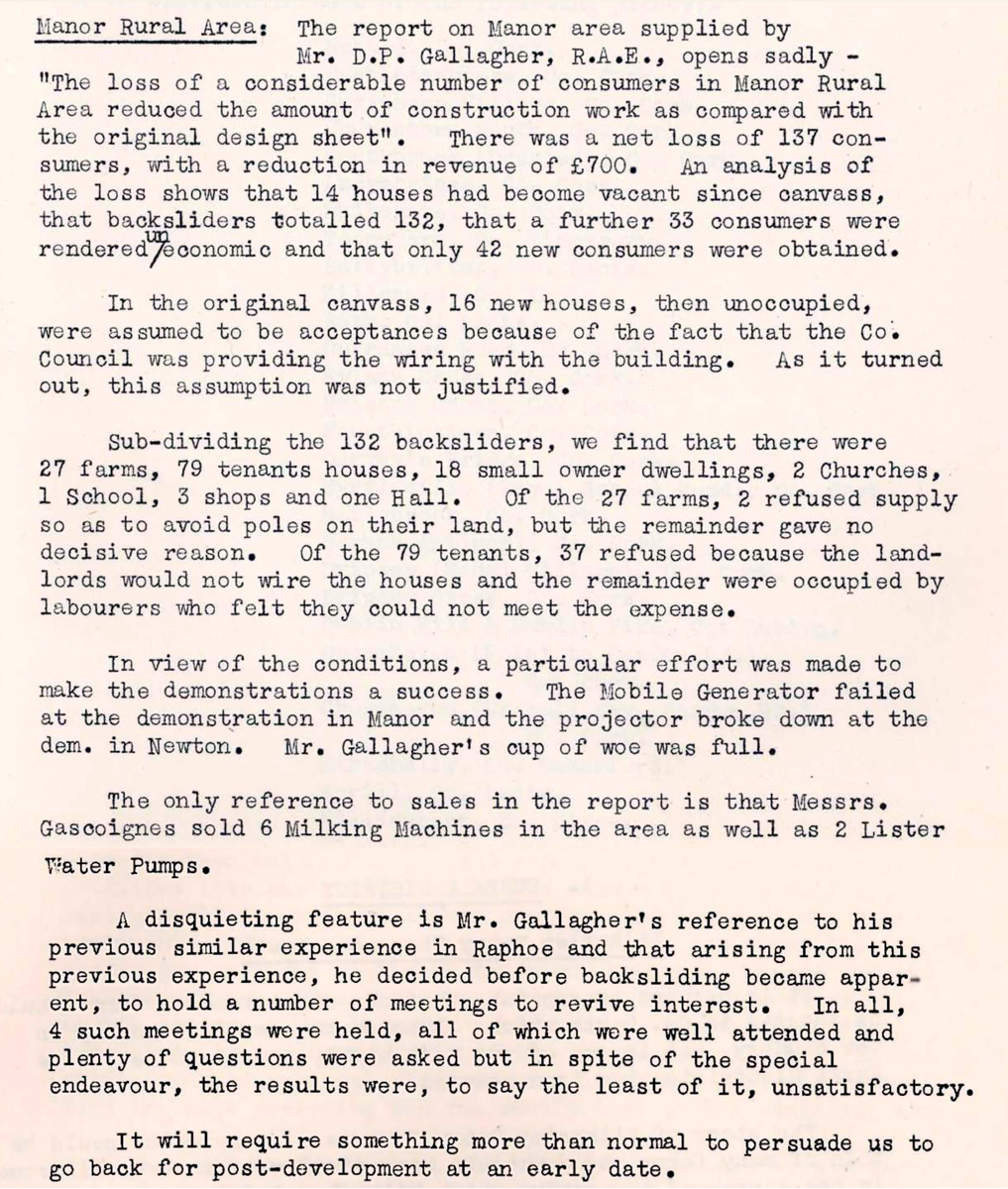 This digital scan from the REO News displays the following text:
"Manor Rural Area: The report on Manor area supplied by Mr. D.P. Gallagher, R.A.E., opens sadly –
'The loss of a considerable number of consumers in Manor Rural Area reduced the amount of construction work as compared with the original design sheet'. There was a net loss of 137 consumers, with a reduction in revenue of £700. An analysis of the loss shows that 14 houses had become vacant since canvass, that backsliders totalled 132, that a further 33 consumers were rendered uneconomic and that only 42 new consumers were obtained.
In the original canvass, 16 new houses, then unoccupied, were assumed to be acceptances because of the fact that the Co. Council was providing the wiring with the building. As it turned out, this assumption was not justified.
Sub‑dividing the 132 backsliders, we find that there were
27 farms, 79 tenants houses, 18 small owner dwellings, 2 Churches, 1 School, 3 shops and one Hall. Of the 27 farms, 2 refused supply so as to avoid poles on their land, but the remainder gave no decisive reason. Of the 79 tenants, 37 refused because the landlords would not wire the houses and the remainder were occupied by labourers who felt they could not meet the expense.
In view of the conditions, a particular effort was made to make the demonstrations a success. The Mobile Generator failed at the demonstration in Manor and the projector broke down at the dem. in Newton. Mr. Gallagher’s cup of woe was full.
The only reference to sales in the report is that Messrs. Gascoignes sold 6 Milking Machines in the area as well as 2 Lister Water Pumps.
A disquieting feature is Mr. Gallagher’s reference to his previous similar experience in Raphoe and that arising from this previous experience, he decided before backsliding became apparent, to hold a number of meetings to revive interest. In all, 4 such meetings were held, all of which were well attended and plenty of questions were asked but in spite of the special endeavour, the results were, to say the least of it, unsatisfactory.
It will require something more than normal to persuade us to go back for post‑development at an early date."