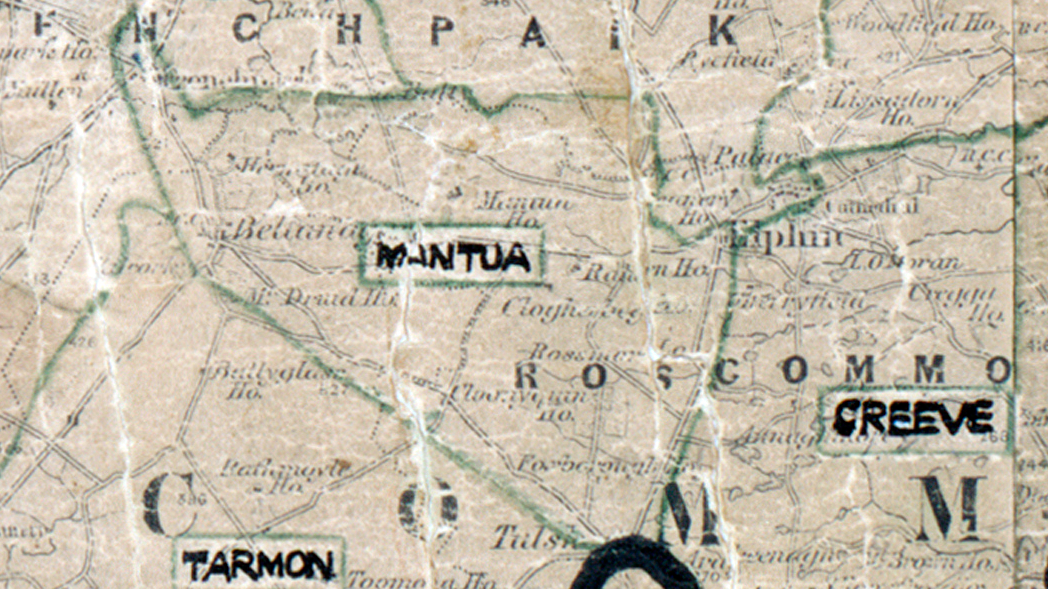
 Area: Mantua
Started: January 1948
Finished: December 1948
Poles used: 1086
Line used (km): 95
Premises connected: 293
The figures above were sourced from our REO News magazine, to learn more about what these figures mean, visit our interactive map. The map above shows the area boundary and is from a digitised version of the original map used during the scheme.
The REO News from May 1961 has a report by Mr. king on the use of aluminium and tells an amusing story about his time in Mantua.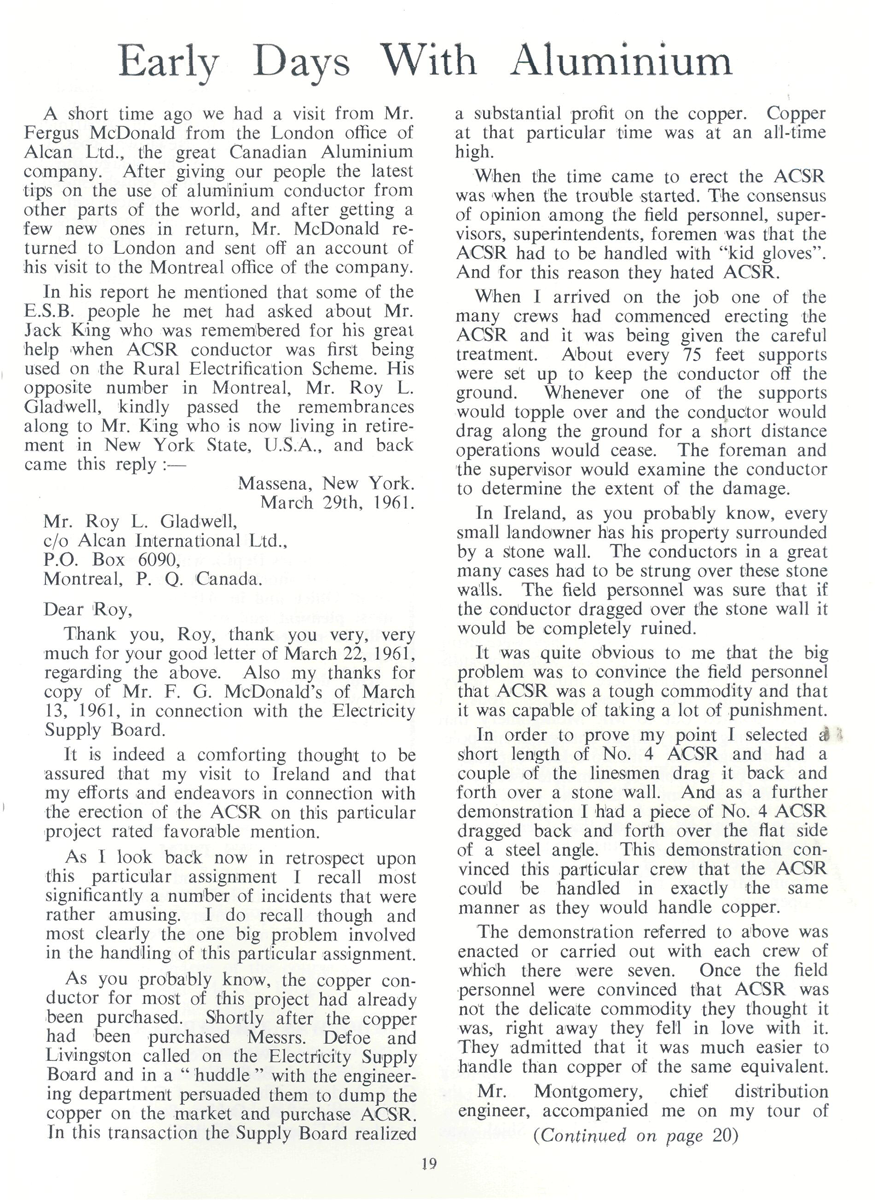 This digital scan from the REO News displays the following text:
"Early Days With Aluminium
A short time ago we had a visit from Mr. Fergus McDonald from the London office of Alcan Ltd., the great Canadian Aluminium company. After giving our people the latest tips on the use of aluminium conductor from other parts of the world, and after getting a few new ones in return, Mr. McDonald returned to London and sent off an account of his visit to the Montreal office of the company.
In his report he mentioned that some of the E.S.B. people he met had asked about Mr. Jack King who was remembered for his great help when ACSR conductor was first being used on the Rural Electrification Scheme. His opposite number in Montreal, Mr. Roy L. Gladwell, kindly passed the remembrances along to Mr. King who is now living in retirement in New York State, U.S.A., and back came this reply:—
Massena, New York.
March 29th, 1961.
Mr. Roy L. Gladwell,
c/o Alcan International Ltd.,
P.O. Box 6090,
Montreal, P. Q. Canada.
Dear Roy,
Thank you, Roy, thank you very, very much for your good letter of March 22, 1961, regarding the above. Also my thanks for copy of Mr. F. G. McDonald’s of March 19, 1961, in connection with the Electricity Supply Board.
It is indeed a comforting thought to be assured that my visit to Ireland and that my efforts and decisions on constructional design were acceptable and that the rural project rated favourable mention.
As I look back now in retrospect upon my Irish assignment, the wonderful helpfulness of a number of the old hands comes to mind. You may remember one of our problems involved the making of the pre‑literature assignment. This primarily involved thorough ground surveys and tests of the application of the conductor. By this project, there had already been shipped a considerable amount of conductor, enough for over 300 miles of balanced transmission. At that time conductor was the very scarce product and money to purchase such large amounts was scarce. The Board took a certain amount of a chance and by this transaction the Supply Board realized a substantial profit on the copper. Copper at that particular time was at an all‑time high.
When the time came to erect the ACSR line, things were better settled. The consensus was that ACSR had to be tensioned over suspension insulators. After the work was done, the ACSR had the bending radius of a jungle vine. It looked horrible. The Executive Supervisor was requested to investigate this and to prescribe means for straightening such a spread condition. Coincident with this, the ACSR jam wires in its construction would sometimes break loose in the conductor and would frequently be found, in some cases at the insulator, while in others at a distance of a ground rod. Whenever one of the jam wire supports dropped loose the conductor of course sagged.
Which part was wrong? Were the supports too far apart or were they too close? If too close the supervisor would call for removing one. If too far apart he would have to add one.
In Ireland, as you probably know, everyone is a miner. The huts around the Copper Mines always told the same stories of a cow thrown down the holes and the strong men were there as many as needed to be. Our guess was that the conductor dropped under the stone wall it would be completely ruined.
After this was finished, the important thing was to make testing checks on all other defects discovered in the line.
We knew, of course, in the erection of this new line what honourable part the necessary sagging procedure would give. But we had available the services of an excellent crew on line construction led by the Executive Supervisor, who was highly trusted by all concerned. This leadership was essential to rapid progress.
We believe that all of us could tell of memorable days of our technical discussions on sagging and on the mechanical usage of fettling the conductor during the erection in Ireland.
At the end of this assignment, after erecting this pilot line at great speed and in a safe and timely manner we were convinced we had done a good job. Something to be proud of. Many thanks to the fellowship and guidance of your Executive Supervisors and our own staff. One of the happier moments was when I was taking leave of the work in the company of the last three men on the job. They gave me a rousing and energetic farewell. My executive engineer, accompanied by a member of our…
(Continued on page 20)"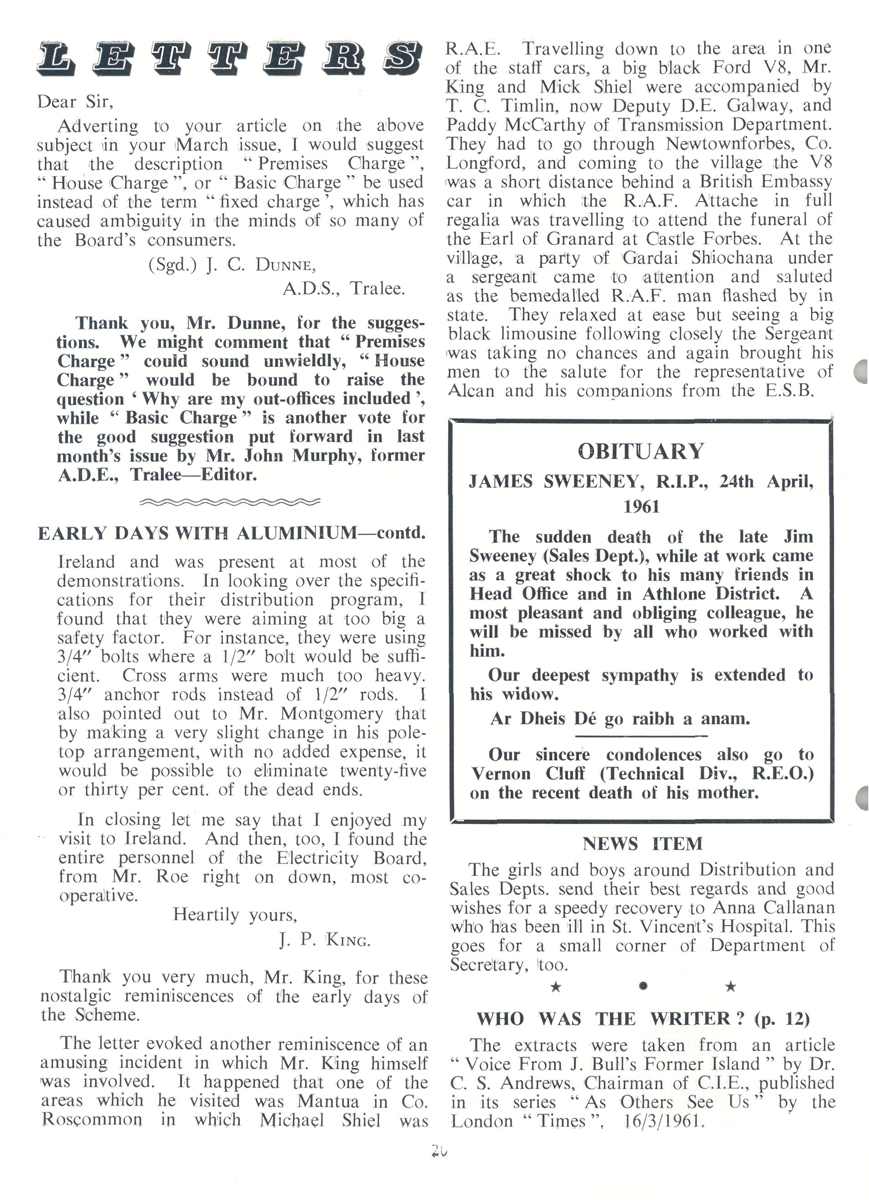 This digital scan from the REO News displays the following text:
"LETTERS
Dear Sir,
Adverting to your article on the above subject in your March issue, I would suggest that the description “Premises Charge” “House Charge” or “Basic Charge” be used instead of the term “fixed charge” which has caused ambiguity in the minds of so many of the Board’s consumers.
(Sgd.) J. C. Dunne,
A.D.S., Tralee.
Thank you, Mr. Dunne, for the suggestions. We might comment that “Premises Charge” could sound unwieldy, “House Charge” would be bound to raise the question “Why are my out‑offices included,” while “Basic Charge” is another word for the good suggestion put forward in last month’s issue by Mr. John Murphy, former A.D.E., Tralee—Editor.
EARLY DAYS WITH ALUMINIUM—contd.
Ireland was in presence at most of the demonstrations. In looking over the specifications for their distribution line, we often found that they were aiming at too big a safety factor for a fast‑moving type of load. 3/47 bolts where a 1/2 bolt would be sufficient. Cross arms were not too heavy. 3/4” was the proper size instead of 1 1/2” wood. I remember very well that the wooden cross arms obtained in American shipments were admired by the Irish for their fabrication. They had a better paint coat and seemed lighter in weight.
When my assignment was finished, I found the entire project most interesting. On my return to America Mr. Roe right on down, most cooperated.
Heartily yours,
J. P. KING.
Thank you very much, Mr. King, for these nostalgic reminiscences of the early days of the Scheme.
The reminiscences recall our fond memories of many incidents, including Mr. King himself amusingly telling how he and Mr. Shiel in the areas where no roads existed, going up the Roscommon mountains until Michael Shiel was R.A.F. Travelling down to the area in one of the staff cars, a big black Ford V8, Mr. King and Mick Shiel were accompanied by T. C. Timlin, now Deputy D.E. Galway, and Paddy McCarthy of Transmission Department. They had to go through Newton where new motor cars were made for the Willys Jeep. This was a short distance from the British Embassy. In front of the Embassy a flag of Ireland flew—very rare in London at that time. At the arrival in Granard at Castle Forbes under the care of Sir Leonard de Windt—a fellow of heavy weight—they found that the estate was house‑warming. The new owner, an ex‑retired R.A.F. man flashed by his size. They were all made welcome. The supervisor was taking no chances and again brought his men to the salute for the representative of Alcan and his companions from the E.S.B.
OBITUARY
JAMES SWEENEY, R.I.P., 24th April, 1961
The sudden death of the late Jim Sweeney (Sales Dept.), while at work came as a great shock to his many friends in Fleet Street and also his colleagues, who will miss his dependable, obliging nature and humour.
Our deepest sympathy is extended to his widow and children.
Ar Dheis Dé go raibh a anam.
Sincere condolences also go to Mr. O’Dea (Technical Div., R.E.O.) on the recent death of his mother.
NEWS ITEM
The girls and boys from Distribution and Sales Departments were anxious and glad to cooperate with the National Blood Transfusion Association recently, and the first of what will probably be regular collections was made in our Department.
WHO WAS THE WRITER? (P. 12)
The little rhyme previously taken from a prize “Voice From a Bull’s Foramen Magnum” by Dr. C. S. Gordon, as part of “Skull and Brain.” The title appears as “As Others See Us” by the London “Times” 16/3/1961."