Area: Mulrany
Started: June 1951
Finished: August 1952
Poles used: 1248
Line used (km): 98
Premises connected: 360
The figures above were sourced from our REO News magazine, to learn more about what these figures mean, visit our interactive map. The map above shows the area boundary and is from a digitised version of the original map used during the scheme.
Construction in Mulrany posed some difficulties as reported in The REO News from February 1953
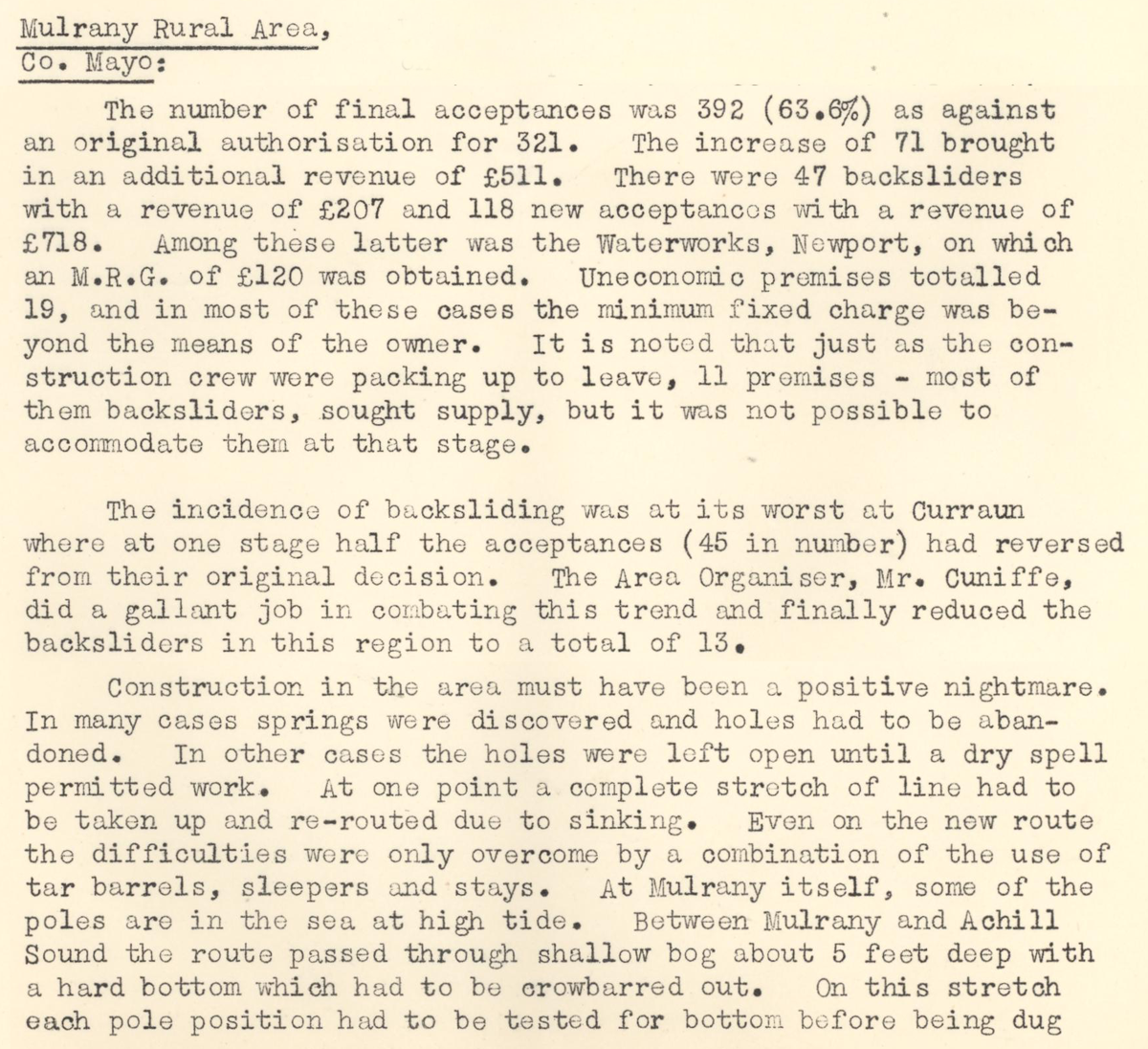
This digital scan from the REO News displays the following text:
"Mulrany Rural Area, Co. Mayo:
The number of final acceptances was 392 (63.6%), as against an original authorisation for 321. The increase of 71 brought in an additional revenue of £511. There were 47 backsliders with a revenue of £207 and 118 new acceptances with a revenue of £718. Among these latter was the Waterworks, Newport, on which an M.R.G. of £120 was obtained. Uneconomic premises totalled 19, and in most of these cases the minimum fixed charge was beyond the means of the owner. It is noted that just as the construction crew were packing up to leave, 11 premises—most of them backsliders—sought supply, but it was not possible to accommodate them at that stage.
The incidence of backsliding was at its worst at Currane where at one stage half the acceptances (45 in number) had reversed from their original decision. The Area Organiser, Mr. Cuniffe, did a gallant job in combating this trend and finally reduced the backsliders in this region to a total of 13.
Construction in the area must have been a positive nightmare. In many cases springs were discovered and holes had to be abandoned. In other cases the holes were left open until a dry spell permitted work. At one point a complete stretch of line had to be taken up and re‑routed due to sinking. Even on the new route the difficulties were only overcome by a combination of the use of tar barrels, sleepers and stays. At Mulrany itself, some of the poles are in the sea at high tide. Between Mulrany and Achill Sound the route passed through shallow bog about 5 feet deep with a hard bottom which had to be crowbarred out. On this stretch each pole position had to be tested for bottom before being dug."
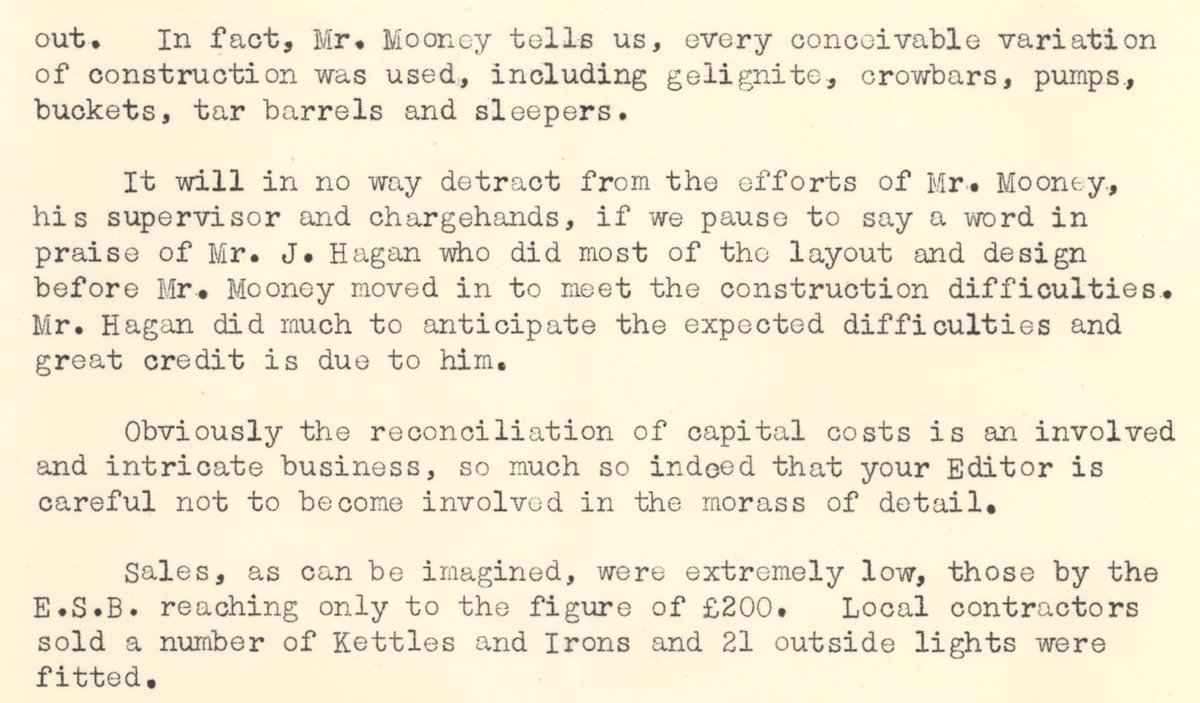
This digital scan from the REO News displays the following text:
"out. In fact, Mr. Mooney tells us, every conceivable variation of construction was used, including gelignite, crowbars, pumps, buckets, tar barrels and sleepers.
It will in no way detract from the efforts of Mr. Mooney, his supervisor and chargehands, if we pause to say a word in praise of Mr. J. Hagan who did most of the layout and design before Mr. Mooney moved in to meet the construction difficulties. Mr. Hagan did much to anticipate the expected difficulties and great credit is due to him.
Obviously the reconciliation of capital costs is an involved and intricate business, so much so indeed that your Editor is careful not to become involved in the morass of detail.
Sales, as can be imagined, were extremely low, those by the E.S.B. reaching only to the figure of £200. Local contractors sold a number of Kettles and Irons and 21 outside lights were fitted."