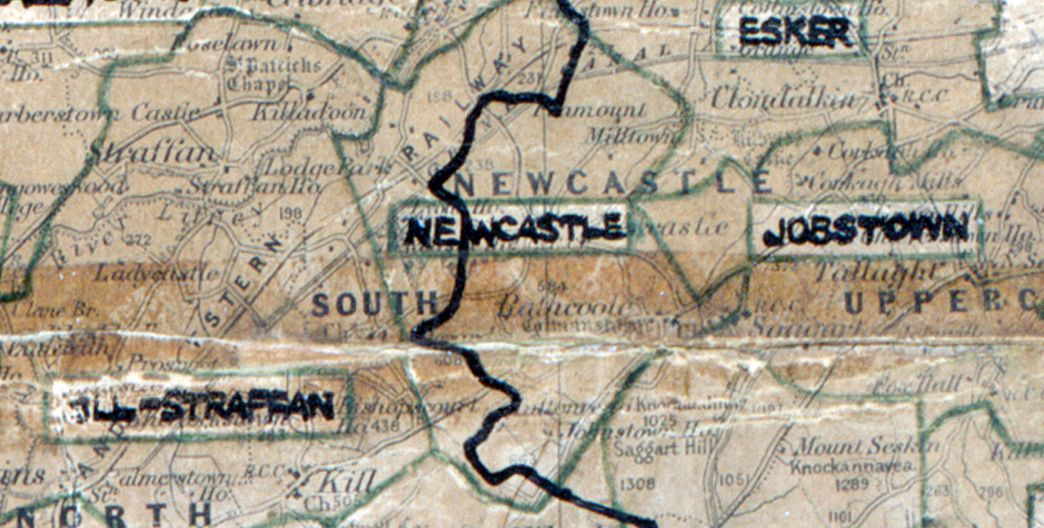
 Area: Newcastle
Started: May 1948
Finished: March 1949
Poles used: 905
Line used (km): 73
Premises connected: 290
The figures above were sourced from our REO News magazine, to learn more about what these figures mean, visit our interactive map. The map above shows the area boundary and is from a digitised version of the original map used during the scheme.
Domestic appliances were in demand in Newcastle according to The REO News from October 1948. This digital scan from the REO news displays the following text:
"A well attended two-day demonstration was held at Rathcoole (Newcastle Rural Area), during the month. We also exhibited at the Waterford Agricultural Show. Keen interest was evident on both occasions, particularly in domestic appliances."
The REO News from January 1954 had an interesting article about Corner Park Farm Newcastle.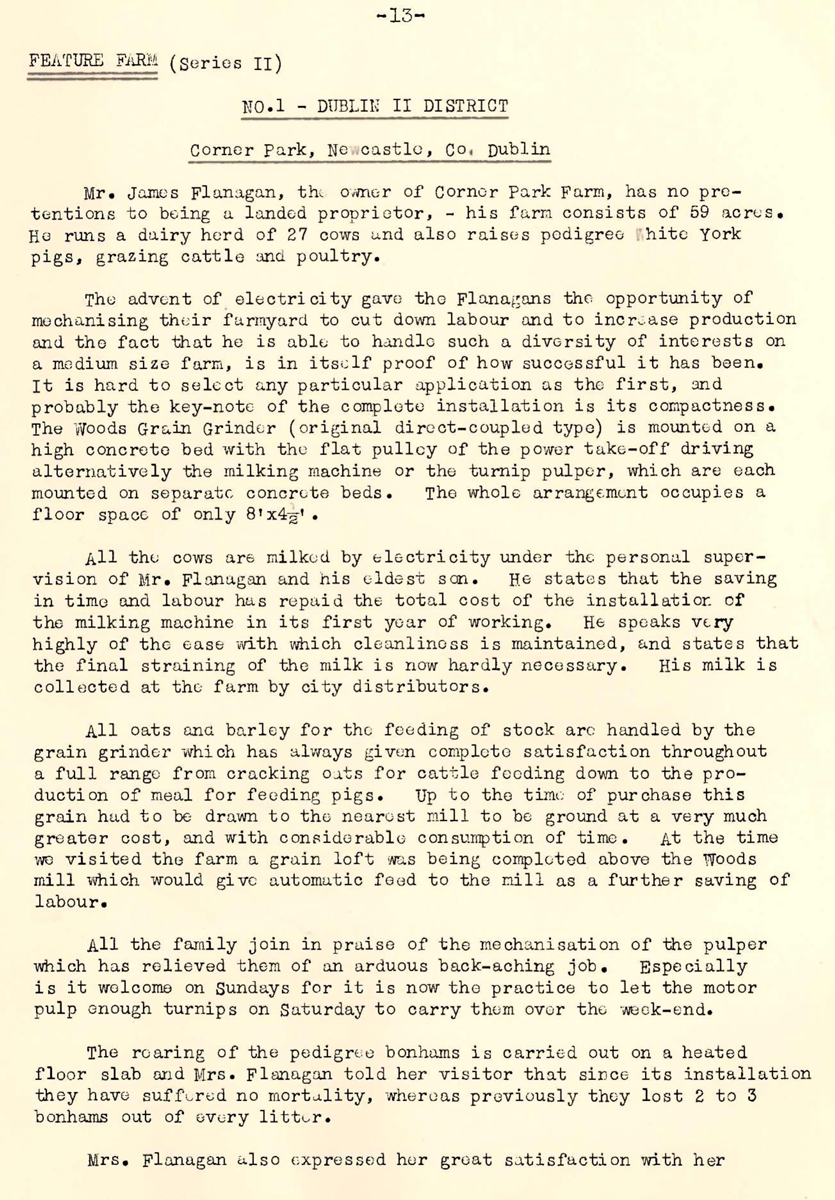 This digital scan from the REO news displays the following text:
"-13-
FEATURE FARM (Series II)
NO. 1 – DUBLIN II DISTRICT
Connor Park, Newcastle, Co. Dublin
"Mr. James Flanagan, the owner of Connor Park Farm, has no pretensions to being a landed proprietor; his farm consists of 50 acres. He runs a dairy herd of 27 cows and also raises pedigree White York pigs, grazing cattle and poultry.
The advent of electricity gave the Flanagans the opportunity of mechanising their farmyard to cut down labour and to increase production and the fact that he is able to handle such a diversity of interests on a medium size farm, is in itself proof of how successful it has been. It is hard to select any particular application as the first, and probably the key-note of the complete installation is its compactness. The Woods Grain Grinder (original direct-coupled type) is mounted on a high concrete bed with the flat pulley of the power take-off driving the grinder or, with the aid of a countershaft, the turnip pulper, which are each mounted on separate concrete beds. The whole arrangement occupies a floor space of only 8' × 4'.
All the cows are milked by electricity under the personal supervision of Mr. Flanagan and his eldest son. He states that the saving in time and labour has repaid the total cost of the installation of the milking machine in the first year of working. He speaks very highly of the ease with which cleanliness is maintained, and states that the final rinsing of the cluster washers is all that is necessary. His milk is collected at the farm gate by distributors.
All oats and barley for the feeding of stock are handled by the grain grinder which has always given complete satisfaction through a full rein of croaking pulleys on complete freedom of servicing, with the exception of fan feed rings, etc. The pigs share this general round of feeding operations for some of the dry feed being given at present, with a considerable consumption of meal. At the time we visited the yard, grain for poultry was being ground very well, all of which would give a little feed to the mills at a further saving of labour.
All the family join in praises of the mechanisation of the pulper which has replaced one of an arduous back-breaking job. Especially is it welcome on Sundays for it is now possible to pulp enough turnips on Saturday to carry them over the week-end.
The rearing of the pedigree bonhams is carried out on a heated floor slab and Mrs. Flanagan told her visitor that since its installation they have not lost a piglet, whereas previously they lost 2 to 3 bonhams out of every litter.
Mrs. Flanagan also expressed her great satisfaction with her."