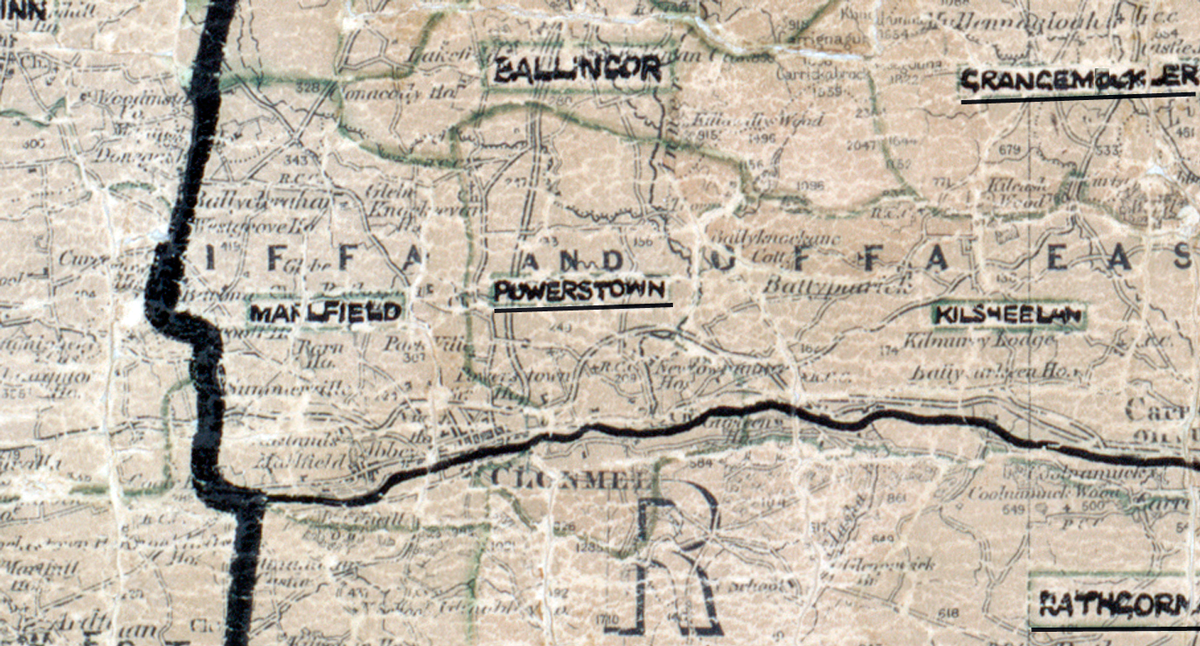
 Area: Powerstown
Started: December 1952
Finished: July 1953
Poles used: 634
Line used (km): 59
Premises connected: 63
The figures above were sourced from our REO News magazine, to learn more about what these figures mean, visit our interactive map. The map above shows the area boundary and is from a digitised version of the original map used during the scheme.
The REO News from November 1953 tells us that the report from Powerstown was very interesting
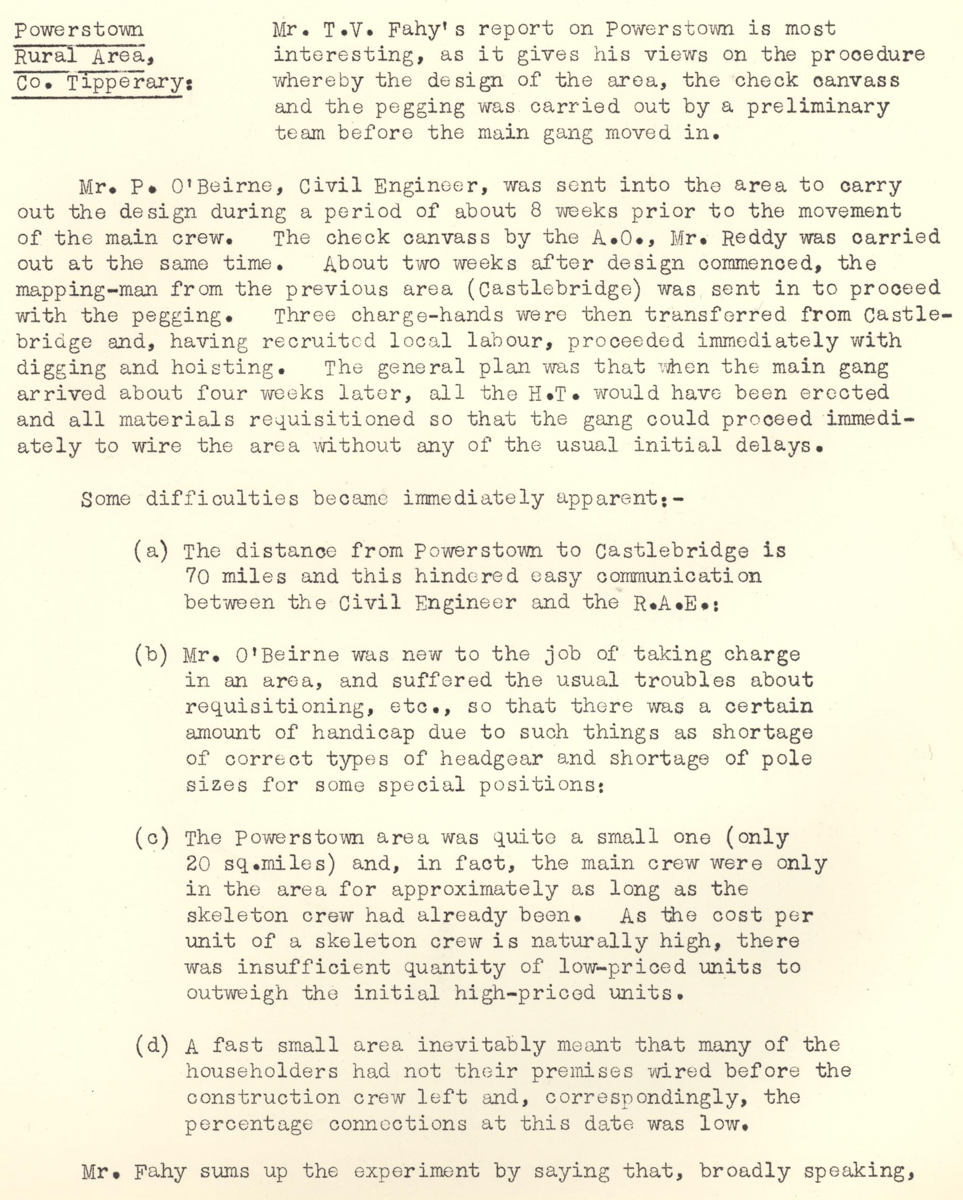 This digital scan from the REO News displays the following text:
"Powerstown Rural Area, Co. Tipperary:
Mr. T. V. Fahy’s report on Powerstown is most interesting, as it gives his views on the procedure whereby the design of the area, the check canvass and the pegging was carried out by a preliminary team before the main gang moved in.
Mr. P. O’Beirne, Civil Engineer, was sent into the area to carry out the design during a period of about 8 weeks prior to the commencement of the main crew. The check canvass was then carried out at the same time. About two weeks after design commenced, the mapping man from the previous area (Castlebridge) was sent in to proceed with the pegging. Three charge‑hands were then transferred from Castlebridge and, having recruited local labour, proceeded immediately with digging and hoisting. The general plan was that when the main gang arrived about four weeks later, all the H.T. would have been erected and all materials requisitioned so that the gang could proceed immediately to wire the area without any of the usual initial delays.
Some difficulties became immediately apparent:
(a) The distance from Powerstown to Castlebridge is 70 miles and this hindered easy communication between the Civil Engineer and the R.A.E.
(b) Mr. O’Beirne was new to the job of taking charge in an area, and suffered the usual troubles about requisitioning, etc., so that there was a certain amount of handicap due to such things as shortage of correct types of headgear and shortage of pole sizes for some special positions.
(c) The Powerstown area was quite a small one (only 20 sq. miles) and, in fact, the main crew were only in the area for approximately as long as the skeleton crew had already been. As the cost per unit of a skeleton crew is naturally high, there was insufficient quantity of low‑priced units to outweigh the initial high‑priced units.
(d) A fast small area invariably meant that many of the householders had not their premises wired before the construction crew left and, correspondingly, the percentage connections at this date was low.
Mr. Fahy sums up the experiment by saying that, broadly speaking,"
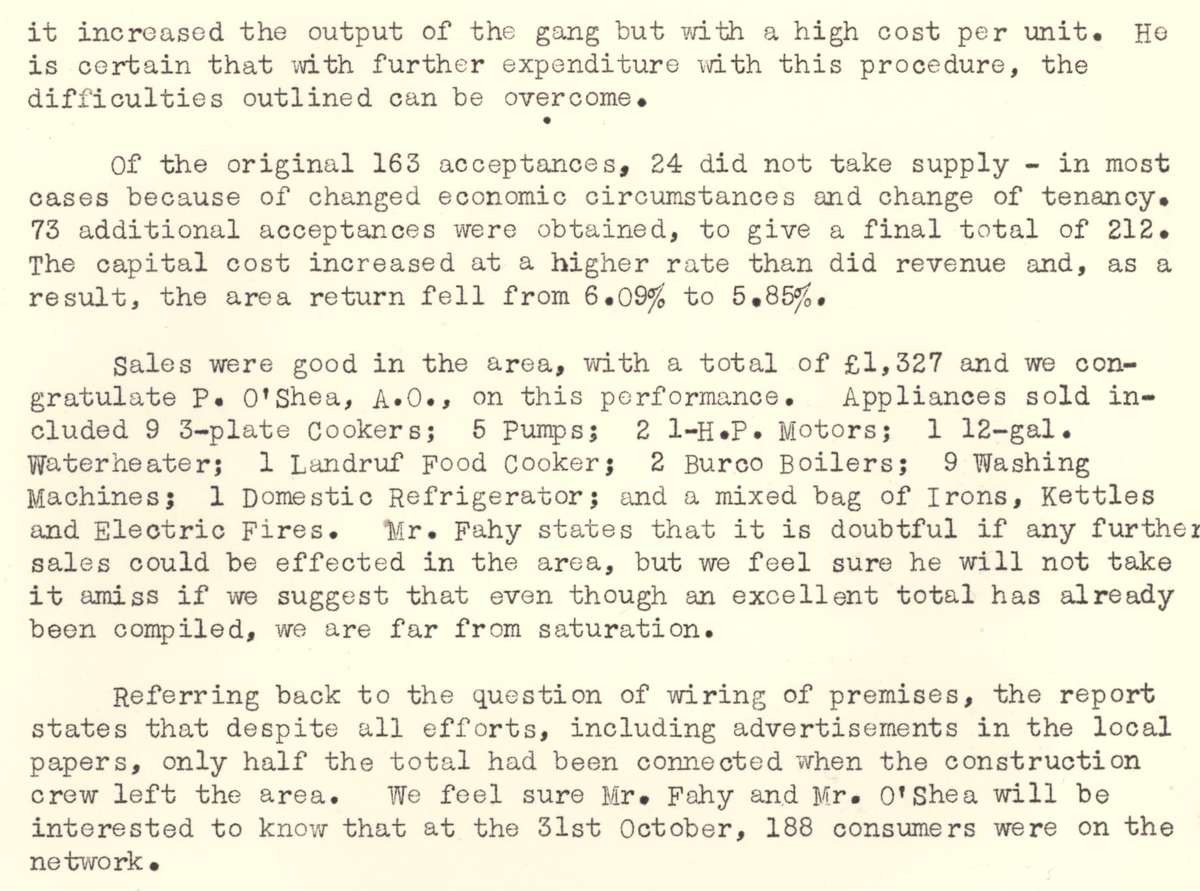 This digital scan from the REO News displays the following text:
"It increased the output of the gang but with a high cost per unit. He is certain that with further expenditure with this procedure, the difficulties outlined can be overcome.
Of the original 163 acceptances, 24 did not take supply — in most cases because of changed economic circumstances and change of tenancy. 73 additional acceptances were obtained, to give a final total of 212. The capital cost increased at a higher rate than revenue and, as a result, the area return fell from 6.09% to 5.85%.
Sales were good in the area, with a total of £1,327 and we congratulate P. O’Shea, A.O., on this performance. Appliances sold included 9 3‑plate Cookers; 5 Pumps; 2 1‑H.P. Motors; 1 12‑gal. Waterheater; 1 Landruft Food Cooker; 2 Burco Boilers; 9 Washing Machines; 1 Domestic Refrigerator; and a mixed bag of Irons, Kettles and Electric Fires. Mr. Fahy states that it is doubtful if any further sales could be effected in the area, but we feel sure he will not take it amiss if we suggest that even though an excellent total has already been compiled, we are far from saturation.
Referring back to the question of wiring of premises, the report states that despite all efforts, including advertisements in the local papers, only half the total had been connected when the construction crew left the area. We feel sure Mr. Fahy and Mr. O’Shea will be interested to know that at the 31st October, 188 consumers were on the network."