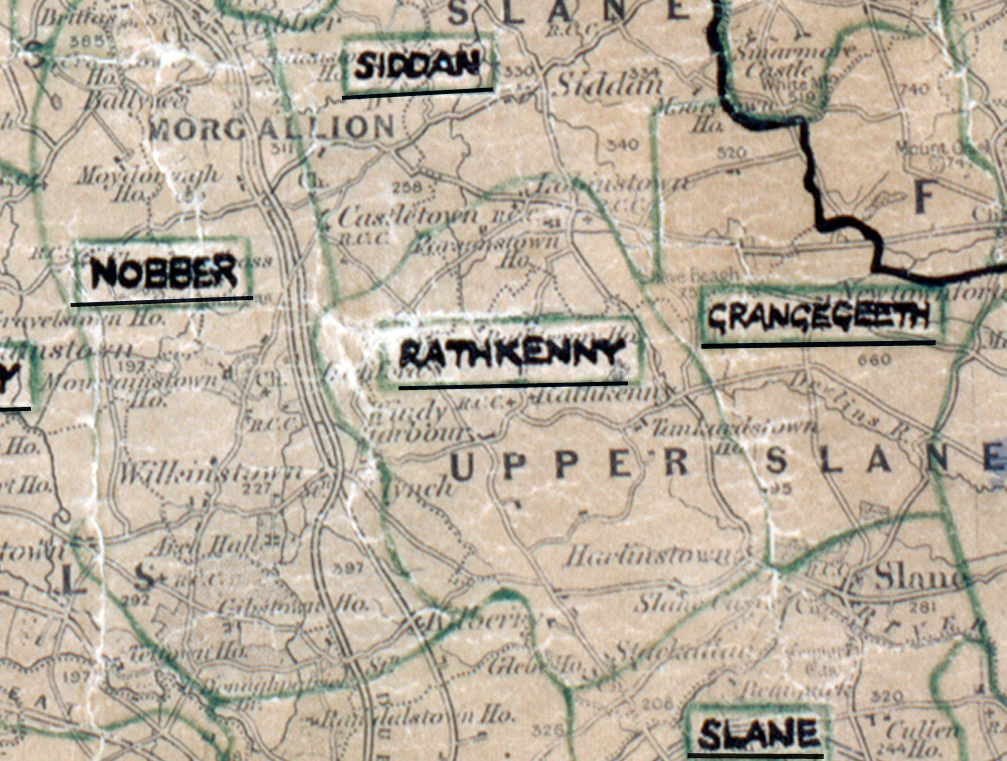
 Area: Rathkenny
Started: January 1953
Finished: October 1953
Poles used: 965
Line used (km): 88
Premises connected: 242
The figures above were sourced from our REO News magazine, to learn more about what these figures mean, visit our rural map explanation page. The map above shows the area boundary and is from a digitised version of the original map used during the scheme.
The REO News from November 1953 reports that there were two major difficulties in Rathkenny.
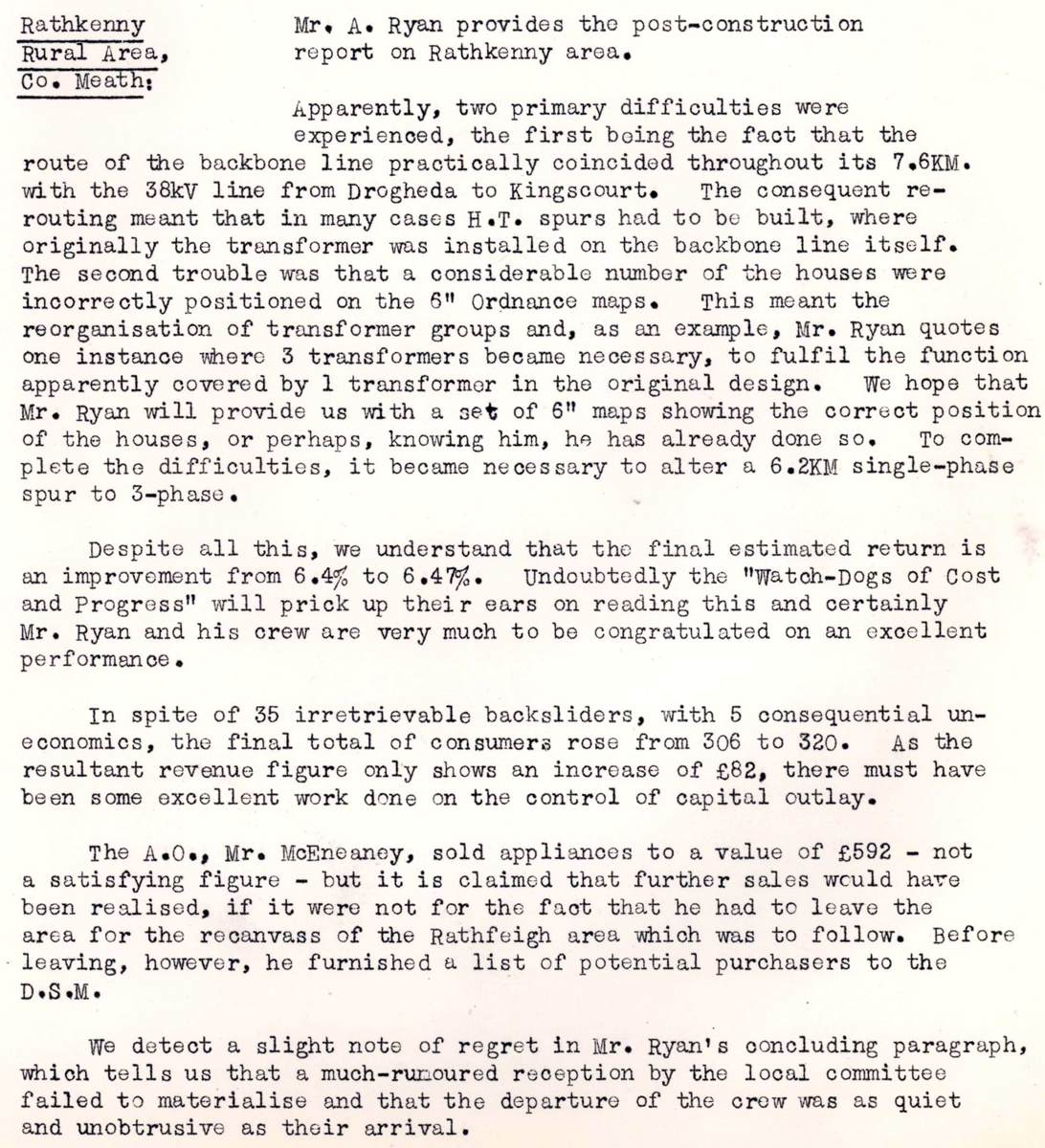 This digital scan from the REO News displays the following text:
"Rathkenny Rural Area, Co. Meath: Mr. A. Ryan provides the post‑construction report on Rathkenny area.
Apparently, two primary difficulties were experienced, the first being the fact that the route of the backbone line practically coincided throughout its 7.6 KM with the 38 kV line from Drogheda to Kingscourt. The consequent re‑routing meant that in many cases H.T. spurs had to be built, where originally the transformer was installed on the backbone line itself. The second trouble was that a considerable number of the houses were incorrectly positioned on the 6" Ordnance maps. This meant the reorganisation of transformer groups and, as an example, Mr. Ryan quotes one instance where 3 transformers became necessary, to fulfil the function apparently covered by 1 transformer in the original design. We hope that Mr. Ryan will provide us with a set of 6" maps showing the correct position of the houses, or perhaps, knowing him, he has already done so. To complete the difficulties, it became necessary to alter a 6.2 KM single‑phase spur to 3‑phase.
Despite all this, we understand that the final estimated return is an improvement from 6.4% to 6.47%. Undoubtedly the “Watch‑Dogs of Cost and Progress” will prick up their ears on reading this and certainly Mr. Ryan and his crew are very much to be congratulated on an excellent performance.
In spite of 35 irretrievable backsliders, with 5 consequential uneconomics, the final total of consumers rose from 305 to 320. As the resultant revenue figure only shows an increase of £82, there must have been some excellent work done on the control of capital outlay.
The A.O., Mr. McEneaney, sold appliances to a value of £592 – not a satisfying figure – but it is claimed that further sales would have been registered were it not for the fact that he had to leave the area for the re‑canvass of the Rathfeigh area which was to follow. Before leaving, however, he furnished the list of potential purchasers to the D. & S.M.
We detect a slight note of regret in Mr. Ryan’s concluding paragraph, in which he tells us that a much‑more‑rousing reception by the local committee tended to materialise and that the departure of the crew was as quiet and unobtrusive as their arrival."