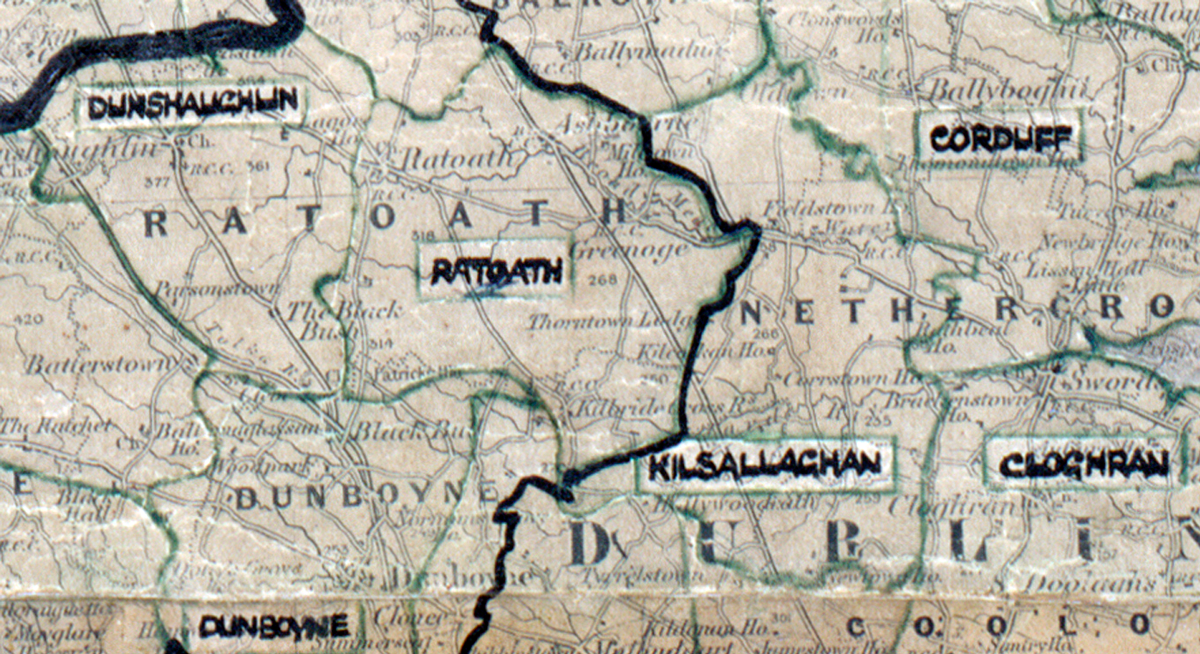
 Area: Ratoath
Started: June 1948
Finished: April 1949
Poles used: 1001
Line used (km): 81
Premises connected: 200
The figures above were sourced from our REO News magazine, to learn more about what these figures mean, visit our interactive map. The map above shows the area boundary and is from a digitised version of the original map used during the scheme.
The REO News from January 1949 reports on the use of concrete poles and conductors in Ratoath.
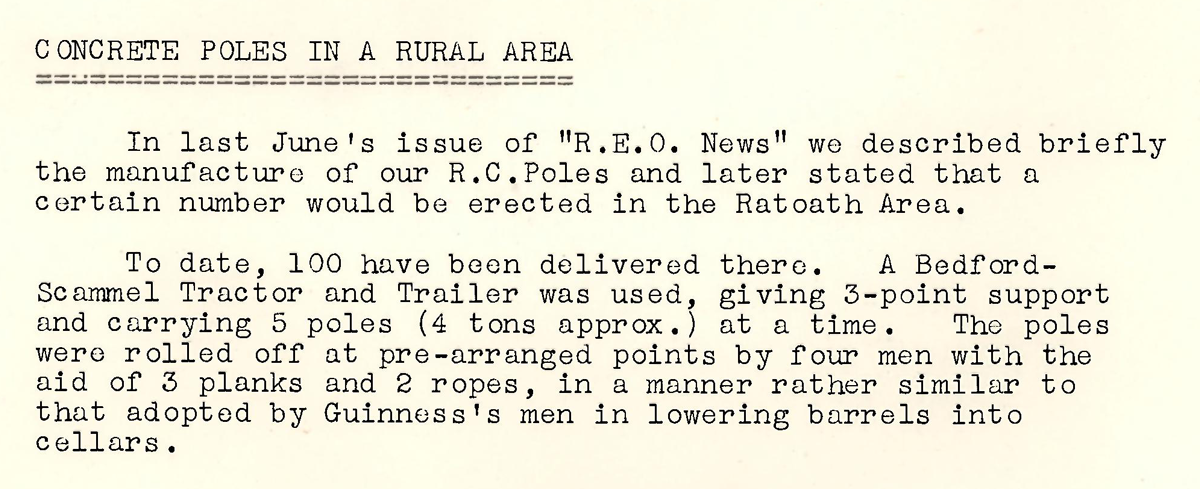
 This digital scan from the REO News displays the following text:
"CONCRETE POLES IN A RURAL AREA
In last June’s issue of “R.E.O. News” we described briefly the manufacture of our R.C. Poles and later stated that a certain number would be erected in the Ratoath Area.
To date, 100 have been delivered there. A Bedford‑Scammel Tractor and Trailer was used, giving 3‑point support and carrying 5 poles (4 tons approx.) at a time. The poles were rolled off at pre‑arranged points by four men with the aid of 3 planks and 2 ropes, in a manner rather similar to that adopted by Guinness’s men in lowering barrels into cellars."
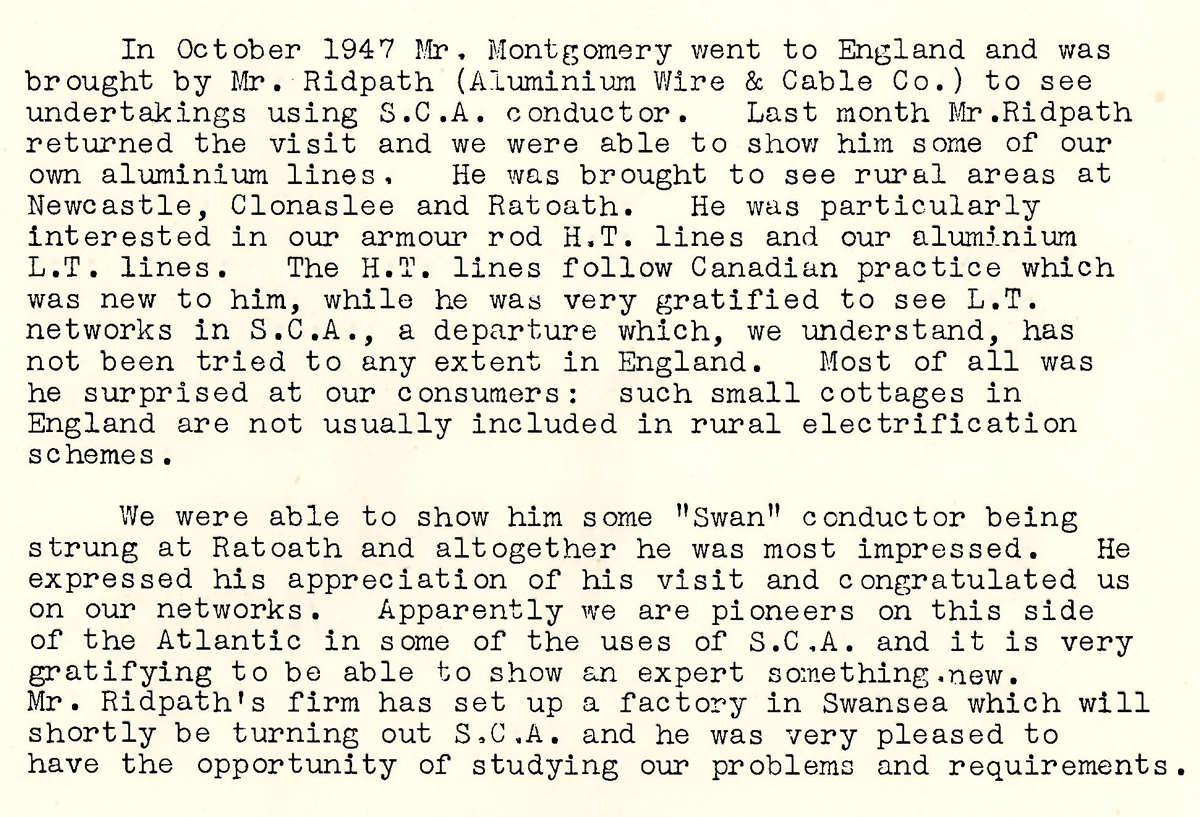
This digital scan from the REO News displays the following text:
"In October 1947 Mr. Montgomery went to England and was brought by Mr. Ridpath (Aluminium Wire & Cable Co.) to see undertakings using S.C.A. conductor. Last month Mr. Ridpath returned the visit and we were able to show him some of our own aluminium lines. He was brought to see rural areas at Newcastle, Clonaslee and Ratoath. He was particularly interested in our armour rod H.T. lines and our aluminium L.T. lines. The H.T. lines follow Canadian practice which was new to him, while he was very gratified to see L.T. networks in S.C.A., a departure which, we understand, has not been tried to any extent in England. Most of all was he surprised at our consumers: such small cottages in England are not usually included in rural electrification schemes.
We were able to show him some “Swan” conductor being strung at Ratoath and altogether he was most impressed. He expressed his appreciation of his visit and congratulated us on our networks. Apparently we are pioneers on this side of the Atlantic in some of the uses of S.C.A. and it is very gratifying to be able to show an expert something new.
Mr. Ridpath’s firm has set up a factory in Swansea which will shortly be turning out S.C.A. and he was very pleased to have the opportunity of studying our problems and requirements."