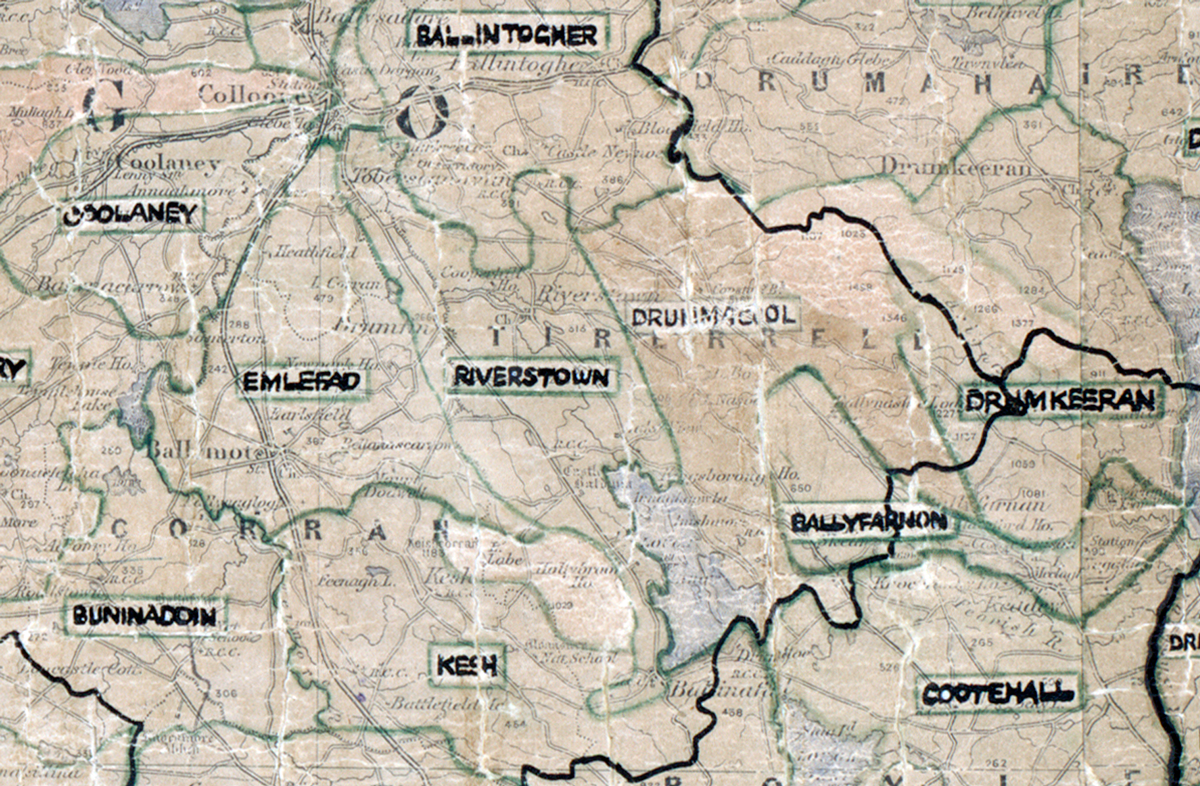
 Area: Riverstown
Started: January 1949
Finished: January 1950
Poles used: 1023
Line used (km): 81
Premises connected: 290
The figures above were sourced from our REO News magazine, to learn more about what these figures mean, visit our interactive map. The map above shows the area boundary and is from a digitised version of the original map used during the scheme.
Ardagh Farm Riverstown featured in The REO News from July 1953.
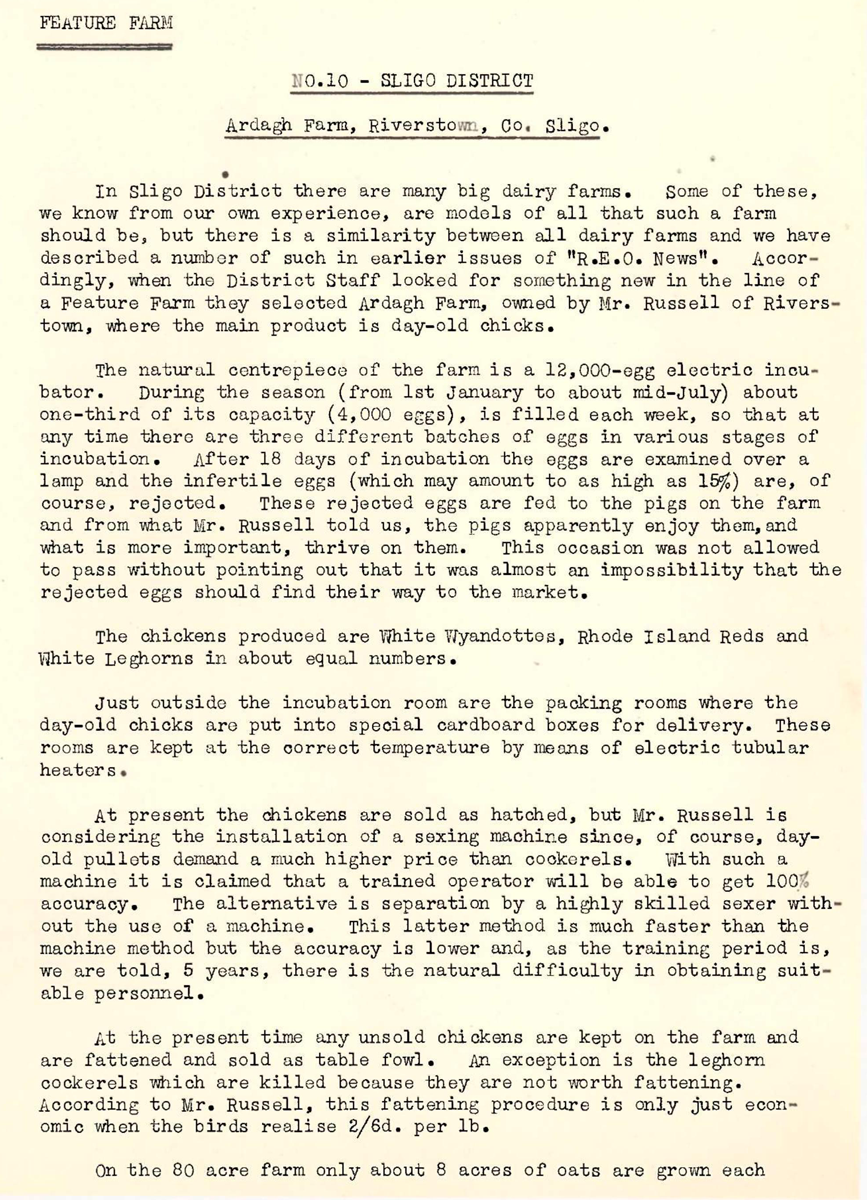
 This digital scan from the REO News displays the following text:
"FEATURE FARM
No. 10 – SLIGO DISTRICT
Ardagh Farm, Riverstown, Co. Sligo: In Sligo District there are many big dairy farms. Some of these, we know from our own experience, are models of all that such a farm should be, but there is a similarity between all dairy farms and we have described a number of such in earlier issues of “R.E.O. News”. Accordingly, when the District Staff looked for something new in the line of a Feature Farm they selected Ardagh Farm, owned by Mr. Russell of Riverstown, where the main product is day‑old chicks.
The natural centrepiece of the farm is a 12,000‑egg electric incubator. During the season (from 1st January to about mid‑July) about one‑third of its capacity (4,000 eggs) is filled each week, so that any time there are three different batches of eggs in various stages of incubation. After 18 days of incubation the eggs are examined over a lamp and the infertile eggs (with any that may be rough) which is 15%, on average, rejected. These rejected eggs are fed to the pigs on the farm and from what Mr. Russell told us we gather that the pigs enjoy this diet, and what is more important, thrive on it. As we were writing this, we were not allowed to pass without pointing out that it was almost an impossibility that the rejected eggs should in any way be the “last word” in nourishment.
The chickens produced are White Wyandottes, Rhode Island Reds and White Leghorns in about equal numbers.
Just outside the incubation room are the packing rooms where the day‑old chicks are put into special cardboard boxes for delivery. These rooms are kept at the correct temperature by electric tubular heaters.
At present the chickens are sold as hatched, but Mr. Russell is considering the question of a sexing machine, and, of course, day‑old pullets demand a higher price than cockerels. If the sexing machine is introduced it is imperative that the work is carried out with accuracy; usually this work is performed by a highly skilled operator who undertakes extensive training. Inasmuch as the sexing operation is a matter of technique, the accuracy is almost, as the training period is, as one might say, “intensive”, rather over 90%. The feature, therefore, is responsible for the proper classification of the chicks.
At the present time any unsold chickens are kept on the farm and are fattened and sold to some butchers locally. In the case of fat cocks and hens Mr. Russell tells us that the procedure is only just economic, since the birds realise 2/6d. per lb.
On the 80 acre farm only about 8 acres of oats are grown each…"
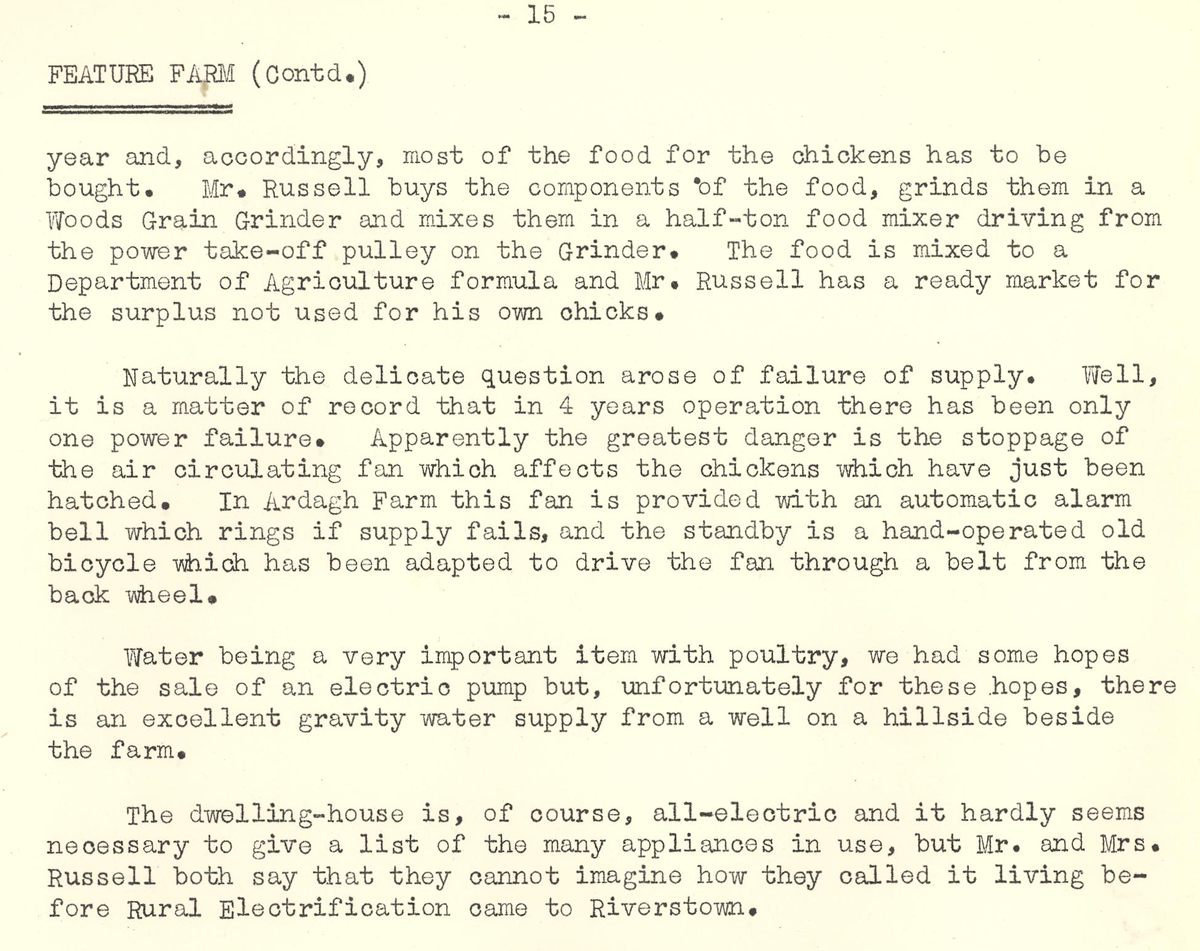
This digital scan from the REO News displays the following text:
"FEATURE FARM (Contd.)
year and, accordingly, most of the food for the chickens has to be bought. Mr. Russell buys the components of the food, grinds them in a Woods Grain Grinder and mixes them in a half‑ton food mixer driving from the power take‑off pulley on the Grinder. The food is mixed to a Department of Agriculture formula and Mr. Russell has a ready market for the surplus not used for his own chicks.
Naturally the delicate question arose of failure of supply. Well, it is a matter of record that in 4 years operation there has been only one power failure. Apparently the greatest danger is the stoppage of the air circulating fan which affects the chickens which have just been hatched. In Ardagh Farm this fan is provided with an automatic alarm bell which rings if supply fails, and the standby is a hand‑operated old bicycle which has been adapted to drive the fan through a belt from the back wheel.
Water being a very important item with poultry, we had some hopes of the sale of an electric pump but, unfortunately for these hopes, there is an excellent gravity water supply from a well on a hillside beside the farm.
The dwelling‑house is, of course, all‑electric and it hardly seems necessary to give a list of the many appliances in use, but Mr. and Mrs. Russell both told us that they cannot imagine how they called it living before Rural Electrification came to Riverstown."