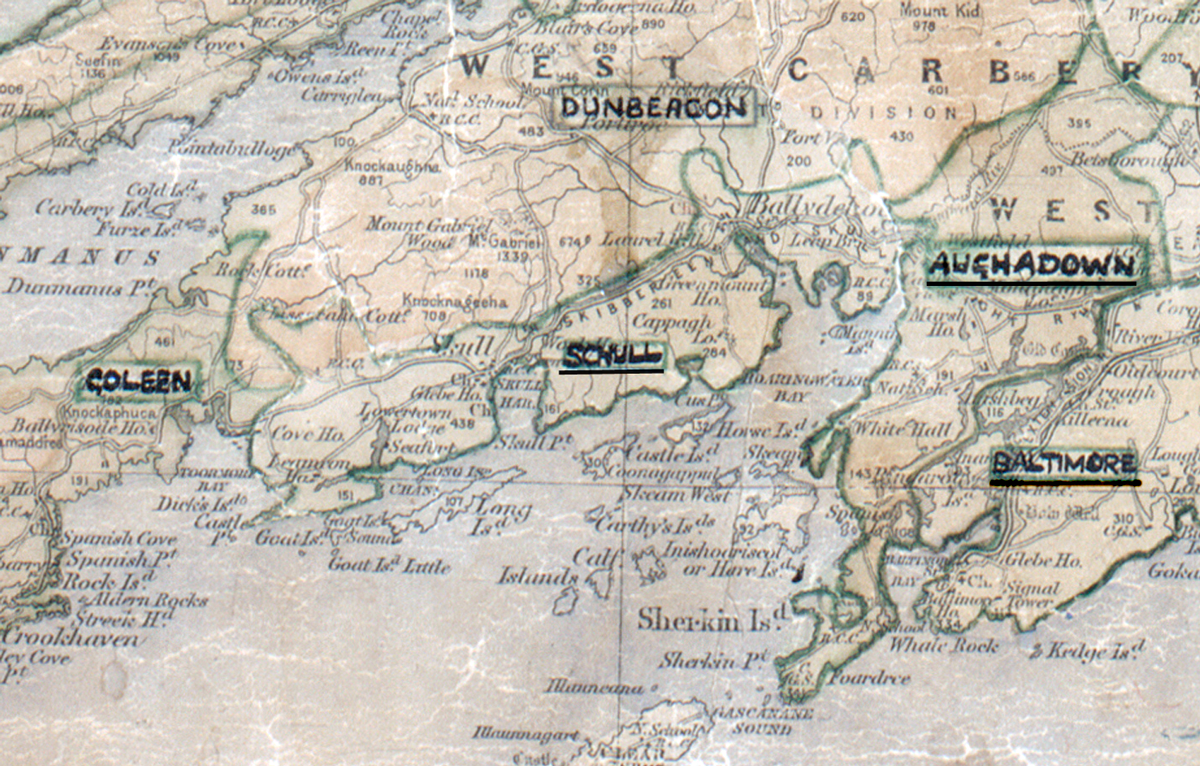
 Area: Schull
Started: December 1950
Finished: February 1952
Poles used: 1048
Line used (km): 89
Premises connected: 340
The figures above were sourced from our REO News magazine, to learn more about what these figures mean, visit our interactive map. The map above shows the area boundary and is from a digitised version of the original map used during the scheme.
The construction crew in Schull gave a good account of themselves reports The REO News from April 1952.
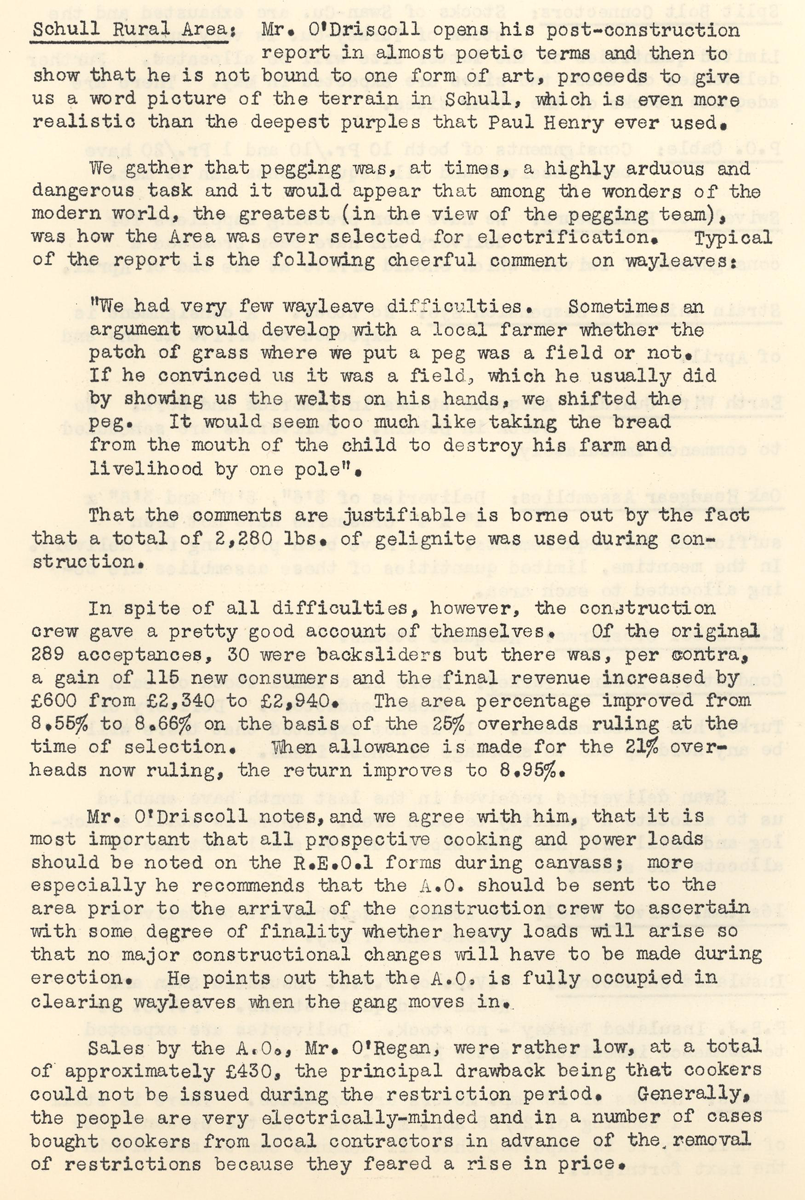
 This digital scan from the REO News displays the following text:
"Schull Rural Area: Mr. O’Driscoll opens his post‑construction report in almost poetic terms and then to show that he is not bound to one form of art, proceeds to give us a word picture of the terrain in Schull, which is even more realistic than the deepest purples that Paul Henry ever used.
We gather that pegging was, at times, a highly arduous and dangerous task and it would appear that the wondrous dens of the demon world, the greatest (in the view of the writer) of which these are, is how the Area was ever selected for electrification. Typical of the report is the following cheerful comment on wayleaves:
“We had very few wayleave difficulties. Sometimes an argument would develop with a local farmer whether the patch of grass the peg was put in was his field or not. If he convinced us it was a field, which he usually did by showing us the welts on his hands, we shifted the peg. It would seem too much like taking the bread from the mouth of the child to destroying his farm and livelihood by one pole”.
That the comments are justifiable is borne out by the fact that a total of 2,280 lbs. of gelignite was used during construction.
In spite of all difficulties, however, the construction crew gave a pretty good account of themselves. Of the original 289 acceptances, 30 were backsliders but there was, per contra, a gain of 116 new consumers and the fixed revenue increased from £600 to £2,940. The area percentage improved from 2.55% to 6.06% and, allowing for the 21% overheads ruling at the time of selection, the allowance makes 8.95%.
Mr. O’Driscoll notes, and we agree with him, that it is most important that all prospective cooking and power loads should be noted when the D.O. is—during canvass—visiting, especially in the case of huts. The number of huts in the area prior to the arrival of the construction crew to ascertain the number of huts, it would have saved a lot of work for him during construction and changes will have to be made during construction. He points out that he is fully occupied in clearing wayleaves when the gang moves in.
Sales by the A.O., Mr. O’Regan, were rather low, at a total of approximately £430; the principal drawback being that cookers could not be delivered. The original drawback lies in the fact that the cookers are now electrically‑minded and in a number of cases orders came from local contractors too, who removed restrictions because they feared a rise in price."
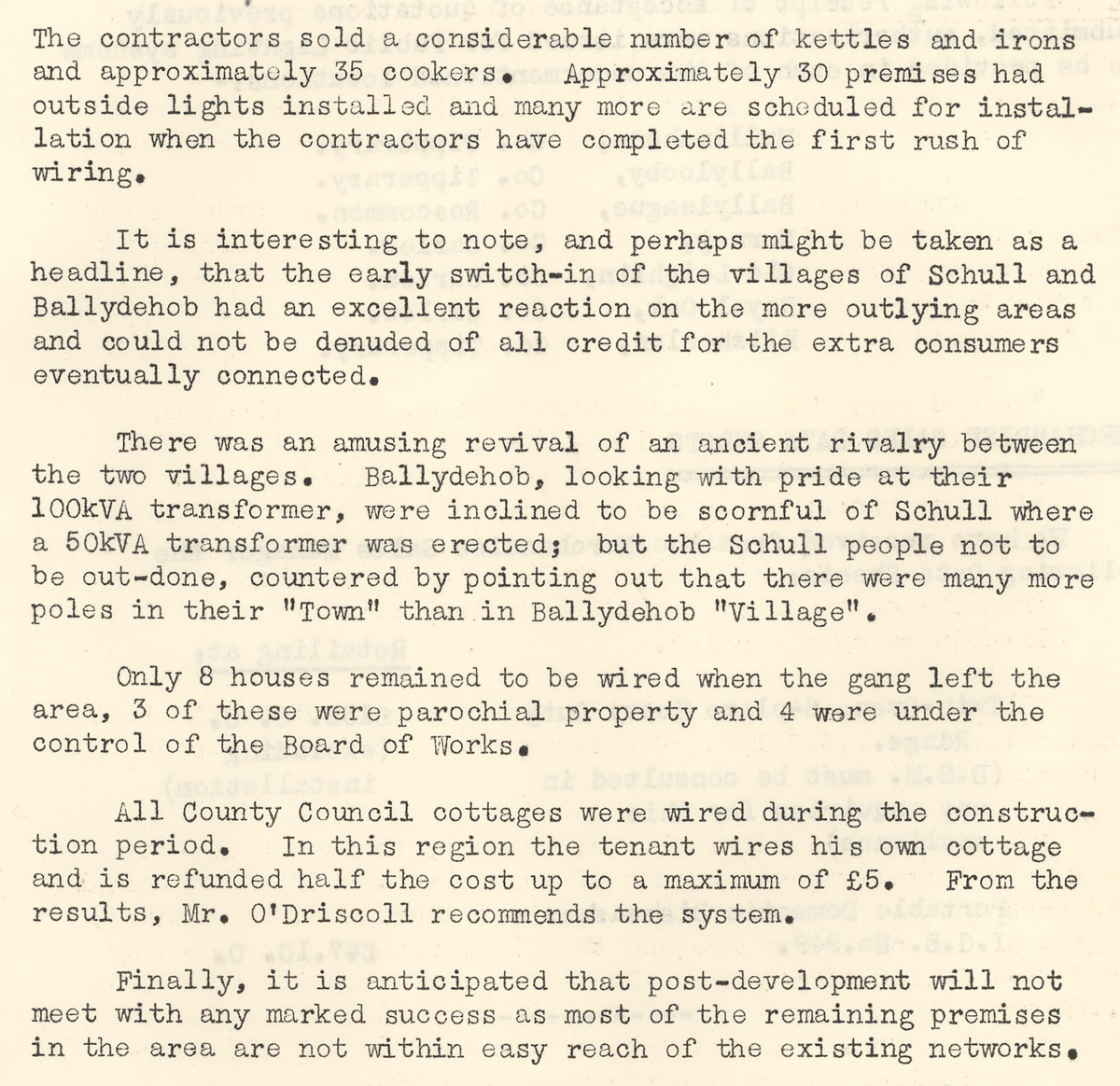
This digital scan from the REO News displays the following text:
"The contractors sold a considerable number of kettles and irons and approximately 35 cookers. Approximately 30 premises had outside lights installed and many more are scheduled for installation when the contractors have completed the first rush of wiring.
It is interesting to note, and perhaps might be taken as a headline, that the early switch‑in of the villages of Schull and Ballydehob had an excellent reaction on the more outlying areas and could not be denuded of all credit for the extra consumers eventually connected.
There was an amusing revival of an ancient rivalry between the two villages. Ballydehob, looking with pride at their 100 kVA transformer, were inclined to be scornful of Schull where a 50 kVA transformer was erected; but the Schull people not to be out‑done, countered by pointing out that there were many more poles in their “Town” than in Ballydehob “Village”.
Only 8 houses remained to be wired when the gang left the area, 3 of these were parochial property and 4 were under the control of the Board of Works.
All County Council cottages were wired during the construction period. In this region the tenant wires his own cottage and is refunded half the cost up to a maximum of £5. From the results, Mr. O’Driscoll recommends the system.
Finally, it is anticipated that post‑development will not meet with marked success as most of the remaining premises in the area are not within easy reach of the existing networks."