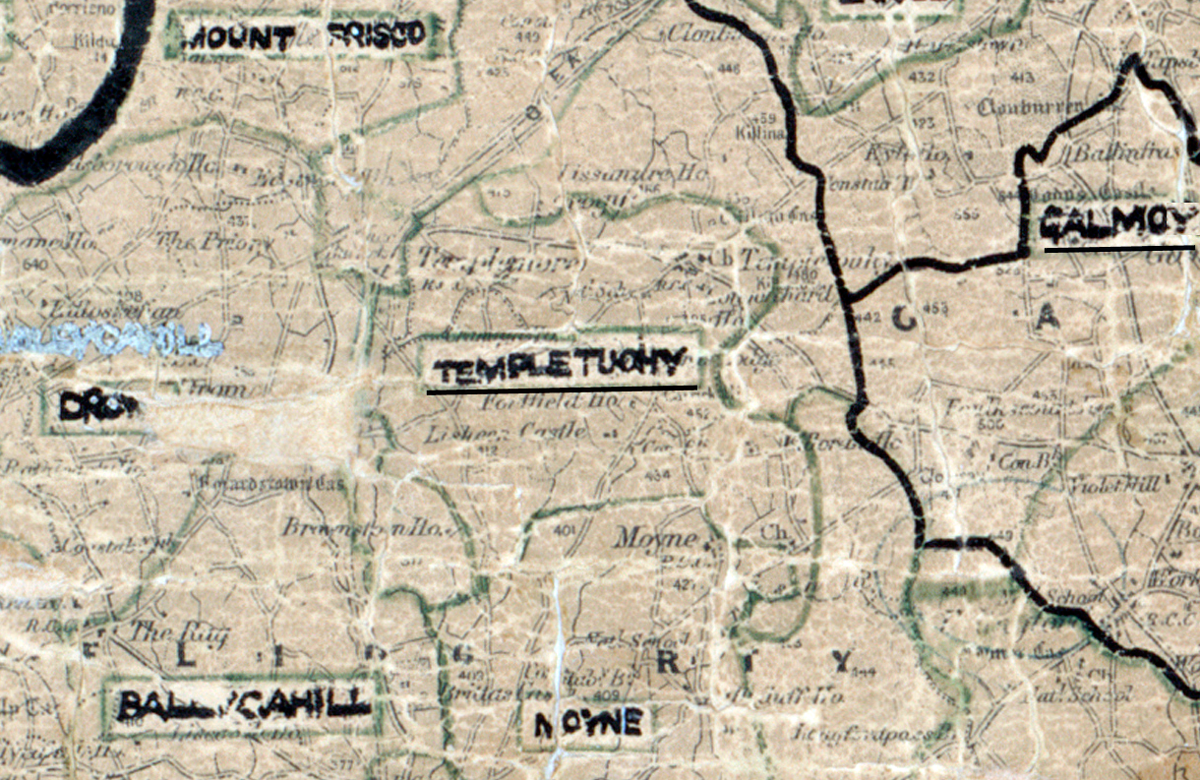
 Area: Templetuohy
Started: December 1949
Finished: August 1950
Poles used: 1045
Line used (km): 97
Premises connected: 260
The figures above were sourced from our REO News magazine, to learn more about what these figures mean, visit our interactive map. The map above shows the area boundary and is from a digitised version of the original map used during the scheme.
The REO News from September 1950 contained a report on Templetuohy
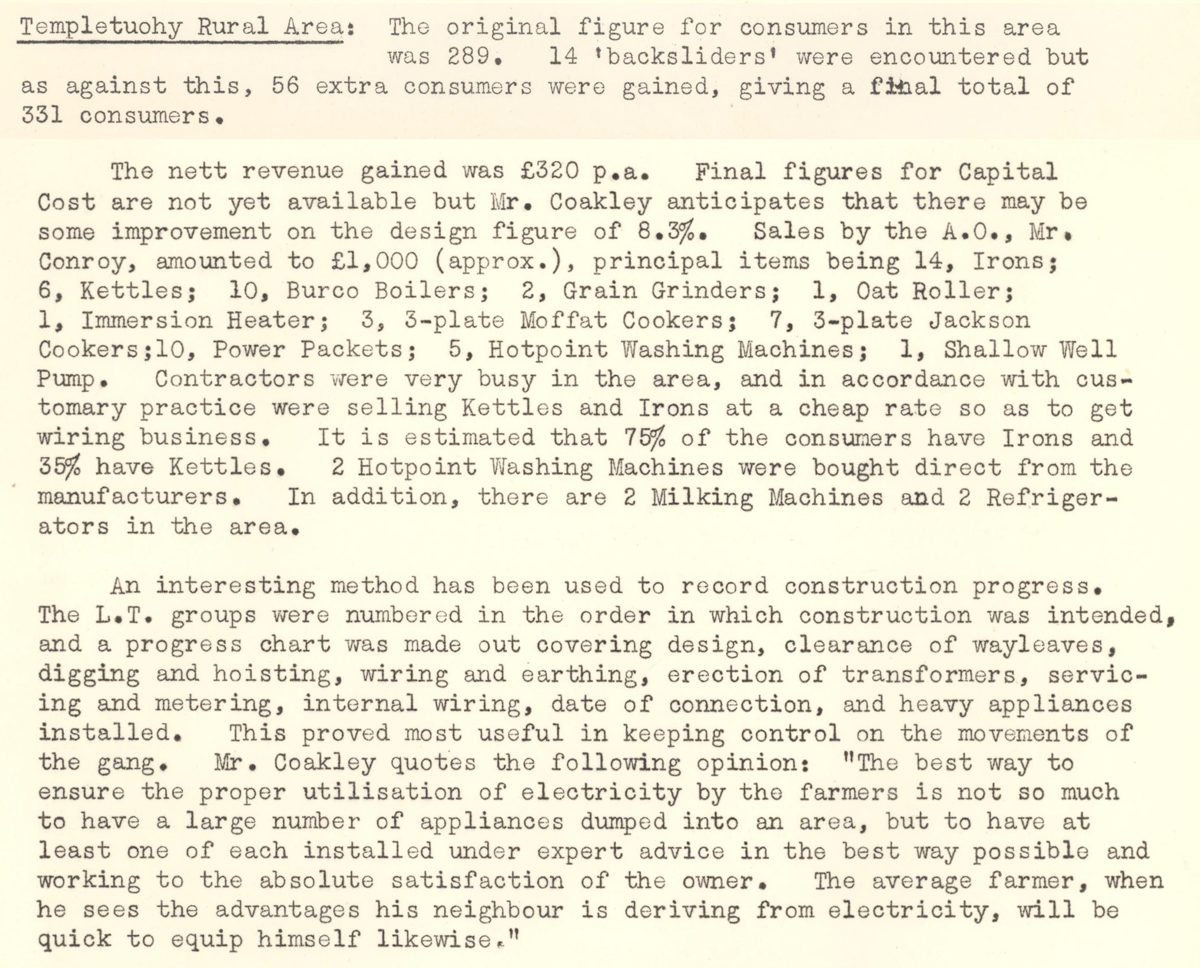 This digital scan from the REO News displays the following text:
"Templetuohy Rural Area: The original figure for consumers in this area was 289. 14 ‘backsliders’ were encountered but as against this, 56 extra consumers were gained, giving a final total of 331 consumers.
The net revenue gained was £520 p.a. Final figures for capital cost are not yet available but Mr. Coakley anticipates that there may be some improvement on the design figure of 8.3%. Sales by the A.O., Mr. Conroy, amounted to £1,000 (approx.), principal items being 14 Irons; 6 Kettles; 10 Burco Boilers; 2 Grain Grinders; 1 Oat Roller; 1 Immersion Heater; 3 3‑plate Moffatt Cookers; 7 3‑plate Jackson Cookers; 10 Power Packets; 5 Hotpoint Washing Machines; 1 Shallow Well Pump. Contractors were very busy in the area, and in accordance with customary practice were selling Kettles and Irons at a cheap rate so as to get wiring business. It is estimated that 75% of the consumers have Irons and 3% have Kettles. 2 Hotpoint Washing Machines were bought direct from the manufacturers. In addition, there are 2 Milking Machines and 2 Refrigerators in the area.
An interesting method has been used to record construction progress. The L.T. groups were numbered in the order in which construction was intended, and a progress chart was made out covering design, clearance of wayleaves, digging and hoisting, wiring and earthing, erection of transformers, servicing and metering, internal wiring, date of connection, and heavy appliances installed. This proved most useful in keeping control on the movements of the gang. Mr. Coakley quotes the following opinion: “The best way to ensure the proper utilisation of electricity by the farmers is not so much to have a large number of appliances dumped into an area, but to have at least one of each installed under expert advice in the best way possible and working to the absolute satisfaction of the owner. The average farmer, when he sees the advantages his neighbour is deriving from electricity, will be quick to equip himself likewise.”"
The featured farm in The REO News from November 1954 was located in Templetuohy rural area
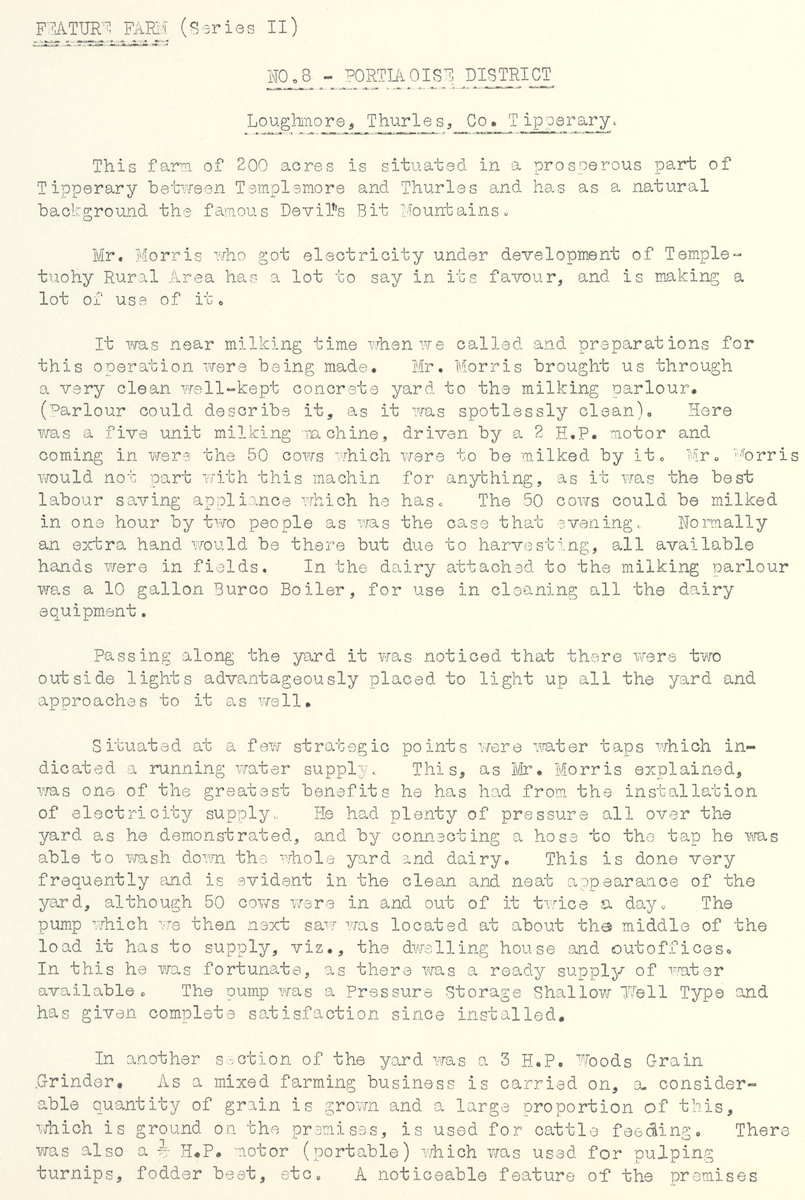 This digital scan from the REO News displays the following text:
"FEATURE FARM (Series II)
No. 8 – PORTLAOISE DISTRICT
Loughmore, Thurles, Co. Tipperary.
This farm of 200 acres is situated in a prosperous part of Tipperary between Templomare and Thurles and has as a natural background the famous Devil’s Bit Mountains.
Mr. Morris who got electricity under development of Templetuohy Rural Area has a lot to say in its favour, and is making a lot of use of it.
It was near milking time when we called and preparations for this operation were being made. Mr. Morris brought us through a very clean well‑kept concrete yard to the milking parlour. (Parlour could describe it, as it was spotlessly clean.) Here was a five unit milking machine driven by a 2 H.P. motor and coming in was the 50 cows which were to be milked by it. Mr. Morris would now rate this machine very highly, as it was the best labour saving appliance which he has. The 50 cows could be milked in one hour by two people as against one hour earlier. Normally an extra hand would be there but due to harvesting, all available hands were in fields. In the dairy attached to the milking parlour was a 10 gallon Burco Boiler, for use in cleaning all the dairy equipment.
Passing along the yard it was noticed that there were two outside lights advantageously placed to light up all the yard and approaches to it as well.
Situated at a few strategic points were water taps which indicated a running water supply. This, as Mr. Morris explained, was one of the greatest benefits he has had from this installation of electricity supply. He had plenty of pressure all over the yard as he demonstrated, and by connecting a hose to the tap he was able to wash down the whole yard and dairy. This is done very frequently and is evident in the clean and neat appearance of the yard, although 50 cows were in and out of it twice a day. The pump which then took over was located at about the middle of the road to his home, with the dwelling house and outoffices. In this he was fortunate, as there was a ready supply of water available. The pump was a Pressure Storage Shallow Well Type and has given complete satisfaction since installed.
In another section of the yard was a 3 H.P. Woods Grain Grinder. As a mixed farming business is carried on, he considers considerably of grain is ground and this takes proportion of milk. There was also a 1 H.P. motor (portable) which was used for pulping turnips, fodder beet, etc. A noticeable feature of the premises"
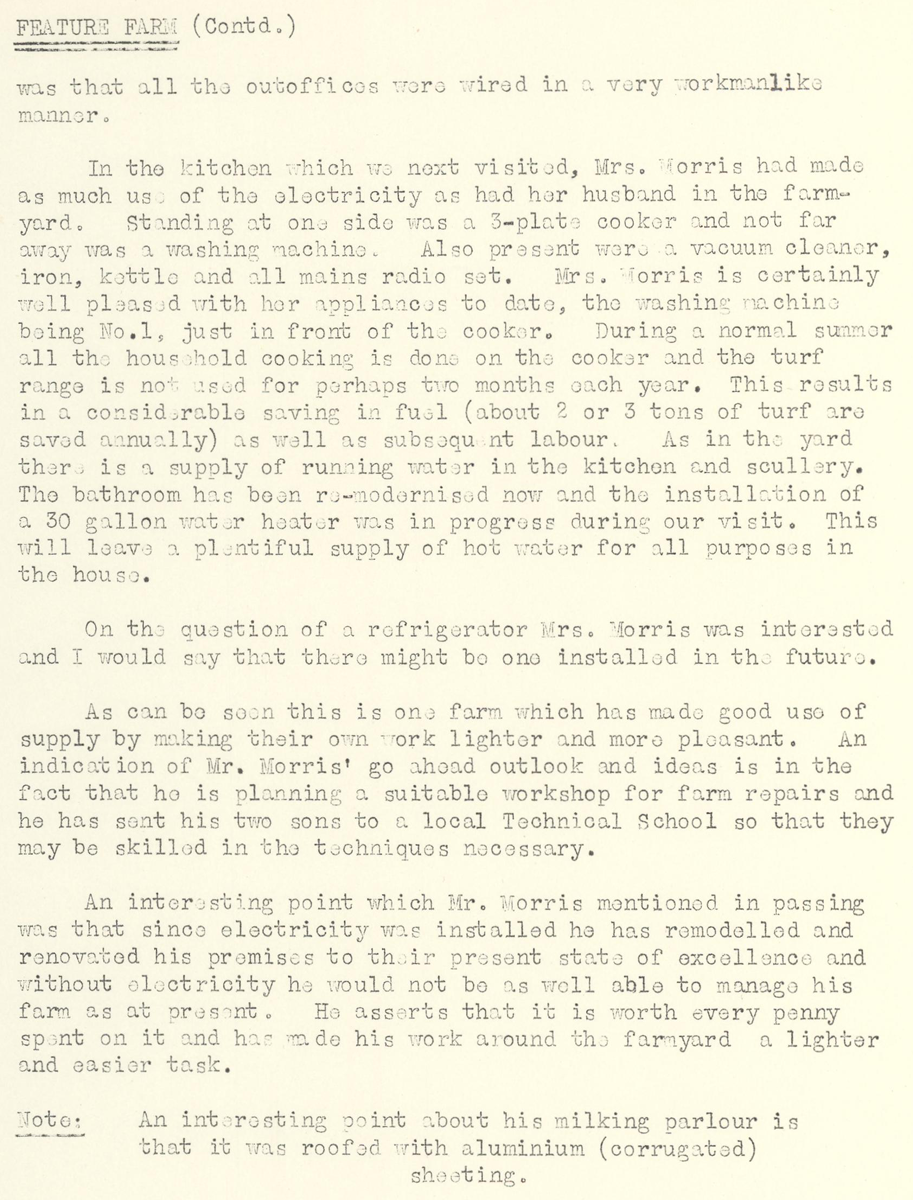 This digital scan from the REO News displays the following text:
"FEATURE FARM (Contd.)
was that all the outoffices were wired in a very workmanlike manner.
In the kitchen which we next visited, Mrs. Morris had made as much use of the electricity as had her husband in the farmyard. Standing on one side was a 3‑plate cooker, and not far away was a washing machine. Also present were a vacuum cleaner, iron, kettle and an all main radio set. Mrs. Morris is certainly well pleased with her appliances to date, the washing machine being No. 1, just in front of the cooker. During normal summer all the household cooking is done on the cooker and the turf range is now kept for perhaps two months each year. This results in considerable saving in fuel (about 2 or 3 tons of turf are saved annually) as well as a saving in labour. As in the yard there is a supply of running water in the kitchen and scullery. The bathroom has been modernised now by the installation of a 30 gallon water heater was in progress during our visit. This will leave a plentiful supply of hot water for all purposes in the house.
On the question of a refrigerator Mrs. Morris was interested and I would say that there might soon be one installed in the future.
As can be seen there is on a farm which has made good use of supply by making their own work lighter and more pleasant. An indication of Mr. Morris’ broad outlook and ideas is in the fact that he is planning a suitable workshop for farm repairs and has sent his two sons to a local Technical School so that they may be skilled in the techniques necessary.
An interesting point which Mr. Morris mentioned in passing was that since electricity was installed he has remodelled and renovated his premises to their present state of excellence and without electricity he would not be so well able to manage his farm as at present. He asserts that it is worth every penny spent on it and has made his work around the farmyard a lighter and easier task.
Note: An interesting point about his milking parlour is that it was roofed with aluminium (corrugated) sheeting."