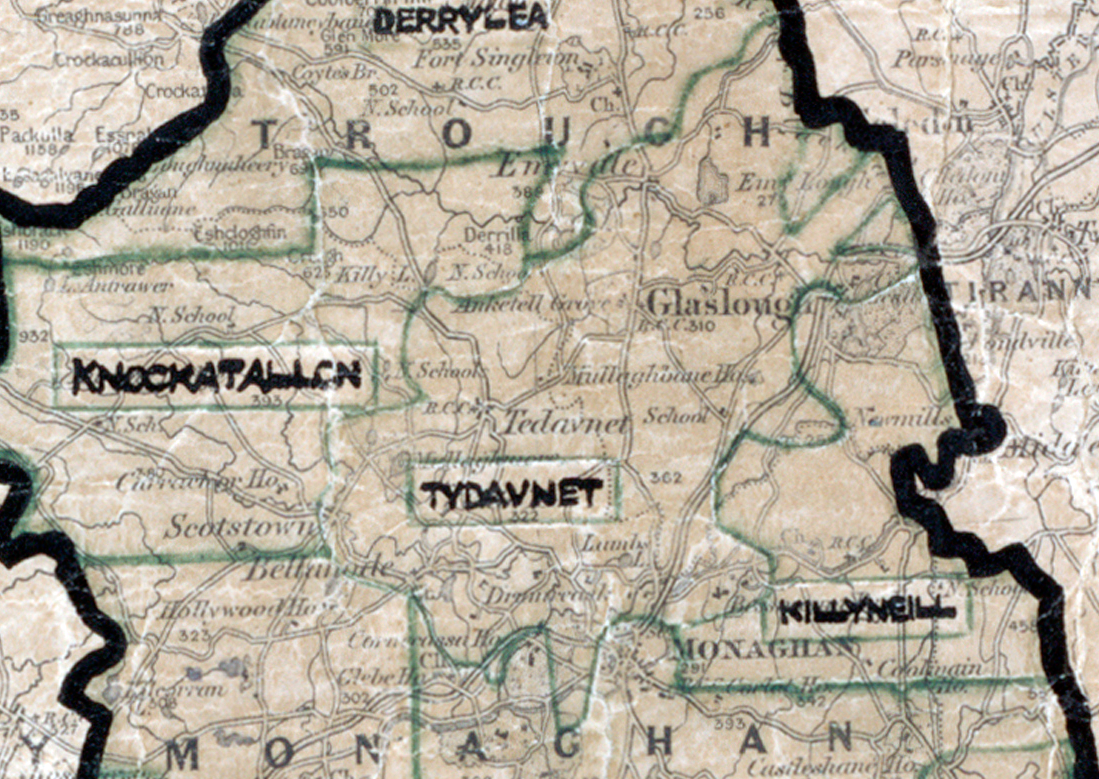
 Area: Tydavnet
Started: January 1948
Finished: June 1948
Poles used: 1846
Line used (km): 161
Premises connected: 367
The figures above were sourced from our REO News magazine, to learn more about what these figures mean, visit our interactive map. The map above shows the area boundary and is from a digitised version of the original map used during the scheme.
The rural staff were not without a sense of humour as noted in The REO News from October 1948
 This digital scan from the REO News displays the following text:
"We have received a present of the first “streak” of flax scutched in Tydavnet Rural Area by one of our first rural power consumers. When the Engineer in Charge was reminded that we already had creameries and a jam factory connected he remarked that when we had the quarry connected at Tydavnet he hoped he would not receive a present of a tombstone."
The REO News from February 1949 reports on an unusual find in Tydavnet
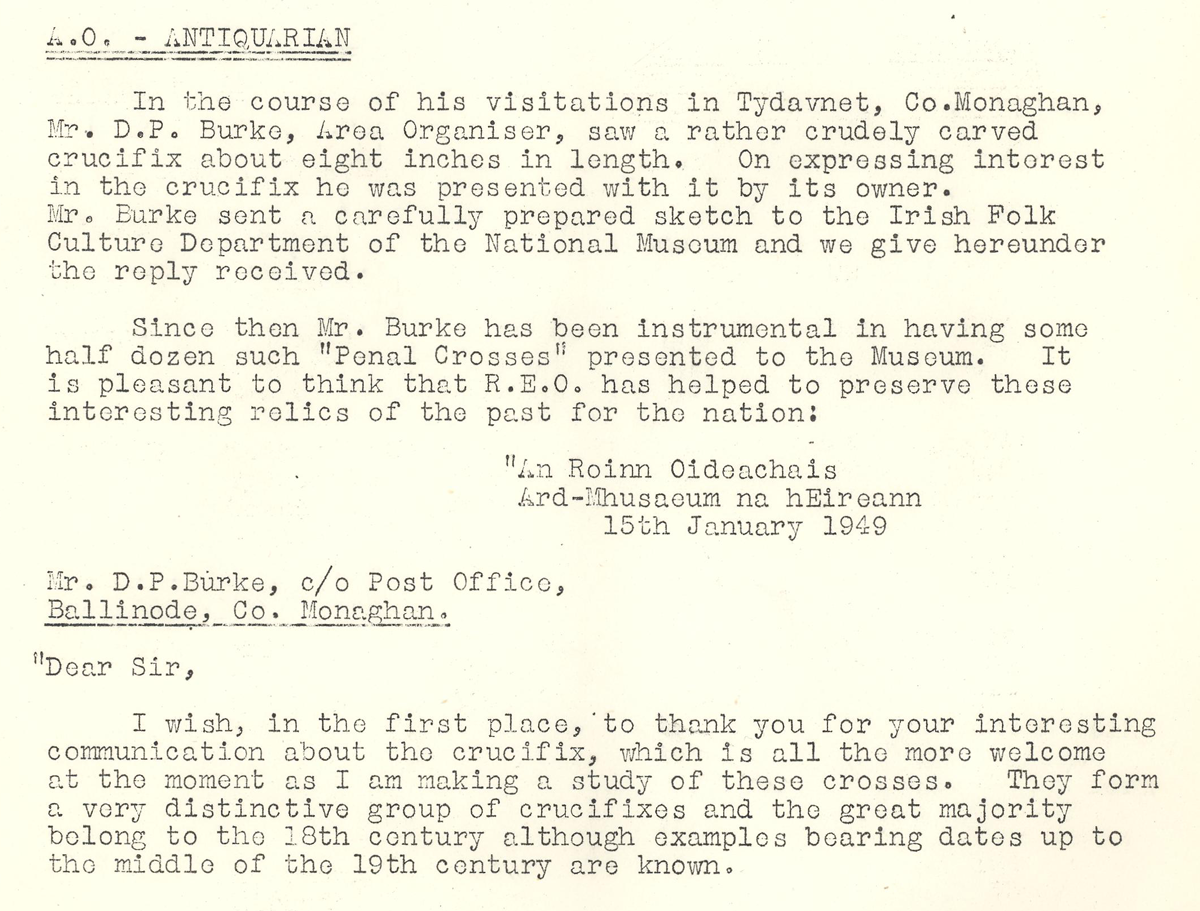 This digital scan from the REO News displays the following text:
"A.O. – ANTIQUARIAN
In the course of his visitations in Tydavnet, Co. Monaghan, Mr. D. P. Burke, Area Organiser, saw a rather crudely carved crucifix about eight inches in length. On expressing interest in the crucifix he was presented with it by its owner. Mr. Burke sent a carefully prepared sketch to the Irish Folk Culture Department of the National Museum and we give hereunder the reply received.
Since then Mr. Burke has been instrumental in having some half dozen such “Penal Crosses” presented to the Museum. It is pleasant to think that R.E.O. has helped to preserve these interesting relics of the past for the nation:
“An Roinn Oideachais
Ard‑Mhuseum na hÉireann
15th January 1949
Mr. D. P. Burke, c/o Post Office, Ballinode, Co. Monaghan.
Dear Sir,
I wish, in the first place, to thank you for your interesting communication about the crucifix, which is all the more welcome at the moment as I am making a study of these crosses. They form a very distinctive group of crucifixes and the great majority belong to the 18th century although examples bearing dates up to the middle of the 19th century are known.”"
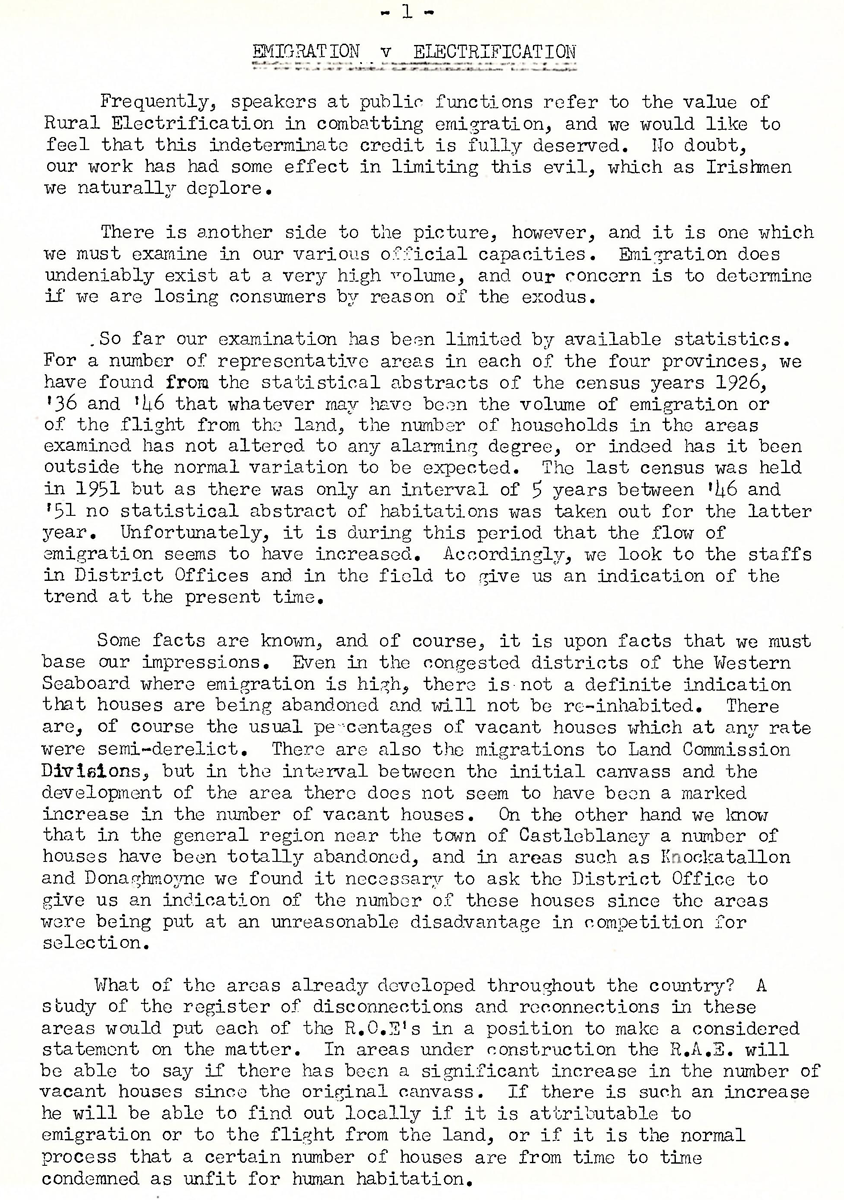
This digital scan from the REO News displays the following text:
"EMIGRATION v. ELECTRIFICATION
Frequently speakers at public functions refer to the value of Rural Electrification in combating emigration, and we would like to feel that this indeterminate credit is fully deserved. No doubt, our work has had some effect in limiting this evil, which as Irishmen we naturally deplore.
There is another side to the picture, however, and it is one which we must examine in our various official capacities. Emigration does undeniably exist at a very high volume, and our concern is to determine if we are losing consumers by reason of the exodus.
So far examination has been limited by available statistics. For a number of representative areas in each of the four provinces, we have found from the statistical abstracts of the census years 1926, 1936 and 1946 that wherever may have been the volume of emigration or of the flight from the land, the number of households in the areas examined has not altered to any alarming degree, or indeed has been outside the normal variation to be expected. The last census was held in 1951 but as the returns are not available as yet we hold 5/1 no statistical abstract of habitations was taken out for the latter year. Unfortunately, it is during this period that the flow of emigration seems to have increased. Accordingly, we look to the staffs in District Offices and in the field to give us an indication of the trend at the present time.
Some facts are known, and of course it is upon facts that we must base our impressions. Even in the congested districts of the Western Seaboard where emigration is high, there is not a definite indication that houses are being abandoned, while not be re‑inhabited. There are, of course, the usual percentages of vacant houses which at any rate were semi‑derelict. There are also the migrations to Land Commission Divisions, but in the interval between the initial canvass and the commencement of the area there does not seem to have been a marked increase in the number of vacant houses. On the other hand we know that in the general region near the town of Castleblayney a number of houses have been totally abandoned, and in areas such as Knockatallen and Donaghmoyne we found it necessary to ask the District Office to give us an indication of the number of these houses since the areas were being put at an unreasonable disadvantage in competition for selection.
What of the areas already developed throughout the country? A study of the register of disconnections and reconnections in these areas would put each of the R.O.E.'s in a position to make a considered statement on the matter. In areas under construction the R.A.E. will be able to say if there has been a significant increase in the number of vacant houses since the original canvass. If there is such an increase he will be able to find out locally if it is attributable to emigration or to the flight from the land, or if it is the normal process that a certain number of houses are from time to time condemned as unfit for human habitation."
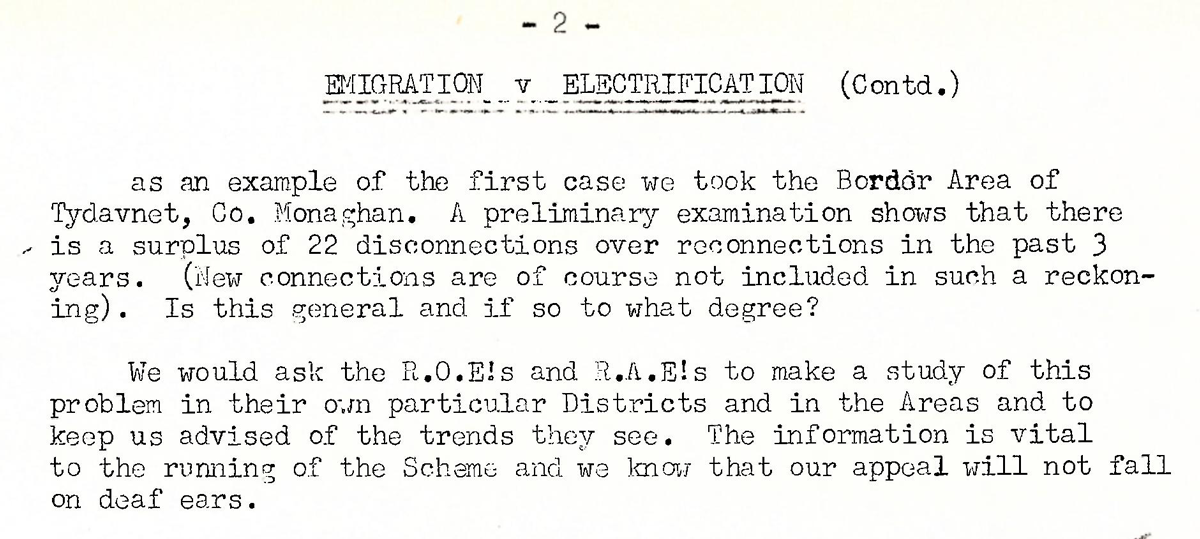
This digital scan from the REO News displays the following text:
"EMIGRATION v. ELECTRIFICATION (Contd.)
As an example of the first case we took the Border Area of Tydavnet, Co. Monaghan. A preliminary examination shows that there is a surplus of 22 disconnections over reconnections in the past 3 years. (New connections are of course not included in such a reckoning). Is this general and if so to what degree?
We would ask the R.O.E.’s and R.A.E.’s to make a study of this problem in their own particular Districts and in the Areas and to keep us advised of the trends they see. The information is vital to the running of the Scheme and we know that our appeal will not fall on deaf ears. "