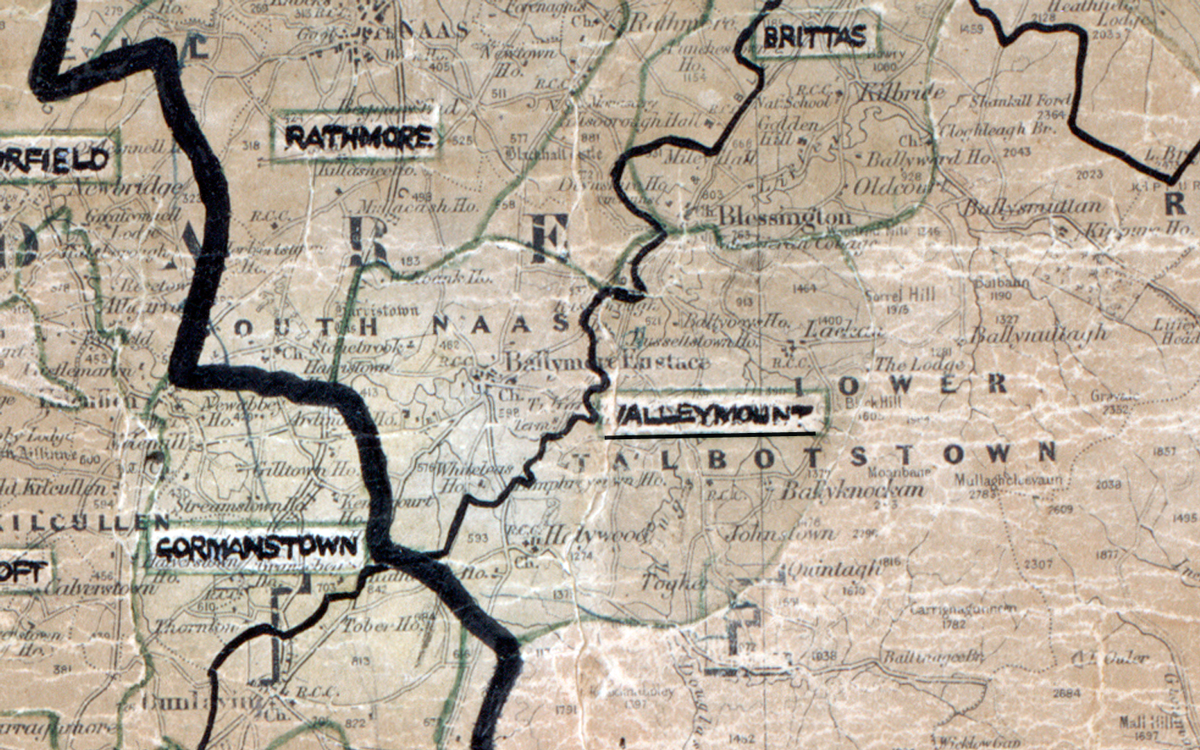
 Area: Valleymount
Started: May 1952
Finished: April 1953
Poles used: 1045
Line used (km): 90
Premises connected: 218
The figures above were sourced from our REO News magazine, to learn more about what these figures mean, visit our interactive map. The map above shows the area boundary and is from a digitised version of the original map used during the scheme.
Working conditions in Valleymount were very difficult according to The REO News from May 1953.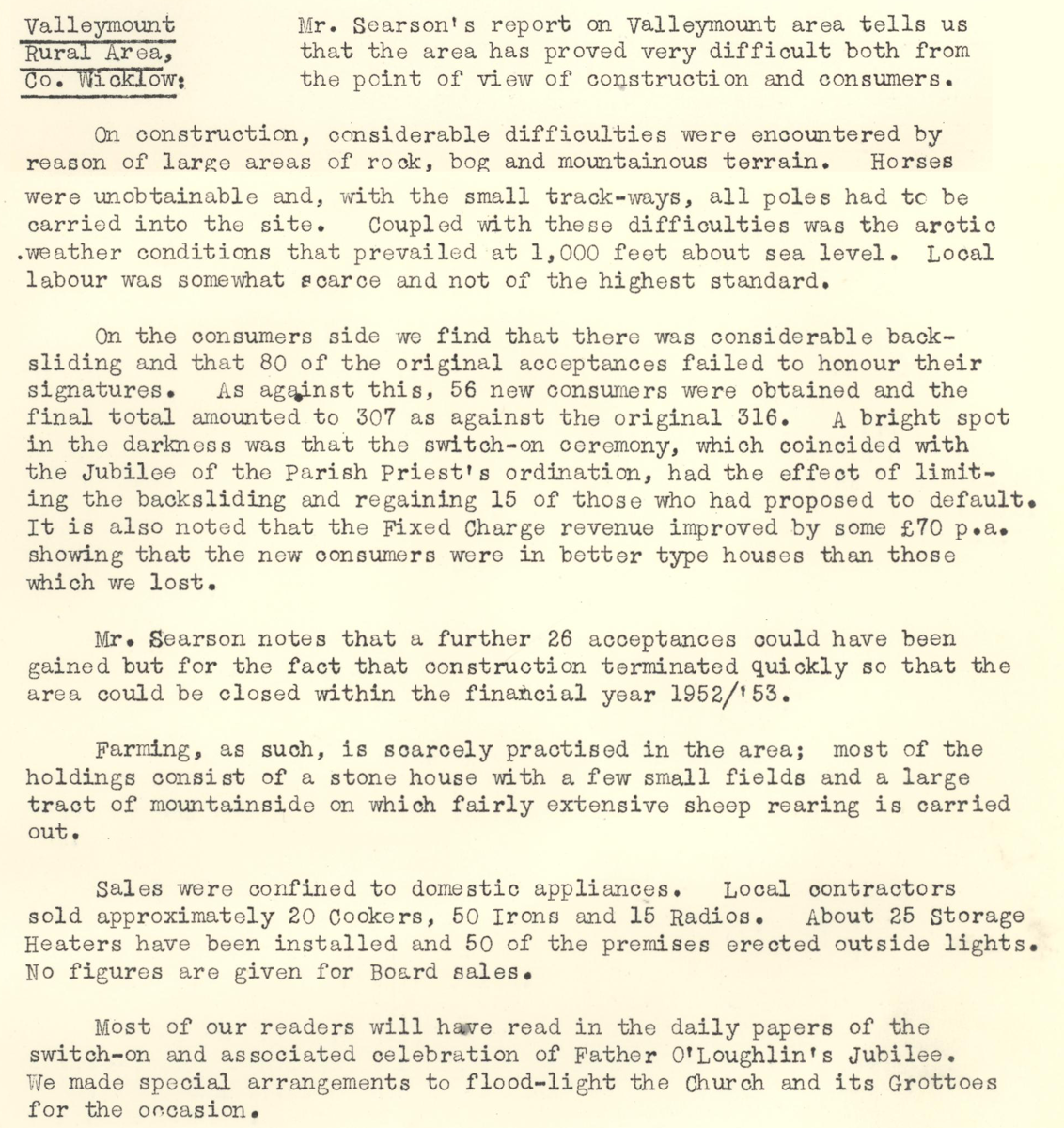 This digital scan from the REO News displays the following text:
“Valleymount Rural Area, Co. Wicklow
Mr. Searson’s report on Valleymount area tells us that the area has proved very difficult both from the point of view of construction and consumers.
On construction, considerable difficulties were encountered by reason of large areas of rock, bog and mountainous terrain. Horses were unobtainable and, with the small track‑ways, all poles had to be carried into the site. Coupled with these difficulties was the arctic weather conditions that prevailed at 1,000 feet above sea level. Local labour was somewhat scarce and not of the highest standard.
On the consumers’ side we find that there was considerable backsliding and that 80 of the original acceptances failed to honour their signatures. As against this, 56 new consumers were obtained and the final total amounted to 307 as against the original 316. A bright spot in the darkness was that the switch‑on ceremony, which coincided with the Jubilee of the Parish Priest’s ordination, had the effect of limiting the backsliding and regaining 15 of those who had proposed to default. It is also noted that the Fixed Charge revenue improved by some £70 p.a. showing that the new consumers were in better type houses than those who were lost.
Mr. Searson notes that a further 26 acceptances could have been gained but for the fact that construction terminated quickly so that the area could be closed within the financial year 1952/53.
Farming, as such, is scarcely practised in the area; most of the holdings consist of a stone house with a few small fields and a large tract of mountainside on which fairly extensive sheep rearing is carried out.
Sales were confined to domestic appliances. Local contractors sold approximately 20 Cookers, 50 Irons and 15 Radios. About 25 Storage Heaters have been installed and 50 of the premises erected outside lights. No figures are given for Board sales.
Most of our readers will have read in the daily papers of the switch‑on associated celebration of Father O’Loughlin’s Jubilee. We made special arrangements to flood‑light the Church and its Grottoes for the occasion.”