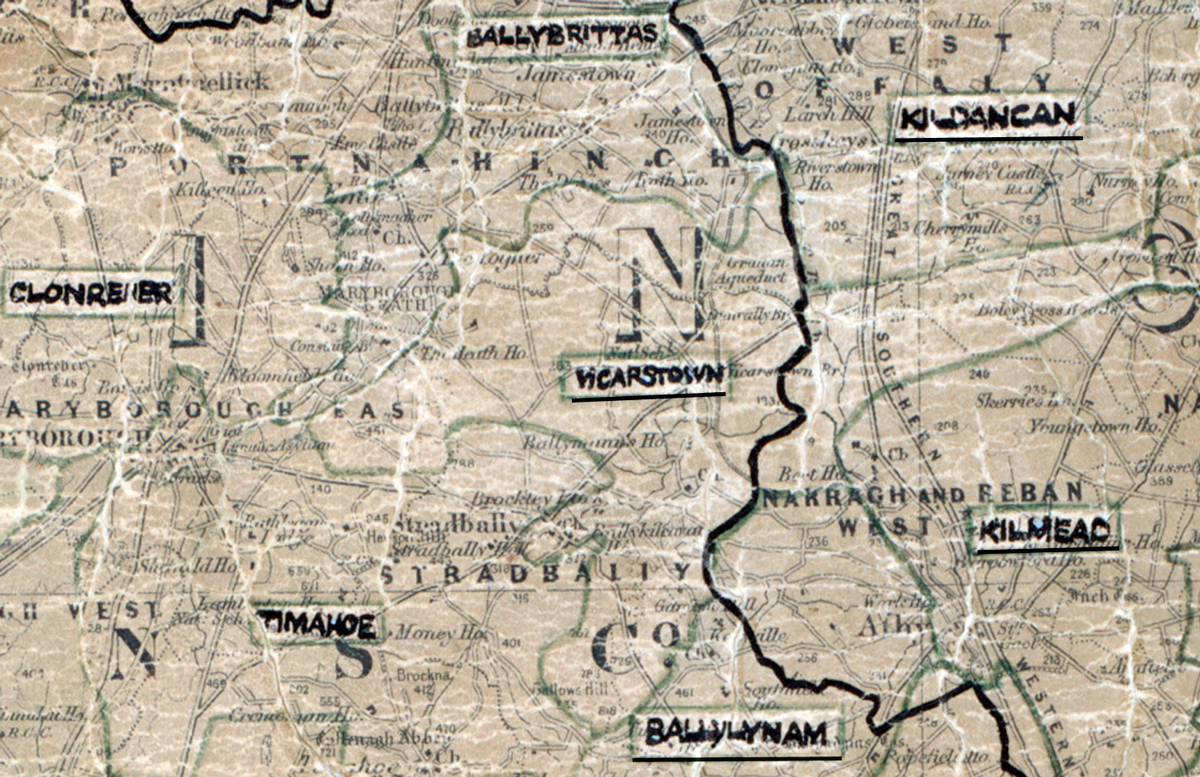
 Area: Vicarstown
Started: August 1959
Finished: August 1960
Poles used: 1181
Line used (km): 106
Premises connected: 210
The figures above were sourced from our REO News magazine, to learn more about what these figures mean, visit our interactive map. The map above shows the area boundary and is from a digitised version of the original map used during the scheme.
The REO News from October 1960 gives us some information on a new wiring system used in Vicarstown.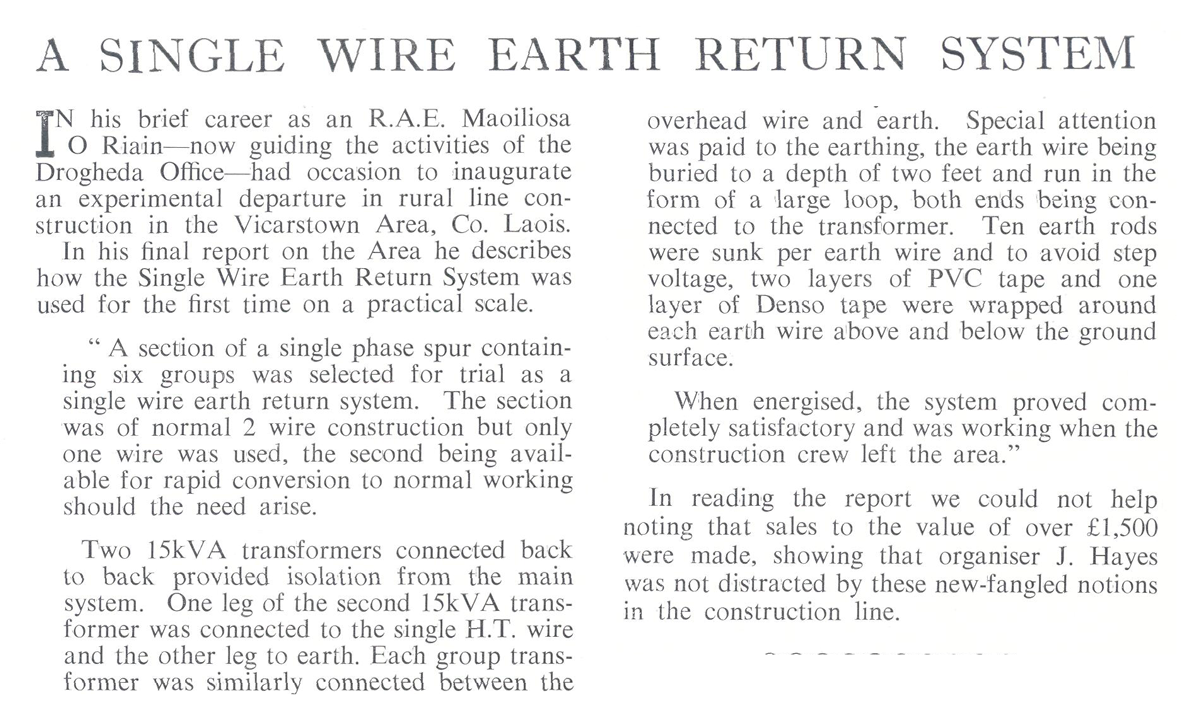 This digital scan from the REO News displays the following text:
"A SINGLE WIRE EARTH RETURN SYSTEM
In his brief career as an R.A.E. Maoiliosa O Riain—now guiding the activities of the Drogheda Office—had occasion to inaugurate an experimental departure in rural line construction in the Vicarstown Area, Co. Laois.
In his final report on the Area he describes how the Single Wire Earth Return System was used for the first time on a practical scale.
“A section of a single phase spur containing six groups was selected for trial as a single wire earth return system. The section was of normal 2 wire construction but only one wire was used, the second being available for rapid conversion to normal working should the need arise.
Two 15kVA transformers connected back to back provided isolation from the main system. One leg of the second 15kVA transformer was connected to the single H.T. wire and the other leg to earth. Each group transformer was similarly connected between the overhead wire and earth. Special attention was paid to the earthing, the earth wire being buried to a depth of two feet and run in the form of a large loop, both ends being connected to the transformer. Ten earth rods were sunk per earth wire and to avoid step voltage, two layers of PVC tape and one layer of Denso tape were wrapped around each earth wire above and below the ground surface.
When energised, the system proved completely satisfactory and was working when the construction crew left the area.”
In reading the report we could not help noting that sales to the value of over £1,500 were made, showing that organiser J. Hayes was not distracted by these new‑fangled notions in the construction line."